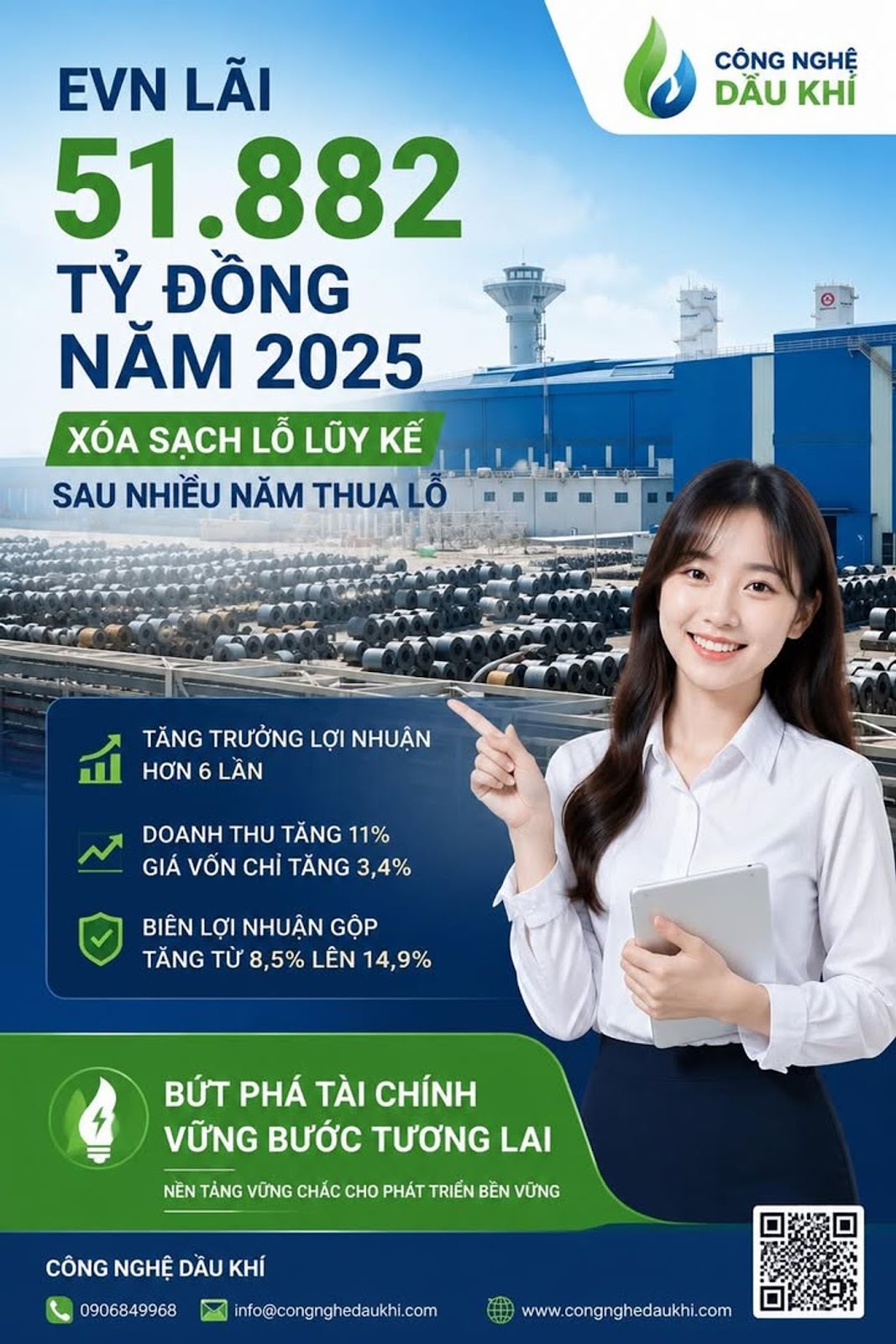
EVN's Remarkable Financial Turnaround: Nearly 52,000 Billion VND Profit in 2025 Clears Years of Accumulated Losses
The Electricity of Vietnam (EVN) has recently announced extraordinary financial results for 2025, reporting a profit after tax of approximately 51,882 billion VND—more than six times the previous year's figure. This remarkable achievement not only marks a significant financial milestone but also represents a complete turnaround from years of accumulated losses that once reached 38,688 billion VND. This transformation stands as one of the most dramatic financial recoveries in Vietnam's state-owned enterprise sector.
Financial Performance Overview: 2025 Results
EVN's 2025 financial statements reveal a company that has successfully navigated through challenging market conditions to emerge as a profitable enterprise. The profit of 51,882 billion VND represents a substantial improvement from the previous year, demonstrating the effectiveness of the company's strategic adjustments and favorable market conditions.
| Financial Metric | Value |
|---|---|
| Profit After Tax | 51,882 billion VND |
| Year-on-Year Profit Growth | More than 6 times |
| Revenue Growth | 11% increase |
| Cost of Goods Sold Increase | 3.4% increase |
| Gross Profit Margin | 14.9% |
| Previous Year's Gross Profit Margin | 8.5% |
| Accumulated Losses at Beginning of Year | 38,688 billion VND |
| Undistributed Profit at Year End | 5,533 billion VND |
Factors Behind EVN's Extraordinary Turnaround
The transformation from significant losses to substantial profitability in just one year can be attributed to several key factors that created favorable conditions for EVN's operations in 2025.
Unlike the challenging period from 2022 to 2023 when global fuel prices surged, 2025 presented more favorable conditions for the electricity sector:
- Strong Electricity Sales Growth: Electricity consumption continued to increase, driven by growth in industrial production, foreign direct investment, and residential demand.
- Favorable Cost Structure: While revenue increased by 11%, the cost of goods rose by only approximately 3.4%, significantly improving profit margins.
- Improved Profit Margins: The gross profit margin expanded from 8.5% to 14.9%, reflecting substantially better operational efficiency.
- Favorable Hydrological Conditions: Abundant rainfall allowed for increased hydropower generation, which is typically more cost-effective than thermal power sources.
- Reduced Fuel Costs: Lower global fuel prices decreased production costs for thermal power plants.
Comparative Analysis: Before and After
| Financial Metric | Previous Challenging Period | 2025 Results |
|---|---|---|
| Gross Profit Margin | 8.5% | 14.9% |
| Financial Status | Significant Accumulated Losses | Accumulated Losses Completely Cleared |
| Undistributed Profit | Negative | Positive 5,533 billion VND |
| Investment Capacity | Limited | Significantly Improved |
Significance of EVN's Financial Recovery
As the central enterprise of Vietnam's national electricity system, EVN's financial transformation carries profound implications for the country's energy security and economic development:
- Enhanced Investment Capacity: The improved financial position enables EVN to invest in new power sources, including LNG power plants, renewable energy projects, and large-scale transmission infrastructure.
- Energy Security: A financially stable EVN can better ensure the reliable supply of electricity to nearly 100 million Vietnamese citizens and millions of businesses.
- Improved Fundraising Ability: Strong financial results enhance EVN's capacity to attract investment for major energy projects.
- Reduced Long-term Financial Pressure: Clearing accumulated losses provides a more solid foundation for sustainable operations.
Understanding EVN's Large Cash Reserves
EVN's reported 152,000 billion VND in bank deposits has sparked public debate about whether the company has excessive cash. However, this figure requires proper context:
Unlike typical enterprises, EVN operates a nationwide electricity system serving nearly 100 million people and millions of businesses. The company must maintain substantial cash reserves to:
- Pay electricity purchases from numerous power plants across Vietnam (hydropower, coal-fired, gas, wind, and solar)
- Service debt obligations as they mature
- Invest in new power plants
- Expand transmission lines and substations
- Maintain contingency funds for fuel price fluctuations
| Purpose of Cash Reserves | Explanation |
|---|---|
| Electricity Purchases | Ensuring continuous power supply from various generation sources |
| New Power Plant Investment | Funding construction of new generation facilities |
| Grid Expansion | Investing in transmission lines and substations |
| Debt Service | Meeting loan payment obligations |
| Contingency Planning | Preparing for fuel price volatility and other risks |
Future Challenges Despite Improved Finances
While EVN's 2025 results are impressive, the company still faces significant challenges:
- Rapidly Growing Electricity Demand: Vietnam's electricity consumption continues to increase at a high rate, driven by industrialization and economic growth.
- Massive Investment Requirements: The power sector requires hundreds of thousands of billions of VND in investments for new power sources and grid expansion.
- Global Fuel Price Volatility: The company remains exposed to fluctuations in global coal, gas, and oil prices.
- Energy Transition Challenges: Vietnam's commitment to renewable energy transition requires significant restructuring of the power system.
- Balancing Profitability and Price Stability: Maintaining reasonable electricity prices while ensuring financial sustainability remains a delicate balance.
Impact on Vietnam's Economy
A financially healthy EVN creates favorable conditions for implementing key power projects such as LNG power plants, renewable energy initiatives, and large-scale transmission projects. In the context of Vietnam's continuously rising electricity demand, EVN's investment capacity plays a crucial role in supporting the country's economic growth targets.
Conclusion: Looking Ahead
EVN's 2025 financial results represent a remarkable turnaround from years of accumulated losses. The company's ability to clear 38,688 billion VND in accumulated losses while generating 51,882 billion VND in profit demonstrates significant operational improvements and favorable market conditions.
However, the large cash reserves of 152,000 billion VND should not be misconstrued as excess profits. These funds are essential for the continuous operation and development of Vietnam's electricity system.
As Vietnam continues its economic development, the critical question remains: With EVN's improved financial position and substantial cash reserves, will there be reduced pressure for electricity price increases in the coming years, or will the rapidly growing demand still necessitate tariff adjustments to fund necessary infrastructure expansion?