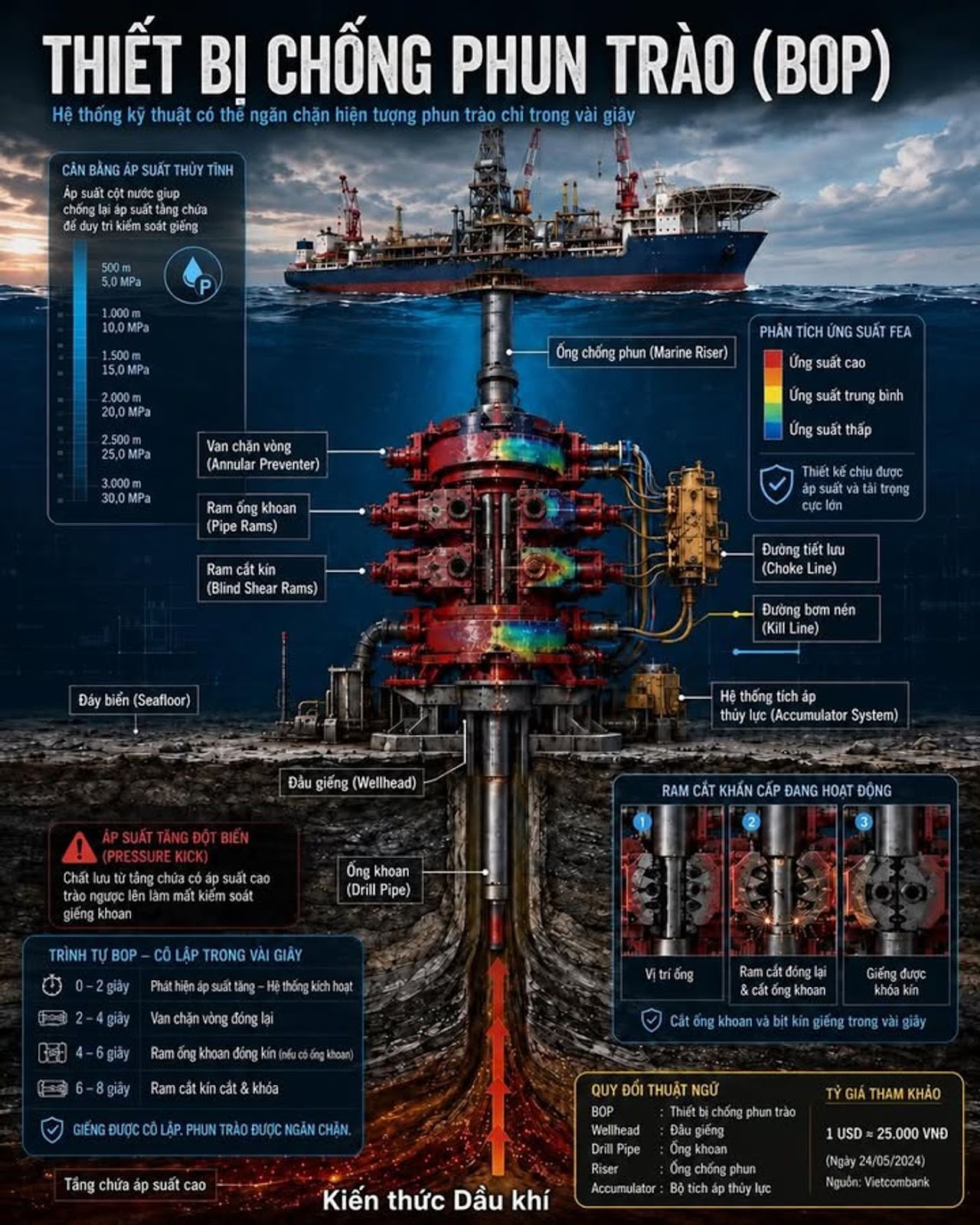
The Blowout Preventer: The Last Line of Defense Between Offshore Drilling Rigs and Catastrophe
In the high-stakes world of offshore petroleum extraction, there exists a critical safety system that engineers refer to as "the final gatekeeper." This is the Blowout Preventer (BOP) – a massive safety apparatus installed on the seabed designed to prevent uncontrolled hydrocarbon eruptions from the well.
When drilling thousands of meters below the ocean floor, the pressure from oil and gas reservoirs can be immense enough to push a mixture of oil, gas, and drilling fluid back to the surface at tremendous velocities. If left uncontrolled, the consequences can include explosions, loss of drilling rigs, human casualties, and widespread environmental damage.
What is a Blowout Preventer?
A BOP is a colossal assembly of valves and hydraulic mechanisms installed at the top of the well. Its primary function is to serve as the ultimate fail-safe system in well control operations.
Core Functions of a BOP System
- Detect abnormal pressure conditions
- Isolate the wellbore
- Block upward hydrocarbon flow
- Shear through drill pipe in emergency situations
- Protect personnel and the environment
Key Components of a BOP System
A modern BOP system consists of several critical components working in concert to ensure safety and operational integrity:
| Component | Function |
|---|---|
| Annular Preventer | Seals around the drill pipe |
| Pipe Rams | Closes around the drill pipe to seal the well |
| Blind Shear Rams | Cuts through drill pipe and seals the well completely |
| Hydraulic Control Pod | Controls the entire BOP system |
| Choke Line | Manages pressure during well control operations |
| Kill Line | Pumps heavy fluid to control well pressure |
| Accumulator System | Provides emergency backup power |
What Happens During a Pressure Kick?
A pressure kick occurs when oil or gas under high pressure from a reservoir infiltrates the wellbore. This process typically unfolds with alarming speed:
| Timeline | Action |
|---|---|
| 0-2 seconds | System detects abnormal pressure |
| 2-4 seconds | Annular Preventer closes |
| 4-6 seconds | Pipe Rams seal around drill pipe |
| 6-8 seconds | Blind Shear Rams activate if needed |
| After 8 seconds | Well is fully isolated |
This rapid response capability is why many experts refer to the BOP as "the life-saving system on the seabed."
Lessons from the Deepwater Horizon Disaster
In 2010, the Deepwater Horizon drilling rig explosion in the Gulf of Mexico became one of the largest environmental disasters in petroleum industry history. The incident resulted in:
| Metric | Value |
|---|---|
| Fatalities | 11 workers |
| Oil spilled | Approximately 4.9 million barrels |
| Duration of leak | 87 days |
| Economic damages | Over $65 billion USD |
| Cleanup and compensation costs | Tens of billions USD |
Subsequent investigations revealed that the well control system, including the BOP, played a pivotal role in the chain of events leading to the catastrophe.
Why BOPs Are Considered Engineering Marvels
A modern deepwater BOP represents extraordinary engineering achievements:
- Weighs several hundred to over 1,000 tons
- Operates at depths exceeding 3,000 meters
- Withstands pressures of over 15,000 psi
- Functions continuously for months
- Remotely controlled from the drilling rig
- Features multiple safety redundancy layers
Pressure Comparison
The pressures that BOPs must handle are difficult to comprehend without context:
| Environment | Pressure (psi) |
|---|---|
| Car tire | 30 psi |
| Industrial air compressor | 150 psi |
| Oil and gas pipelines | 2,000 - 5,000 psi |
| Deepwater oil wells | 10,000 - 15,000 psi |
These figures illustrate that the pressures a BOP must endure are so extreme that even a minor malfunction could lead to catastrophic consequences.
More Than Just Oilfield Equipment
A BOP represents the integration of multiple advanced engineering disciplines:
- Precision mechanical engineering
- High-power hydraulics
- Electronic control systems
- Advanced materials science
- Deepwater engineering techniques
- Industrial safety protocols
It stands as one of the most complex systems ever deployed on the ocean floor.
The Critical Importance of BOP Systems
In offshore drilling operations, no one hopes their BOP will need to activate in an emergency. Yet when a crisis occurs, the few seconds of response from this system can determine the fate of hundreds of workers, a drilling rig worth tens of billions of dollars, and vast marine ecosystems.
The Blowout Preventer is not merely technical equipment. It is the final line of defense between the success of a drilling operation and a potential disaster that could enter the annals of global energy history.