## Introduction
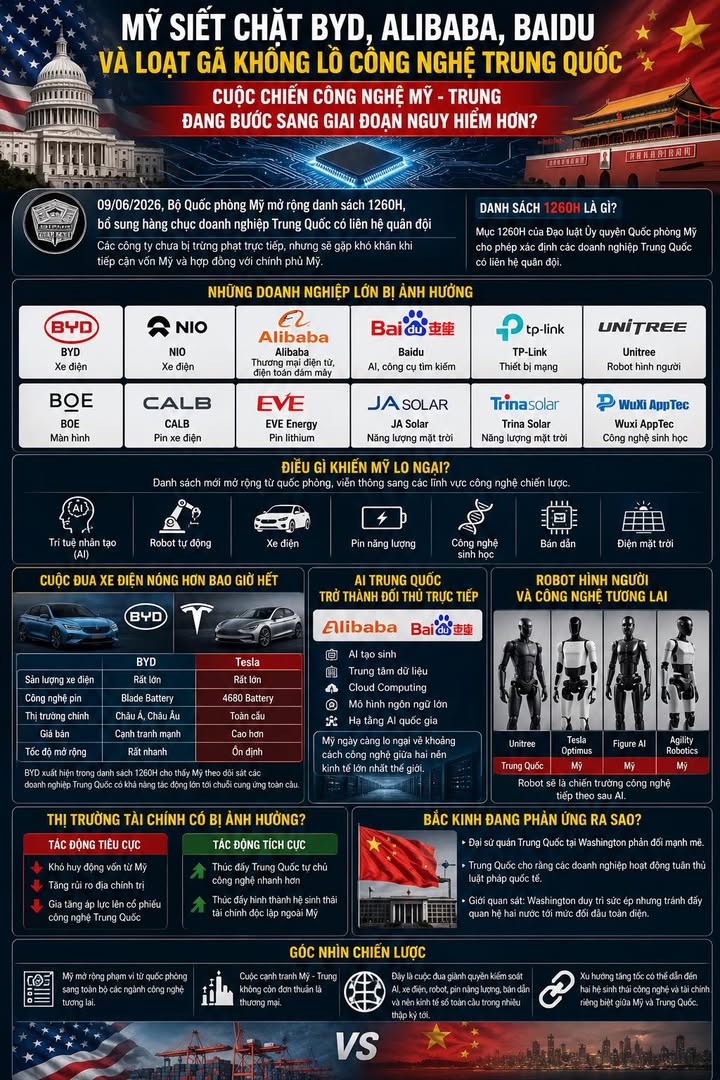
On June 9, 2026, the United States Department of Defense significantly expanded its "Military-End User List" (List 1260H), adding dozens of Chinese technology companies operating in strategic sectors. This development raises critical questions about whether the US-China tech competition is escalating into a more comprehensive and potentially destabilizing "Tech War 2.0" that could surpass the earlier conflict involving Huawei.
The expanded list now includes major Chinese corporations spanning electric vehicles, artificial intelligence, energy storage, robotics, semiconductors, biotechnology, and renewable energy. While these companies have not yet been subject to direct sanctions, their inclusion on the list creates significant obstacles for accessing US capital markets, attracting American investors, and participating in US government contracts.
## Background: Evolution of US Restrictions on Chinese Technology
The US government has gradually expanded its scrutiny of Chinese technology companies over the past decade. Initially focused on telecommunications and national security concerns, the scope has broadened to encompass virtually all sectors deemed critical to future economic competitiveness.
The 1260H list, maintained by the Department of Defense, identifies companies that are "owned or controlled by, or are subject to the jurisdiction or control of, the military-industrial complex of the People's Republic of China." While placement on the list doesn't automatically trigger sanctions, it serves as a warning signal to investors and business partners about potential future restrictions.
## Comprehensive Expansion of the 1260H List
The latest expansion represents a significant broadening of US concerns beyond traditional defense and telecommunications sectors. The updated list now targets companies that form the foundation of what both nations view as the economy of the future.
| Key Details of the 1260H List Expansion | |
|---|---|
| Date of Announcement | June 9, 2026 |
| Number of Companies Added | Dozens of major Chinese tech firms |
| Primary Maintaining Agency | US Department of Defense |
| Legal Basis | Export Administration Regulations (EAR) |
| Current Status | Identification as potential military-linked entities |
The updated list includes some of China's most prominent technology companies across multiple strategic sectors. These corporations represent the cutting edge of Chinese technological advancement and global competitiveness.
| Company | Primary Sector | Global Significance |
|---|---|---|
| BYD | Electric Vehicles | World's largest EV manufacturer by volume |
| Nio | Electric Vehicles | Premium EV segment competitor |
| Alibaba | E-commerce, Cloud Computing | Global e-commerce and cloud services leader |
| Baidu | AI, Search Engines | China's leading AI and internet company |
| TP-Link | Networking Equipment | Global consumer networking leader |
| Unitree | Humanoid Robotics | Emerging humanoid robotics innovator |
| BOE | Display Technology | Major global display manufacturer |
| CALB | Electric Vehicle Batteries | Key battery technology provider |
| EVE Energy | Lithium Batteries | Global battery component supplier |
| JA Solar | Solar Energy | Major solar technology manufacturer |
| Trina Solar | Solar Energy | Global solar panel producer |
| Wuxi AppTec | Biotechnology | Leading biopharmaceutical company |
The expanded list reveals a strategic shift in US priorities, moving beyond traditional defense concerns to encompass the entire technological ecosystem that will define economic leadership in the coming decades.
Key Strategic Sectors Targeted in the Expansion:
- Artificial Intelligence (AI): Machine learning, natural language processing, computer vision, and generative AI systems
- Robotics: Industrial automation, autonomous systems, and humanoid robotics
- Electric Vehicles (EVs): Manufacturing, battery technology, and charging infrastructure
- Energy Storage: Battery technology, grid storage solutions, and energy management systems
- Biotechnology: Pharmaceutical research, genetic engineering, and healthcare technology
- Semiconductors: Chip design, fabrication, and advanced semiconductor materials
- Solar Technology: Photovoltaic manufacturing, solar panel efficiency improvements
BYD's inclusion on the 1260H list highlights the growing importance of electric vehicles in the US-China strategic competition. As China's largest EV manufacturer and a global competitor to Tesla, BYD represents a significant challenge to US automotive industry leadership.
The electric vehicle sector has emerged as a critical battleground in the tech war, with implications for energy security, manufacturing dominance, and technological leadership in transportation. Both the US and China view EVs as essential components of their economic and strategic futures.
| Comparison | BYD | Tesla |
|---|---|---|
| Production Volume | Extremely large (millions annually) | Very large (millions annually) |
| Battery Technology | Blade Battery (LFP chemistry) | 4680 Battery (high-energy NMC) |
| Primary Markets | Asia, Europe | Global |
| Pricing Strategy | Highly competitive, value-oriented | Premium positioning |
| Expansion Rate | Extremely rapid global expansion | Steady, methodical expansion |
Alibaba and Baidu represent China's formidable push into artificial intelligence, a sector the US views as critical to maintaining technological leadership. These companies have evolved from their internet origins into comprehensive AI enterprises with global ambitions.
Both corporations have made substantial investments in generative AI, large language models, data center infrastructure, and cloud computing capabilities. Their AI initiatives receive significant support from the Chinese government as part of the national technology strategy.
Key AI Investment Areas for Alibaba and Baidu:
- Generative AI systems for content creation and business applications
- Large-scale data center infrastructure for AI training and deployment
- Cloud computing services integrated with AI capabilities
- Large language models optimized for Chinese language and cultural contexts
- National AI infrastructure projects with government backing
Unitree's inclusion on the 1260H list signals the growing importance of robotics in the US-China tech competition. The company has gained international attention for its affordable humanoid robots that could potentially compete directly with US-developed systems.
The humanoid robotics sector represents the next frontier in technological competition, with implications for labor markets, manufacturing automation, and even military applications. Both nations recognize that leadership in robotics will translate to economic and strategic advantages across multiple industries.
| Company | Country | Key Technology Focus |
|---|---|---|
| Unitree | China | Cost-effective humanoid robots with advanced mobility |
| Tesla (Optimus) | USA | AI-powered humanoid robots for industrial applications |
| Figure AI | USA | Advanced humanoid robots for labor applications |
| Agility Robotics | USA | Bipedal robots for logistics and warehouse automation |
The inclusion of these prominent Chinese companies on the 1260H list carries significant financial implications, both immediate and long-term. While the immediate impact may be primarily psychological, the longer-term consequences could reshape global investment patterns and technology development.
Short-Term Financial Impacts:
- Increased market volatility for Chinese technology stocks
- Heightened risk premiums for Chinese tech companies
- Potential reevaluation of investment theses by global funds
Long-Term Financial Consequences:
- Significant difficulty in raising capital from US investors
- Increased geopolitical risk premiums for Chinese tech companies
- Sustained pressure on Chinese technology stock valuations
- Acceleration of China's push toward technological self-sufficiency
- Development of alternative financial ecosystems independent of US markets
The Chinese government has responded strongly to the expanded 1260H list, with the Chinese Embassy in Washington issuing a firm statement condemning the move.
"These Chinese companies operate in compliance with international laws and regulations," stated a spokesperson for the Chinese Embassy. "The US actions are discriminatory and aimed at suppressing normal business operations. We strongly oppose such practices that undermine international business norms."
Meanwhile, observers note that Washington appears to be carefully calibrating its approach, maintaining pressure while avoiding actions that could completely derail US-China relations ahead of anticipated high-level meetings between the two nations.
## Strategic Implications: Beyond Trade to Technological Supremacy
The most significant aspect of the expanded 1260H list is not the inclusion of specific companies like BYD or Alibaba, but the strategic shift in US focus. The US is expanding its concerns from defense and telecommunications to encompass virtually all sectors that will define economic leadership in the coming decades.
This evolution indicates that the US-China competition has transcended traditional trade disputes to become a comprehensive contest for technological supremacy. The battle now encompasses control over AI, electric vehicles, robotics, energy storage, semiconductors, and the global digital economy.
Broader Strategic Consequences:
- Accelerated bifurcation of global technology standards and ecosystems
- Increased pressure on companies to choose between US and Chinese technological frameworks
- Greater emphasis on technological self-sufficiency by both nations
- Potential fragmentation of global supply chains along technological lines
- Intensified competition for talent in critical technology sectors
If current trends continue, the world may witness the emergence of two largely separate technological and financial ecosystems—one centered around the United States and its allies, and another led by China. This bifurcation would represent a fundamental shift in the global economic order.
Such a development would have profound implications for international trade, investment patterns, technological development, and geopolitical alignment. Companies operating in both spheres would face increasing complexity in navigating the divergent requirements and standards of these separate ecosystems.
For consumers and businesses worldwide, this technological bifurcation could lead to higher costs, reduced innovation through less competitive pressure, and increased complexity in global supply chains. However, it could also spur greater innovation within each ecosystem as nations and companies strive for self-sufficiency in critical technologies.
## Conclusion
The expansion of the 1260H list to include major Chinese technology companies across strategic sectors signals a significant escalation in the US-China tech competition. This development reflects a broader strategic contest that extends beyond trade disputes to encompass the foundational technologies that will define economic leadership in the coming decades.
As both nations position themselves for technological supremacy in AI, electric vehicles, robotics, energy storage, and semiconductors, the world may be entering a period of increased technological bifurcation. While this competition drives innovation in certain areas, it also carries risks of market fragmentation, higher costs, and reduced global cooperation on shared challenges.
The path forward will require careful navigation by policymakers, businesses, and investors as they adapt to this new reality of intensified technological competition between the world's two largest economies.