Asian PVC Market Continues Downward Trend: Opportunity or Warning of New Downturn?
As the Asian PVC market experiences another week of declining prices, industry stakeholders are questioning whether this persistent price drop represents a favorable opportunity for plastic manufacturers or signals a deeper weakening of regional industrial demand that could herald a new downturn cycle.
The Asian PVC market has just concluded another week of price reductions as buying power remains weak and a wait-and-see mentality dominates most major markets in the region. Importers, particularly in India, Pakistan, and Bangladesh, maintain cautious stances amid the deepening downtrend in the petrochemical raw material chain.
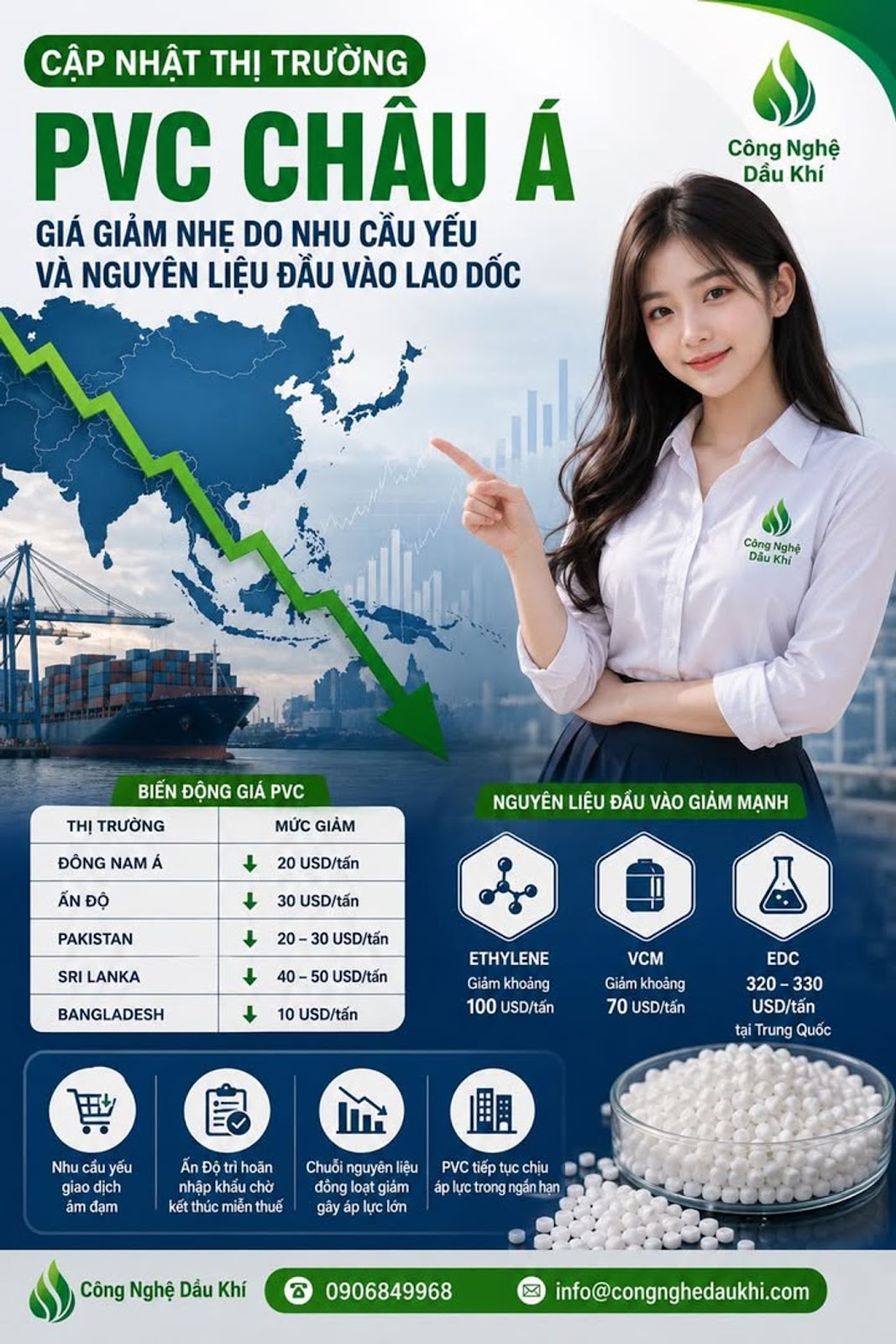
According to regional trading sources, PVC suspension prices in Southeast Asia have decreased by approximately $20 per ton compared to the previous week. In India, the decline was more pronounced, with prices falling by about $30 per ton within just one week.
Asian PVC Price Fluctuation
| Market | Price Decrease |
|---|---|
| Southeast Asia | $20/ton |
| India | $30/ton |
| Pakistan | $20-30/ton |
| Sri Lanka | $40-50/ton |
| Bangladesh | $10/ton |
Notably, quotations from major regional producers have failed to generate significant traction. Actual trading volumes have fallen below expectations as buyers believe prices may continue declining in the coming weeks.
In India specifically, many importers continue to postpone new contracts to await the conclusion of the tax exemption policy for certain petrochemical products at the end of June. This has further reduced market liquidity.
Entire Raw Material Chain in Downward Spiral
The price decline is not limited to PVC; the entire upstream raw material chain is experiencing significant adjustments.
| Raw Material | Price Movement |
|---|---|
| Ethylene | Decreased by approximately $100/ton |
| VCM | Decreased by approximately $70/ton |
| China EDC | Remained at $320-330/ton |
The simultaneous decline in Ethylene, VCM, and EDC prices is creating substantial pressure on the PVC market. As production costs decrease significantly, suppliers are forced to adjust selling prices to maintain competitiveness.
Why PVC Prices Cannot Recover Yet
Three main factors are driving the market downward:
- Slow recovery in construction and infrastructure demand in many countries
- Buyers delaying contracts due to expectations of further price reductions
- Weakening prices for oil and petrochemical feedstocks
This creates a vicious cycle that makes it difficult for the market to find upward momentum in the short term.
Impact on Vietnamese Enterprises
For Vietnamese enterprises producing plastic pipes, construction materials, electrical cables, and industrial plastics, the PVC price reduction significantly helps lower raw material costs.
However, the downside is that product prices are also under downward pressure, limiting profit margin expansion as expected if consumption demand remains weak.
Industry Analysis
Industry experts note that Vietnamese plastic manufacturers face a dual challenge: maintaining profit margins while remaining competitive in a price-sensitive market. While lower PVC prices reduce production costs, the overall market weakness means manufacturers cannot easily pass these savings to consumers. Additionally, customers are delaying purchases, expecting further price drops, creating a challenging environment despite lower input costs.
Future Outlook
Market analysts suggest that the short-term trend for PVC remains tilted toward decline or stabilization. The market can only recover when:
- Import demand from India rebounds
- Construction activities accelerate in Southeast Asia
- Ethylene and VCM prices stabilize again
- Inventory levels at plants return to balanced levels
In the current context, most enterprises are prioritizing a wait-and-see strategy rather than making large-scale purchases.
Market Predictions
If PVC prices continue to decrease by an additional $50-100 per ton in the next quarter, this could represent a golden opportunity for Vietnam's plastics industry to increase market share and improve margins. However, it could also indicate a deeper economic slowdown in the region, potentially leading to reduced demand for plastic products across various sectors.
Strategic Recommendations
For Vietnamese plastic enterprises navigating this challenging market environment, several strategic approaches are recommended:
- Maintain flexible procurement strategies to capitalize on potential further price drops
- Focus on value-added products with higher margins rather than competing solely on price
- Strengthen relationships with key customers to maintain market share despite price pressures
- Explore export opportunities in markets less affected by the current downturn
- Invest in efficiency improvements to offset potential margin compression
Conclusion
The ongoing decline in PVC prices presents a complex situation for Vietnam's plastics industry. While lower input costs offer immediate relief and potential margin improvements, the underlying weakness in demand and the broader economic context cannot be ignored.
Enterprises that successfully navigate this environment will likely be those that combine strategic procurement with operational excellence and market diversification. The coming months will be critical in determining whether this price decline represents a temporary opportunity or the beginning of a more sustained downturn in the regional plastics market.
Regardless of the eventual outcome, the current situation underscores the importance of market agility and strategic foresight in Vietnam's increasingly competitive plastics sector.