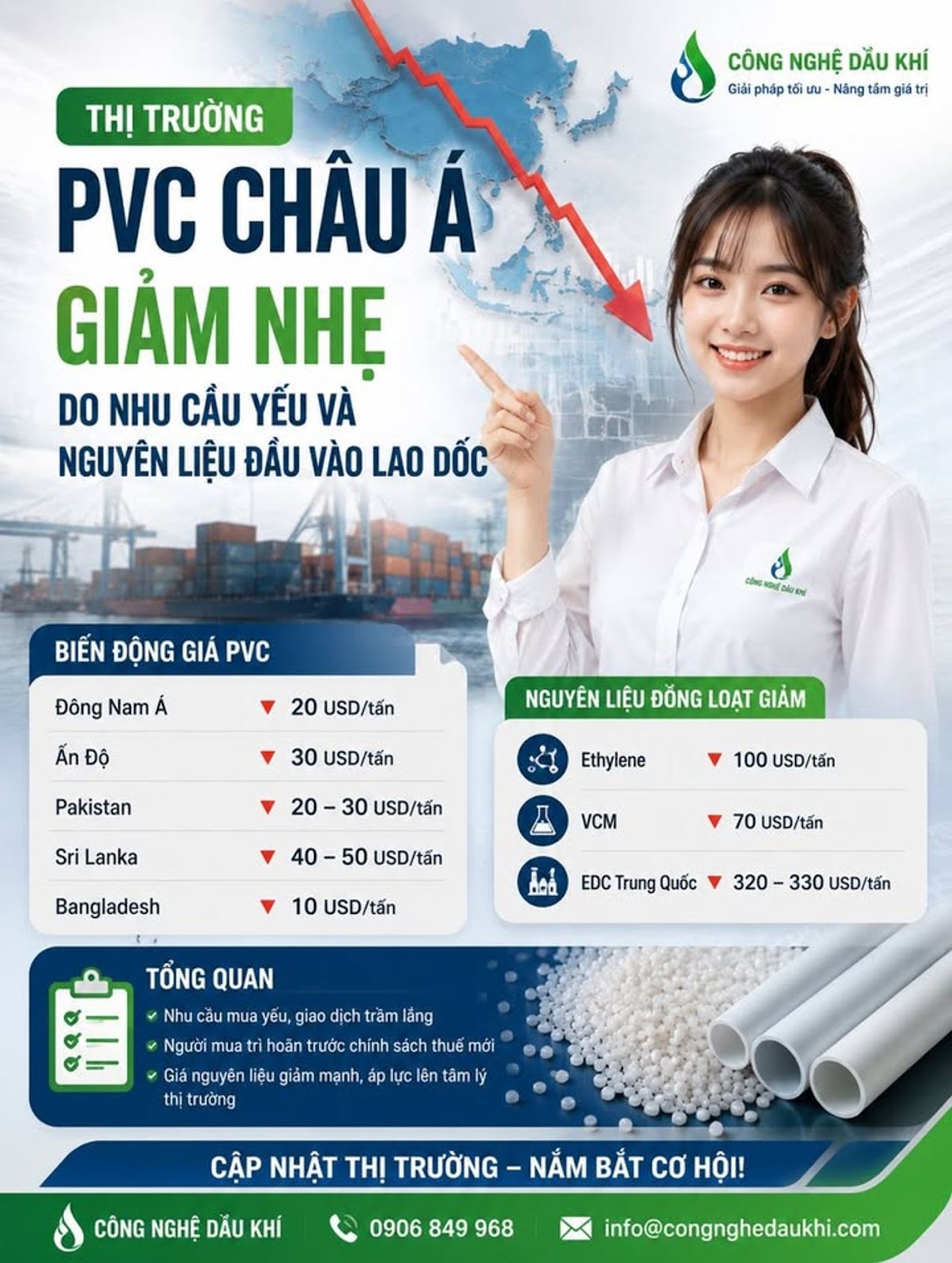
Asian PVC Market Continues Downward Trend: Opportunity or Warning of New Downturn?
The Asian PVC market has experienced another week of declining prices as buying forces remain weak and a wait-and-see mentality dominates most major markets in the region. Importers, particularly in India, Pakistan, and Bangladesh, are maintaining cautious stances amid the deepening downward trend in the petrochemical feedstock chain.
According to regional trading sources, PVC suspension prices in Southeast Asia have decreased by approximately $20 per ton compared to the previous week. In India, the decline was more pronounced, with prices falling about $30 per ton within just one week.
Price Decline Across Asian Markets
| Market | Price Decline |
|---|---|
| Southeast Asia | $20/ton |
| India | $30/ton |
| Pakistan | $20 - $30/ton |
| Sri Lanka | $40 - $50/ton |
| Bangladesh | $10/ton |
Notably, offers from major producers in the region have failed to generate significant interest. Actual transaction volumes have been lower than expected as buyers believe prices may continue to decline in the coming weeks.
In India specifically, many importers continue to delay new contracts to await the end of tax exemption policies for certain petrochemical products at the end of June. This has further reduced market liquidity.
Entire Raw Material Chain Experiences Sharp Decline
The price reduction is not limited to PVC; the entire raw material input chain is experiencing significant adjustments.
| Raw Material | Price Movement |
|---|---|
| Ethylene | Decreased by approximately $100/ton |
| VCM | Decreased by approximately $70/ton |
| EDC (China) | Remained at $320 - $330/ton |
The simultaneous decline in Ethylene, VCM, and EDC is creating significant pressure on the PVC market. As production costs decrease sharply, suppliers are forced to adjust selling prices to maintain competitiveness.
Why PVC Prices Cannot Recover Yet
Three main factors are driving the market downward:
- Slow recovery in construction and infrastructure demand in many countries
- Buyers delaying contracts due to expectations of further price reductions
- Weakening oil prices and petrochemical feedstock costs
This creates a vicious cycle that makes it difficult for the market to find upward momentum in the short term.
Impact on Vietnamese Enterprises
For Vietnamese businesses producing plastic pipes, construction materials, electrical cables, and industrial plastics, the PVC price reduction significantly helps lower raw material costs.
However, the downside is that product prices are also under downward pressure, preventing profit margins from increasing as much as expected if consumption demand remains weak.
Future Outlook
Market analysts suggest that the short-term trend for PVC will remain downward or flat. The market can only recover when:
- Import demand from India rebounds
- Construction activities accelerate in Southeast Asia
- Ethylene and VCM prices stabilize again
- Inventory levels at plants return to balanced levels
In the current context, most businesses are still prioritizing a wait-and-see strategy rather than making large-scale purchases.
If PVC prices continue to decline by an additional $50 - $100 per ton in the next quarter, this could represent a golden opportunity for Vietnam's plastics industry or serve as a warning signal for regional economic slowdown.