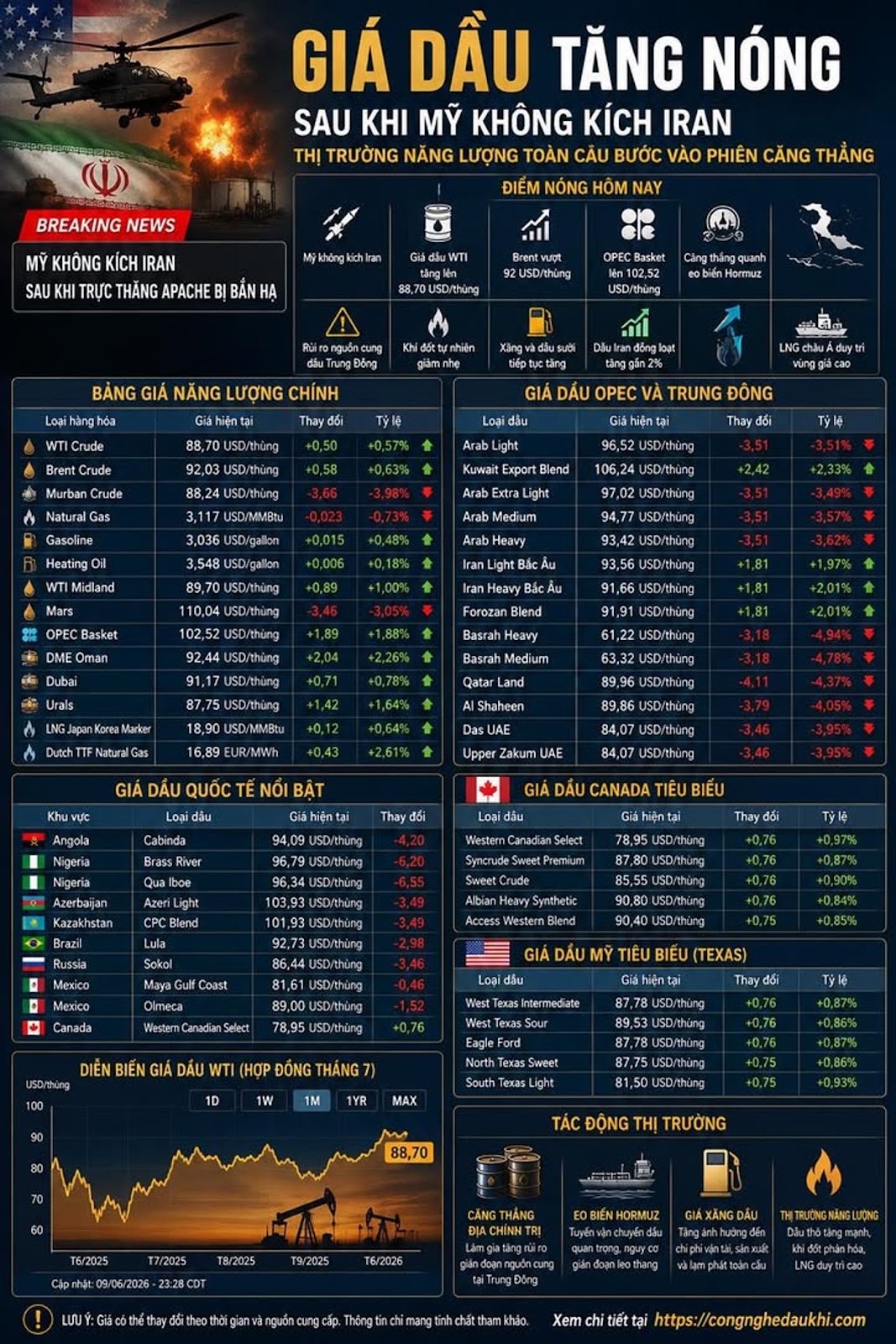
Oil Prices Surge Following US Airstrikes on Iran Amidst Middle East Tensions
Global oil markets experienced significant volatility today as news broke of US military strikes against Iran, conducted in retaliation for the downing of an Apache helicopter. The geopolitical tensions in the Middle East immediately shifted investor focus toward the potential for supply disruptions, particularly in the strategic Strait of Hormuz, which accounts for approximately 20% of global oil trade.
Geopolitical Escalation and Market Response
The military action has created an atmosphere of uncertainty in energy markets, with traders quickly positioning themselves for potential supply constraints. The incident underscores the delicate balance in global energy markets, where even localized conflicts can have far-reaching implications for prices worldwide.
"The market is reacting nervously to the heightened tensions," said energy analyst Michael Chen. "With approximately one-third of global seaborne oil passing through the Strait of Hormuz, any disruption could have immediate and profound effects on supply chains."
Current Market Overview
As of today's trading session, major oil benchmarks have shown varied movements, with some benchmarks reaching critical price levels:
| Commodity | Current Price | Change | Percentage Change |
|---|---|---|---|
| WTI Crude | $88.70/barrel | +$0.50 | +0.57% |
| Brent Crude | $92.03/barrel | +$0.58 | +0.63% |
| Murban Crude | $88.24/barrel | -$3.66 | -3.98% |
| Natural Gas | $3.117/MMBtu | -$0.023 | -0.73% |
| Gasoline | $3.036/gallon | +$0.015 | +0.48% |
| Heating Oil | $3.548/gallon | +$0.006 | +0.18% |
| WTI Midland | $89.70/barrel | +$0.89 | +1.00% |
| Mars | $110.04/barrel | -$3.46 | -3.05% |
| OPEC Basket | $102.52/barrel | +$1.89 | +1.88% |
| DME Oman | $92.44/barrel | +$2.04 | +2.26% |
| Dubai | $91.17/barrel | +$0.71 | +0.78% |
| Urals | $87.75/barrel | +$1.42 | +1.64% |
| LNG Japan Korea Marker | $18.90/MMBtu | +$0.12 | +0.64% |
| Dutch TTF Natural Gas | €16.89/MWh | €+0.43 | +2.61% |
Regional Oil Price Variations
The market has shown divergent performance across different regional benchmarks, with Middle Eastern and Iranian crude oils showing particular strength amid the tensions:
| Oil Type | Current Price | Change | Percentage Change |
|---|---|---|---|
| Arab Light | $96.52/barrel | -$3.51 | -3.51% |
| Kuwait Export Blend | $106.24/barrel | +$2.42 | +2.33% |
| Arab Extra Light | $97.02/barrel | -$3.51 | -3.49% |
| Arab Medium | $94.77/barrel | -$3.51 | -3.57% |
| Arab Heavy | $93.42/barrel | -$3.51 | -3.62% |
| Iran Light Europe | $93.56/barrel | +$1.81 | +1.97% |
| Iran Heavy Europe | $91.66/barrel | +$1.81 | +2.01% |
| Forozan Blend | $91.91/barrel | +$1.81 | +2.01% |
| Basrah Heavy | $61.22/barrel | -$3.18 | -4.94% |
| Basrah Medium | $63.32/barrel | -$3.18 | -4.78% |
| Qatar Land | $89.96/barrel | -$4.11 | -4.37% |
| Al Shaheen | $89.86/barrel | -$3.79 | -4.05% |
| Das UAE | $84.07/barrel | -$3.46 | -3.95% |
| Upper Zakum UAE | $84.07/barrel | -$3.46 | -3.95% |
Global Production Benchmarks
Oil prices from various production regions have shown mixed reactions to the geopolitical tensions:
| Region | Oil Type | Current Price | Change |
|---|---|---|---|
| Angola | Cabinda | $94.09/barrel | -$4.20 |
| Nigeria | Brass River | $96.79/barrel | -$6.20 |
| Nigeria | Qua Iboe | $96.34/barrel | -$6.55 |
| Azerbaijan | Azeri Light | $103.93/barrel | -$3.49 |
| Kazakhstan | CPC Blend | $101.93/barrel | -$3.49 |
| Brazil | Lula | $92.73/barrel | -$2.98 |
| Russia | Sokol | $86.44/barrel | -$3.46 |
| Mexico | Maya Gulf Coast | $81.61/barrel | -$0.46 |
| Mexico | Olmeca | $89.00/barrel | -$1.52 |
| Canada | Western Canadian Select | $78.95/barrel | +$0.76 |
Market Analysis and Implications
The current oil price movements reflect the market's heightened sensitivity to geopolitical factors. While WTI and Brent have shown modest gains, the OPEC Basket has surpassed the $102/barrel threshold, indicating that concerns extend beyond US supply to potential disruptions from Middle Eastern producers.
Notably, Iranian crude oils have increased by nearly 2% across the board, reflecting defensive positioning by traders amid the escalating tensions. Should instability persist in the Strait of Hormuz, upward pressure could extend to gasoline, heating oil, maritime transport, aviation, and global production costs.
Conversely, US natural gas has seen slight declines, suggesting speculative capital is currently favoring crude oil over natural gas. However, Asian LNG and European TTF gas remain at elevated levels, signaling that global energy markets have yet to cool.
Key Factors to Watch
Several critical developments will likely shape the market's direction in the coming days:
- Iran's Response: How Iran will respond to the US military strikes will be crucial in determining whether tensions escalate further.
- Supply Disruption Risks: The potential for disruptions to oil shipping through the Strait of Hormuz remains a primary concern.
- Price Targets: Market analysts are closely monitoring whether Brent could approach the $95-100/barrel range.
- Domestic Impact: The effects on domestic gasoline prices and transportation costs are already being felt in various markets.
- OPEC Response: The reaction from OPEC and other major oil-exporting countries could significantly influence market dynamics.
- Inventory Levels: US crude inventories and refinery demand during the peak summer driving season will be closely watched.
Market Outlook
Today's trading session indicates that global oil markets are entering an extremely sensitive phase. Even a single military development in the Middle East can trigger significant price increases, raising concerns about energy inflation and global consumer costs.
With WTI at $88.70/barrel, Brent at $92.03/barrel, and the OPEC Basket exceeding $102/barrel, the central question is whether this represents short-term volatility or the beginning of a new upward price cycle for oil.
Energy analysts suggest that while the immediate spike may moderate if tensions de-escalate, the underlying risk factors in the Middle East could sustain elevated prices through the summer months, potentially impacting global economic recovery efforts.