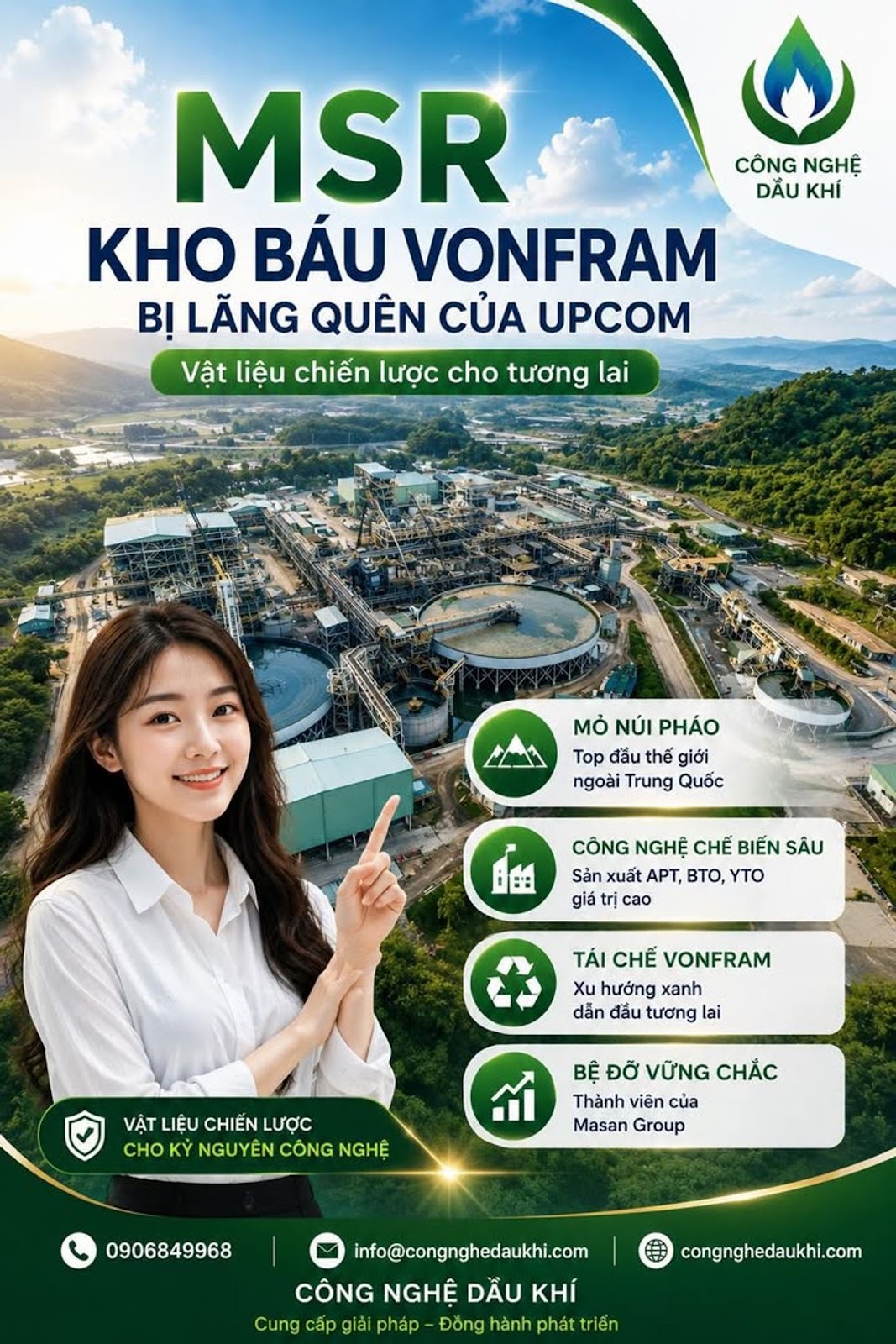
MSR - Vietnam's Tungsten Treasure or Market Mispricing?
In an era where artificial intelligence, data centers, and electric vehicles are driving unprecedented demand for strategic materials, is the market overlooking a company controlling one of the world's largest tungsten deposits outside China?
For years, when investors discussed Masan High-Tech Materials (MSR), they primarily viewed it as a cyclical mining business whose performance fluctuated with commodity prices. However, a deeper analysis reveals a position that few companies worldwide can replicate.
This article examines how MSR has established near-complete control over the tungsten value chain—from mining and deep processing to high-tech material recycling—and whether the market has fully recognized this strategic advantage.
The Strategic Rise of Tungsten in the Global Economy
Tungsten stands out as the metal with the highest melting point among commonly used metals. Its exceptional heat resistance, wear resistance, and extreme hardness have made it indispensable in numerous high-tech applications.
The current technological landscape has dramatically increased tungsten's strategic importance:
| Application Area | Strategic Importance |
|---|---|
| High-performance AI chips | Critical for heat dissipation in advanced computing systems |
| Data Centers | Essential for server components requiring thermal stability |
| Semiconductor Equipment | Vital for precision manufacturing processes |
| Defense Industry | Key for armor-piercing munitions and military equipment |
| Next-generation Electric Vehicle Batteries | Increasingly used in battery components and charging infrastructure |
| CNC Precision Tools | Essential for cutting and machining hard materials |
| Aerospace | Critical for engine components and structural elements |
As the AI competition intensifies between the United States and China, securing supply chains for strategic materials has become a national security priority. This has heightened interest in companies controlling resources outside China, which currently dominates the global tungsten market.
What Makes MSR Different from Traditional Mining Companies
Unlike most mining enterprises that typically sell raw ore or concentrates, MSR has pursued a distinctly different strategy by focusing on deep processing to create high-value-added products.
The company's vertically integrated approach transforms low-value raw materials into premium products:
| Value Chain Stage | Value Level |
|---|---|
| Mined Ore | Low |
| Concentrate | Medium |
| APT (Ammonium Paratungstate) | High |
| BTO (Blue Tungsten Oxide) | High |
| YTO (Yellow Tungsten Oxide) | High |
| High-tech Tungsten Powder | Very High |
This strategic approach reduces MSR's dependence on raw material price fluctuations and enhances long-term profit margins. By controlling multiple stages of the value chain, the company can capture more value from each ton of extracted tungsten.
The Nui Phao Mine: A Strategic Asset of Global Significance
Located in Thai Nguyen province, the Nui Phao mine is recognized as one of the world's largest tungsten deposits outside China. This represents a competitive advantage that few companies can replicate.
Developing a new mining operation requires:
- Decades of geological exploration and surveying
- Investment costs amounting to trillions of Vietnamese Dong
- Complex permitting procedures
- Increasingly stringent environmental requirements
The true value of MSR extends beyond current revenues to encompass ownership of this strategic resource. As global demand for tungsten intensifies, the significance of controlling such a substantial deposit outside China continues to grow.
Strategic Pivot: Embracing the Circular Economy
Recognizing that natural resources are finite, MSR has made a strategic shift toward tungsten recycling—a move that aligns with global ESG (Environmental, Social, and Governance) trends.
This recycling model offers multiple advantages:
- Reduces dependence on natural resource extraction
- Increases raw material supply sources
- Aligns with global ESG standards
- Facilitates partnerships with major technology corporations
- Enhances the company's "green" corporate image
This recycling strategy mirrors the approach being adopted by leading global materials companies such as Sandvik and Kennametal, positioning MSR at the forefront of sustainable materials management.
The Masan Group Advantage
As a member of Masan Group, MSR benefits from several strategic advantages:
- Strong capital mobilization capabilities
- Capacity for long-term investment
- Supportive financial ecosystem
- Access to international customer networks
When tungsten prices enter favorable cycles, the economic benefits can directly reflect in Masan's consolidated results, creating potential synergies across the group's diverse portfolio.
Investment Opportunities and Risks
Key Opportunities
| Opportunity Factor | Potential Impact |
|---|---|
| AI boom | Increased demand for tungsten in chip manufacturing and data centers |
| Global data center acceleration | Growing need for heat-resistant components in server infrastructure |
| Electric vehicle expansion | Rising consumption in battery components and charging systems |
| Reduced dependence on Chinese supply | Strategic advantage as alternative supplier to global markets |
| Increasing strategic resource value | Appreciation of asset-based value in resource-constrained world |
Significant Risks
| Risk Factor | Potential Impact |
|---|---|
| High commodity price volatility | Unpredictable revenue and profitability fluctuations |
| Rising extraction costs | Margin pressure as operational expenses increase |
| Global economic downturn risk | Reduced demand from key industrial and technology sectors |
| Currency exchange fluctuations | |
| Environmental and regulatory pressures |
An Investment Perspective
MSR is not suited for investors seeking short-term profits over weeks or months. This is an enterprise whose value typically materializes over years rather than quarters.
If current trends in AI, semiconductors, advanced defense technology, and electric vehicles continue to expand as they have been, companies controlling strategic material supplies outside China will increasingly be revalued by the market.
The fundamental question is no longer whether MSR possesses valuable assets, but whether the market has fully reflected the value of those assets in the stock price.
As global technology races accelerate and supply chain security becomes increasingly paramount, companies controlling critical resources like tungsten may find their strategic importance—and market valuations—continuing to rise.