Iraq Faces Critical Deadline as Oil Exports Hang in the Balance
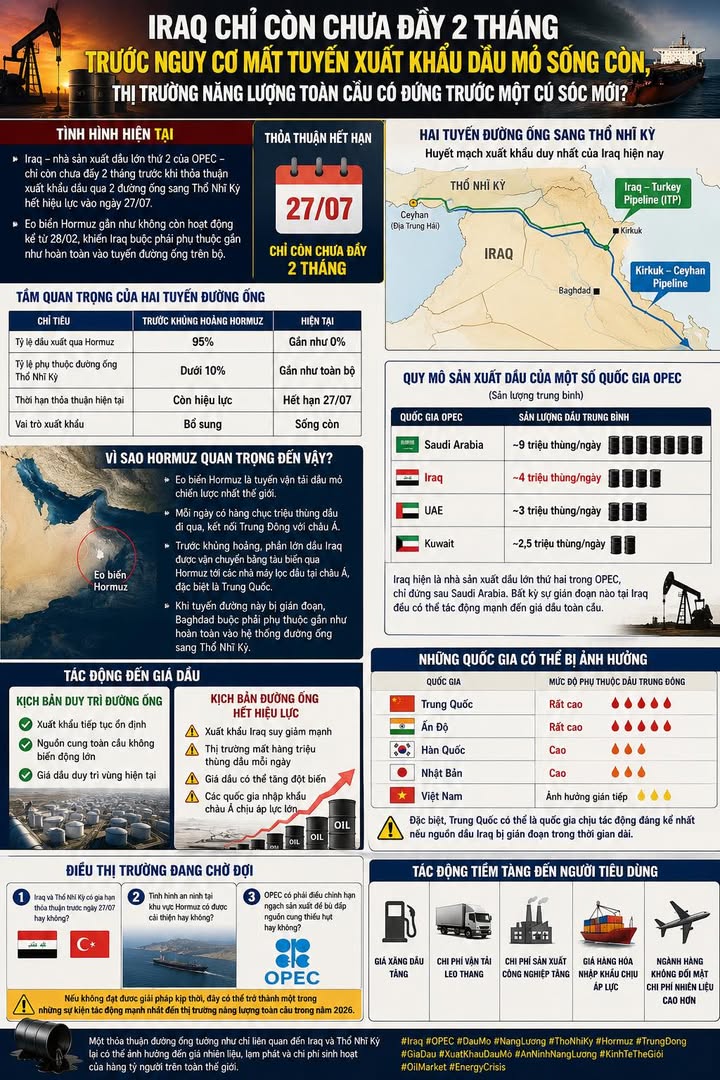
What would happen if the world's second-largest OPEC producer suddenly lost nearly all its oil export capacity within just a few weeks, while global supply remains tight? This is the precarious situation facing Iraq as it confronts one of the most severe energy crises in recent years.
The country now has less than two months before an agreement allowing crude oil transport through two pipelines to Turkey expires on July 27. With the Strait of Hormuz virtually non-operational since late February, these pipelines have become Iraq's sole lifeline to continue international oil exports.
The Critical Importance of the Turkish Pipelines
| Metric | Pre-Hormuz Crisis | Current Situation |
|---|---|---|
| Oil Export via Hormuz | 95% | Nearly 0% |
| Dependence on Turkish Pipelines | Below 10% | Nearly 100% |
| Current Agreement Status | In effect | Expires July 27 |
| Export Role | Supplementary | Critical |
Why the Strait of Hormuz Matters So Much
The Strait of Hormuz has long been considered the world's most strategic oil transport corridor. Each day, tens of millions of barrels of oil pass through this vital waterway, connecting major oil producers in the Middle East with customers in Asia.
For Iraq, China has been one of the largest buyers of its oil. Before the disruption, the majority of Iraqi oil was transported by sea through Hormuz to refineries in Asia. When this route became obstructed, Baghdad was forced to rely almost entirely on the overland pipeline system.
The Scale of Iraq's Oil Production
| OPEC Country | Average Oil Production |
|---|---|
| Saudi Arabia | Approximately 9 million barrels/day |
| Iraq | Approximately 4 million barrels/day |
| UAE | Approximately 3 million barrels/day |
| Kuwait | Approximately 2.5 million barrels/day |
Currently, Iraq is the second-largest oil producer in OPEC, trailing only Saudi Arabia. This means any disruption in Iraqi oil production could directly impact global oil prices.
Potential Impact on Oil Prices
Scenario: Pipelines Remain Operational
- ✅ Exports continue steadily
- ✅ Global supply remains stable
- ✅ Oil prices maintain current levels
Scenario: Pipelines Expire
- ⚠️ Significant decline in Iraqi exports
- ⚠️ Market loses millions of barrels daily
- ⚠️ Potential for sharp oil price increases
- ⚠️ Asian importers face substantial pressure
Countries Potentially Affected
| Country | Level of Dependence on Middle Eastern Oil |
|---|---|
| China | Very High |
| India | Very High |
| South Korea | High |
| Japan | High |
| Vietnam | Indirect Impact |
Particularly, China could be the most significantly affected country if Iraqi oil supplies remain disrupted for an extended period.
What the Market is Waiting For
Investors are currently focusing on three critical factors:
- Whether Iraq and Turkey will extend the agreement before July 27
- Whether security situations in the Hormuz region will improve
- Whether OPEC will adjust production quotas to compensate for potential supply shortages
If timely solutions are not achieved, this could become one of the most significant events affecting the global energy market in 2026.
Potential Impact on Consumers
- Rising gasoline and diesel prices
- Escalating transportation costs
- Increased industrial production costs
- Pressure on imported commodity prices
- The aviation industry facing higher fuel costs
An agreement concerning pipelines that seemingly only involves Iraq and Turkey could ultimately affect fuel prices, inflation, and the cost of living for billions of people worldwide.
The coming weeks will be critical in determining whether this potential crisis escalates into a full-blown global energy shock, or whether diplomatic and economic solutions can be found to maintain stability in the oil markets.