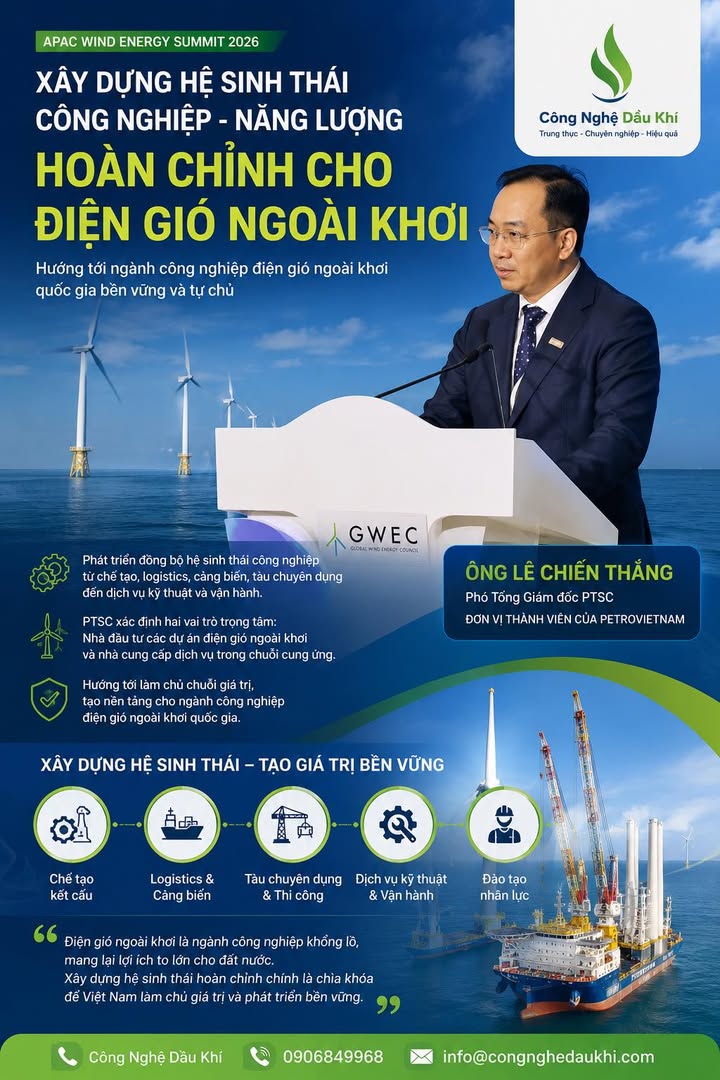
Building a Complete Offshore Wind Power Industrial Ecosystem in Vietnam
As Vietnam strategically transitions its energy landscape, offshore wind power has emerged as a key driver of growth. However, industry leaders caution that merely constructing offshore wind farms without mastering the entire value chain—including ports, logistics, manufacturing, and technical services—could result in billions of dollars in added value flowing to foreign enterprises.
This perspective was shared by executives from Petrovietnam Technical Services Corporation (PTSC) during the APAC Wind Energy Summit 2026, where they emphasized that developing offshore wind power extends beyond power generation projects. Instead, it requires establishing a comprehensive industrial-energy ecosystem to create sustainable value for the national economy.
The Imperative for a Holistic Approach
"Vietnam currently possesses numerous favorable conditions for developing offshore wind power," stated Mr. Le Chien Thang, Deputy General Director of PTSC. "However, we still lack synchronized connections between the various links in the value chain."
According to PTSC leadership, Vietnam's advantages include:
- An extensive coastline with abundant wind resources
- Experience gained from the oil and gas sector
- Growing electricity demand
Despite these advantages, isolated investments in individual projects are insufficient to transform potential into genuine competitive advantage.
The Components of a Complete Offshore Wind Ecosystem
A comprehensive offshore wind ecosystem requires multiple interconnected components working in harmony. The following table outlines these essential elements:
| Component | Role |
|---|---|
| Specialized Seaports | Transportation of oversized and overweight equipment |
| Manufacturing Centers | Production of foundations, turbine bases, and steel structures |
| Specialized Vessel Fleet | Offshore construction and installation |
| Logistics | Supply chain for equipment and materials |
| Transmission Grid | Integration into the national power system |
| O&M Services | Long-term operation and maintenance |
| Workforce Training | Provision of engineers and specialized experts |
PTSC emphasizes that the absence of any single component significantly impacts the effectiveness of investment across the entire sector.
PTSC's Strategic Investments
Over the past five years, PTSC has proactively invested heavily in infrastructure supporting offshore wind power, from manufacturing foundations and turbine bases to specialized logistics services. The company is developing:
- A large-scale offshore wind industrial manufacturing center
- A port system for transporting oversized equipment
- Offshore survey and construction capabilities
- A chain of specialized technical services
- International market connections
PTSC has identified two strategic development directions: serving as both an offshore wind project investor and a service provider within the supply chain.
Economic Value Beyond Power Generation
The economic benefits of offshore wind extend far beyond electricity sales. The following table illustrates the value distribution across different activities:
| Activity | Value Contribution |
|---|---|
| Power Generation | High |
| Equipment Manufacturing | Very High |
| Maritime Logistics | High |
| Technical Services | High |
| Long-term Maintenance | Very High |
| Workforce Training | Medium-High |
This value distribution explains why developed countries consistently aim to establish complete wind power industries rather than focusing solely on individual power generation projects.
International Lessons and Best Practices
Norway's experience with offshore wind power demonstrates the importance of a comprehensive approach. Ambassador Hilde Solbakken emphasized that Norway's success stems from the simultaneous development of infrastructure, supply chains, and coordination mechanisms among market participants.
"This approach is particularly crucial for Vietnam," noted industry experts, "as the country's offshore wind sector remains in its early development stages."
Current Status of Offshore Wind Development in Vietnam
The following table provides an overview of Vietnam's current offshore wind development landscape:
| Indicator | Status |
|---|---|
| Sea Survey Companies | 12 units |
| Legal Framework | Under completion |
| International Support | Norway, Denmark, GWEC |
| Current Priority | Institutional completion |
| Long-term Goal | Building a strategic industrial sector |
Representatives from the Ministry of Industry and Trade reported that Vietnam is studying international experiences to perfect legal regulations related to offshore wind power while simultaneously creating an attractive investment environment to attract domestic and foreign capital.
Strategic Vision for Vietnam's Wind Power Future
If successfully implemented, offshore wind power will not only help Vietnam achieve its Net Zero targets but also open up a new industrial sector worth tens of billions of USD, create high-quality jobs, and elevate the country's position in the international maritime industry.
The most important message from the APAC Wind Energy Summit 2026 is that Vietnam should not limit itself to producing clean electricity. The broader objective is to master the entire value chain—from manufacturing, logistics, ports, specialized vessels to operation and maintenance—to retain added value within the domestic economy.
Conclusion: A Historic Opportunity
Vietnam stands at a historic opportunity to become a Southeast Asian hub for offshore wind industry. The critical question remains: Will the country merely sell electricity, or will it master an entire new energy industry worth tens of billions of USD in the future?
The development of a complete offshore wind ecosystem represents not just an energy transition but an industrial transformation that could redefine Vietnam's economic landscape for decades to come.