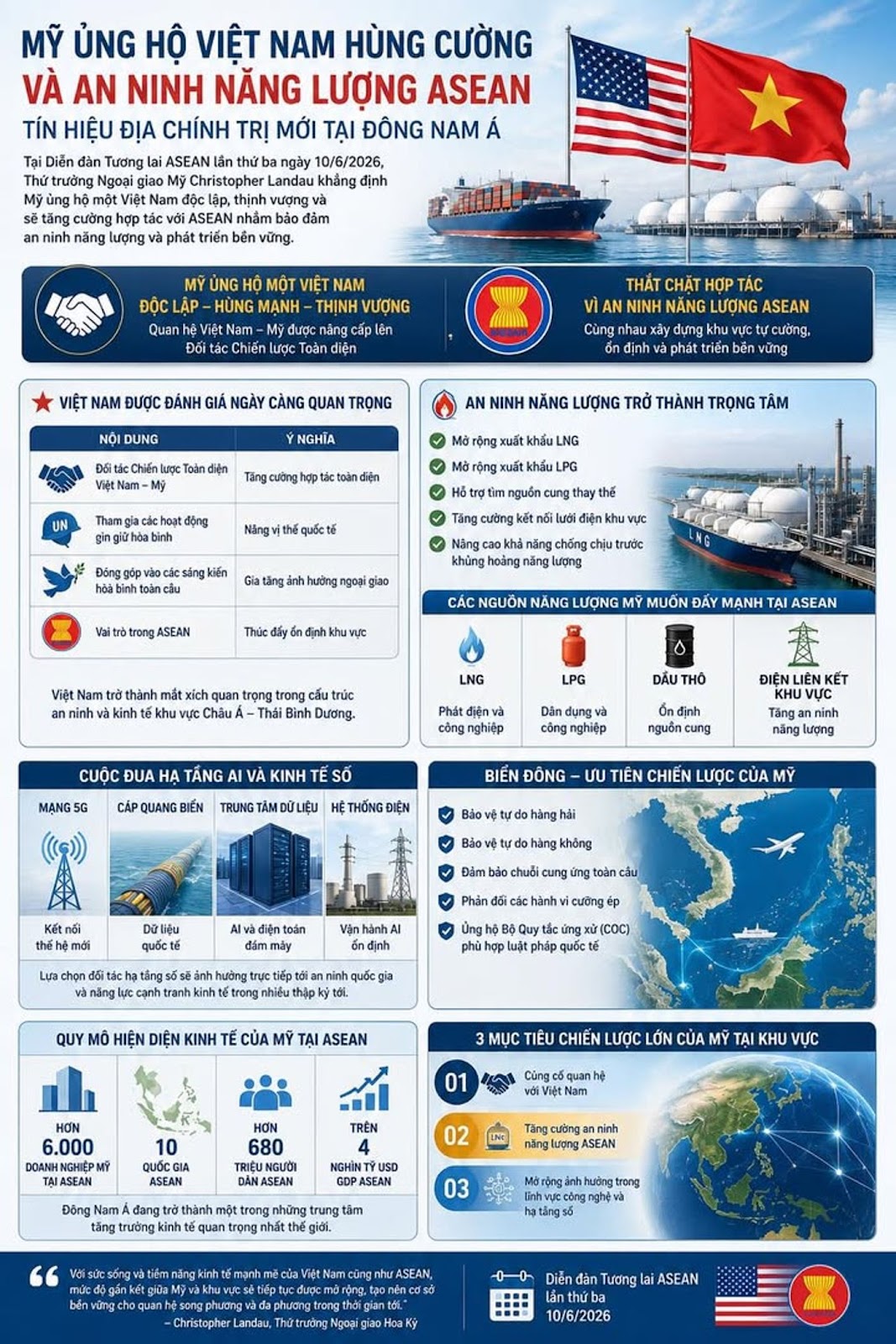
US Strong Support for Vietnam and ASEAN Energy Security: New Geopolitical Signal in Southeast Asia?
In a significant diplomatic move that signals shifting geopolitical priorities in Southeast Asia, the United States has publicly declared its support for a strong, prosperous Vietnam and expanded energy cooperation with ASEAN. This announcement, made by US Deputy Secretary of State Christopher Landau at the third ASEAN Future Forum on June 10, 2026, represents one of Washington's most strategic moves in the region in recent years.
Vietnam's Growing Regional Importance
According to Deputy Secretary Landau, Vietnam is not merely an important economic partner but also a positive contributor to global peace and stability. The US acknowledgment comes as Vietnam continues to strengthen its position in the international arena, particularly following the elevation of bilateral relations to a Comprehensive Strategic Partnership.
The US highlighted several milestones that demonstrate Vietnam's increasing significance:
| Milestone | Significance |
|---|---|
| Comprehensive Strategic Partnership | Enhanced comprehensive cooperation |
| Peacekeeping participation | Elevated international standing |
| Contributions to global peace initiatives | Increased diplomatic influence |
| Role within ASEAN | Promotion of regional stability |
This recognition indicates that Vietnam is gradually becoming a crucial component in the security and economic architecture of the Asia-Pacific region.
Energy Security Takes Center Stage
The most notable aspect of Landau's speech was the commitment to energy cooperation between the US and ASEAN. Washington announced its intention to:
- Expand LNG exports
- Increase LPG exports
- Support alternative sourcing for member states
- Enhance regional power grid interconnection
- Improve energy crisis resilience
The following energy sources are particularly emphasized by the US:
| Energy Type | Role in ASEAN |
|---|---|
| LNG | Power generation and industrial use |
| LPG | Residential and industrial applications |
| Crude oil | Supply stability |
| Regional interconnected electricity | Enhanced energy security |
In a world facing continuous volatility in the Middle East, Red Sea, and Hormuz Strait, energy security has become a top priority for many ASEAN nations.
The Race for AI and Digital Infrastructure
Beyond energy, the US emphasized the development of artificial intelligence and digital transformation. Washington expressed particular interest in:
| Infrastructure Area | Strategic Importance |
|---|---|
| 5G networks | Next-generation connectivity |
| Submarine optical cables | International data transmission |
| AI and cloud computing data centers | Digital processing capabilities |
| AI-operated power systems | Stable power operations |
According to US assessments, the choice of digital infrastructure partners today will directly impact national security and economic competitiveness for decades to come.
South China Sea Remains a Flashpoint
Washington reaffirmed its positions on the South China Sea, emphasizing:
- Protection of freedom of navigation
- Safeguarding freedom of overflight
- Ensuring global supply chains
- Opposing coercive actions
- Supporting a Code of Conduct (COC) consistent with international law
This indicates that the South China Sea remains one of the most important strategic priorities in US policy toward Southeast Asia.
Scale of US Economic Presence in ASEAN
The United States maintains substantial economic engagement across ASEAN:
| Indicator | Scale |
|---|---|
| US companies in ASEAN | Over 6,000 enterprises |
| Benefiting markets | 10 ASEAN nations |
| ASEAN population | Over 680 million people |
| ASEAN GDP | Over $4 trillion |
The growing presence of US enterprises demonstrates that Southeast Asia is becoming one of the world's most important economic growth centers.
Strategic Perspective
The message from Christopher Landau goes beyond mere diplomatic rhetoric. It reflects three major strategic objectives for the US in the region:
- Strengthening relations with Vietnam
- Enhancing ASEAN energy security
- Expanding influence in technology and digital infrastructure
In an increasingly intense global geopolitical competition, the US public support for a strong Vietnam is viewed as a positive signal for bilateral relations and Vietnam's growing role in the region.
As Southeast Asia continues to navigate complex geopolitical dynamics, the US alignment with Vietnam on energy security and technological development may reshape regional partnerships and influence the future economic landscape of ASEAN in the coming decade.