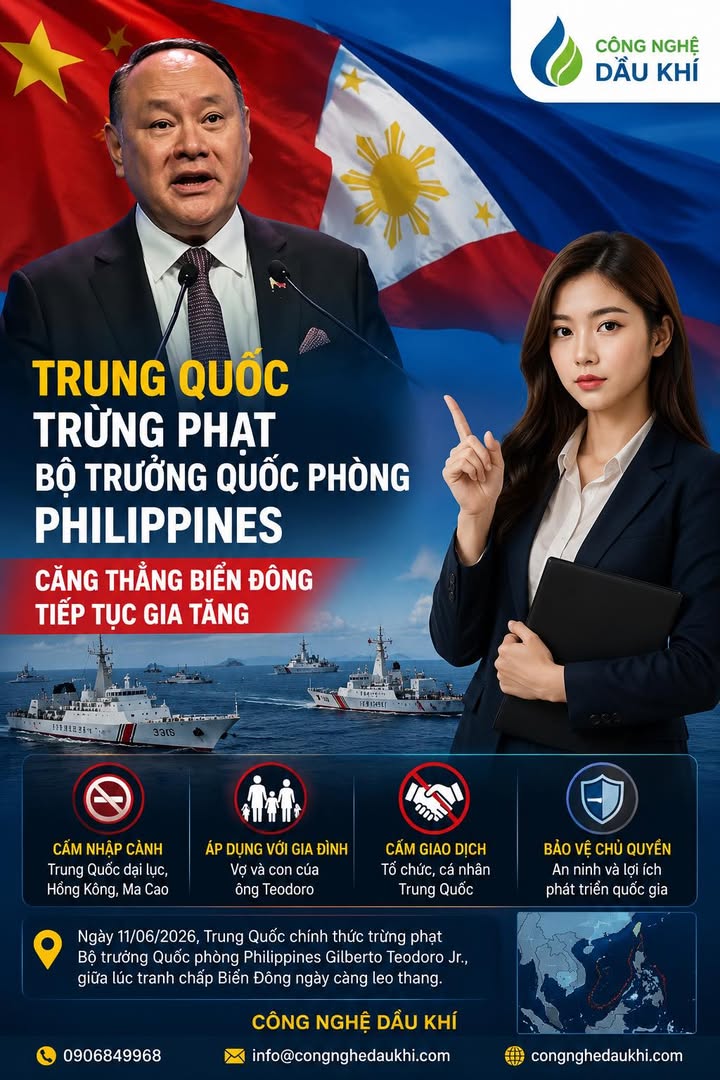
China Imposes Sanctions on Philippine Defense Minister as South China Sea Tensions Escalate
On June 11, 2026, China's Ministry of Foreign Affairs officially announced sanctions against Philippine Defense Minister Gilberto Teodoro Jr., a rare and politically significant move amid continuously escalating tensions in the South China Sea. This development marks the latest escalation in a series of confrontations between China and the Philippines regarding sovereignty disputes in a region widely regarded as one of the world's most critical geopolitical hotspots.
Details of the Announced Sanctions
According to the Chinese government statement, the measures applied to Gilberto Teodoro Jr. include:
| Measure | Details |
|---|---|
| Entry Ban | Prohibition from entering mainland China |
| Extended Restrictions | Application to Hong Kong and Macau |
| Family Application | Includes wife and children of Minister Teodoro |
| Economic Transactions | Prohibits Chinese organizations and individuals from cooperating or transacting with the sanctioned individual |
| Effective Date | Immediate upon public announcement |
Beijing stated that Defense Minister Teodoro has repeatedly made statements that harm China's interests and international image. The Chinese government's response reflects its growing intolerance for what it perceives as hostile rhetoric from Philippine officials regarding the disputed waters.
Who is Gilberto Teodoro Jr.?
Gilberto Teodoro Jr. currently serves as the Philippines' Secretary of National Defense and is considered one of the toughest voices against China within President Ferdinand Marcos Jr.'s cabinet. Over the past several months, he has consistently spoken out against the activities of Chinese coast guard and maritime militia forces in disputed areas of the South China Sea.
At the Shangri-La Dialogue security forum held in Singapore in late May 2026, Teodoro directly accused China of exerting military and political pressure on neighboring countries. His statements at this prestigious Asian security conference drew immediate attention from regional and global security observers.
Statements That Prompted Beijing's Strong Reaction
At the premier Asian security forum, Defense Minister Teodoro declared that the Philippines is facing serious threats related to territory and sovereignty. He emphasized that Manila would continue to enhance its defense capabilities and expand cooperation with international partners to protect national interests.
These remarks quickly elicited a strong reaction from Beijing. Observers noted that these statements were likely a direct contributing factor to the decision to implement sanctions against the Philippine defense minister.
Notable Response from the Philippine Defense Minister
Significantly, Gilberto Teodoro Jr. showed little concern regarding the Chinese sanctions. He stated:
"I have no assets in China and have no plans to visit there."
The defense minister subsequently continued to criticize the Beijing administration in statements widely reported by Philippine media outlets. The hardline stance from both sides suggests that the possibility of de-escalation in the short term is unlikely.
Current State of South China Sea Tensions
The following table illustrates the direct parties involved in the South China Sea dispute and their respective claims:
| Involved Party | Claimed Sovereignty |
|---|---|
| China | Nine-dash line |
| Vietnam | Sovereignty over Hoang Sa (Paracels) and Truong Sa (Spratlys) |
| Philippines | Exclusive economic zone under UNCLOS |
| Malaysia | Part of the Truong Sa (Spratlys) archipelago |
| Brunei | Some southern waters |
| Taiwan | Similar claims to China |
In 2016, the Permanent Court of Arbitration (PCA) in The Hague issued a ruling that rejected the legal basis of China's nine-dash line claim. However, China has consistently refused to recognize this arbitral decision, continuing to assert its historical rights over most of the South China Sea.
Why This Event Matters
Typically, nations respond to diplomatic disagreements with protests or ambassadorial summonses. The imposition of personal sanctions against a sitting defense minister represents a significantly harder stance. This indicates that Beijing intends to send a clear message that statements regarding the South China Sea may trigger direct consequences.
Security experts suggest that this move could strengthen defense cooperation between the Philippines and regional partners including the United States, Japan, and Australia in the coming period. The Philippines has been increasingly engaging in joint military exercises and security agreements with these nations, partly in response to perceived Chinese assertiveness in the disputed waters.
Comprehensive Impact Assessment
| Domain | Impact Level |
|---|---|
| Personal Economics | Low |
| Diplomacy | Very High |
| China-Philippines Relations | Negative |
| South China Sea Security | Increased Risk |
| Regional Geopolitical Competition | High |
Broader Regional Implications
The events of June 11, 2026, demonstrate that the South China Sea dispute is no longer limited to maritime confrontations but has expanded into diplomatic, political, and strategic fronts. China's direct sanctions against the Philippine defense minister reflect the deepening tensions between the two nations.
In the context of increasing military patrols, coast guard presence, and security alliances in the region, the South China Sea continues to be one of the world's most closely watched geopolitical flashpoints. The situation raises questions about whether the region could become Asia's most dangerous hotspot between 2026-2027 if diplomatic and punitive measures continue to escalate.
As regional powers continue to assert their interests and counter each other's moves in these strategically vital waters, the international community remains watchful for any potential miscalculations that could lead to broader conflict in one of the world's most critical trade corridors.