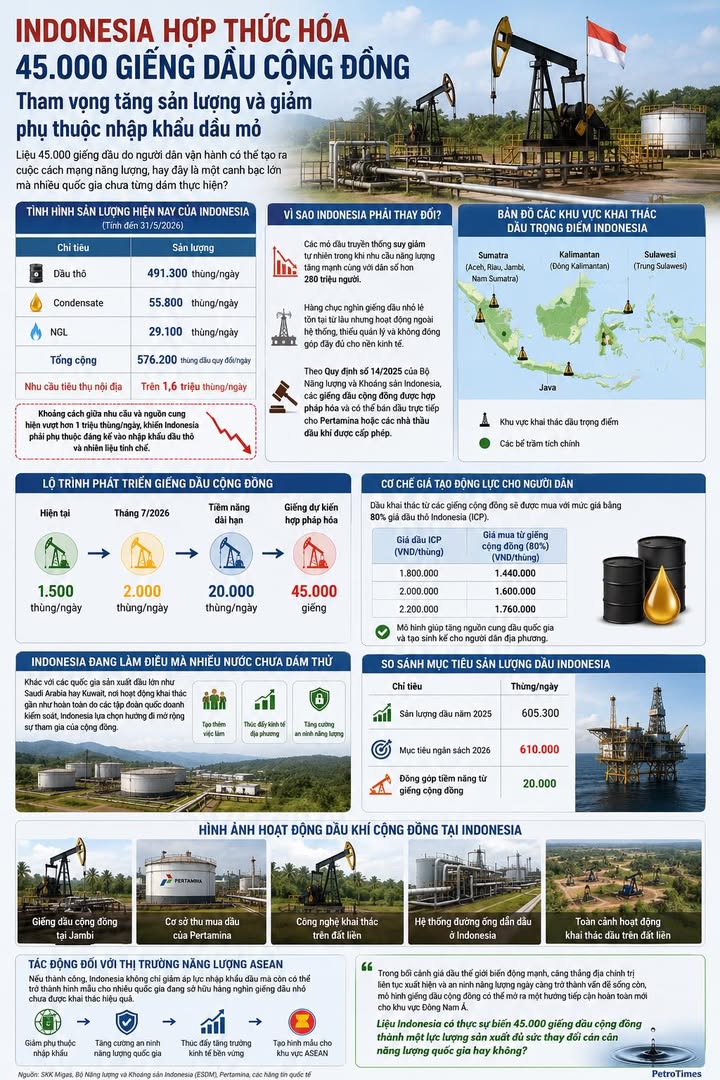
Indonesia Legalizes 45,000 Community Oil Wells in Ambitious Bid to Boost Production and Reduce Import Dependence
In a bold move that has captured international attention, Indonesia is implementing an innovative energy model known as "community oil wells." Rather than confining oil extraction operations solely to major oil corporations, the Indonesian government has decided to empower cooperatives, local businesses, and small enterprises to directly participate in the crude oil extraction chain.
This unprecedented initiative aims to raise production from community oil wells to a minimum of 2,000 barrels per day by July 2026. More ambitiously, Jakarta envisions this model could contribute up to 20,000 barrels per day to Southeast Asia's largest economy.
The Current Energy Landscape in Indonesia
Indonesia faces significant challenges in its energy sector. Despite being a historically important oil exporter in the region, the country now confronts a substantial supply-demand gap.
| Indonesia's Current Oil Production | |
|---|---|
| Crude Oil | 491,300 barrels/day |
| Condensate | 55,800 barrels/day |
| Natural Gas Liquids (NGL) | 29,100 barrels/day |
| Total | 576,200 barrels of oil equivalent/day |
The domestic consumption demand exceeds 1.6 million barrels per day, creating a gap of over 1 million barrels daily. This deficit forces Indonesia to rely heavily on imported crude oil and refined fuels, straining the economy and creating energy security vulnerabilities.
Why Indonesia Needs This Transformation
For many years, Indonesia stood as a significant oil exporter in the region. However, conventional oil fields have naturally declined while energy consumption continues to rise sharply alongside a population exceeding 280 million people.
The government of President Prabowo Subianto argues that community resources have been overlooked. Tens of thousands of small-scale oil wells have existed for years but operate outside the formal system, lacking proper management and failing to contribute adequately to the national economy.
Legal Framework for Community Oil Wells
According to Indonesian Ministry of Energy and Mineral Resources Regulation No. 14/2025, community oil wells are being legalized and permitted to sell oil directly to Pertamina (the state-owned oil and gas company) or other licensed oil and gas contractors.
This regulatory shift formalizes what was previously an informal sector, bringing transparency, accountability, and economic benefits to local communities while increasing national oil production capacity.
The Development Roadmap for Community Oil Wells
| Phase | Target Production |
|---|---|
| Current | 1,500 barrels/day |
| July 2026 | 2,000 barrels/day |
| Long-term Potential | 20,000 barrels/day |
| Wells Expected to be Legalized | 45,000 wells |
Economic Mechanisms: Creating Incentives for Community Participation
A key feature of this initiative is the pricing mechanism for oil extracted from community wells. The oil will be purchased at 80% of the Indonesia Crude Price (ICP).
This pricing structure provides legal, stable, and transparent market access for community producers, representing a significant improvement over previous informal operations.
| Indonesia Crude Price (ICP) | Purchase Price from Community Wells |
|---|---|
| 1,800,000 VND/barrel | 1,440,000 VND/barrel |
| 2,000,000 VND/barrel | 1,600,000 VND/barrel |
| 2,200,000 VND/barrel | 1,760,000 VND/barrel |
This model is designed to simultaneously increase national oil supply and create sustainable livelihoods for local communities.
Indonesia's Bold Approach: A Model Unlike Others
Unlike major oil-producing nations such as Saudi Arabia or Kuwait, where extraction operations are almost entirely controlled by state-owned enterprises, Indonesia has chosen to expand community participation in the oil sector.
The government anticipates that this model will generate additional employment opportunities, stimulate local economies, and contribute to Indonesia's national oil production target of approximately 610,000 barrels per day in 2026.
Indonesia's Oil Production Targets
| Indicator | Barrels/Day |
|---|---|
| Oil Production in 2025 | 605,300 |
| 2026 Budget Target | 610,000 |
| Potential Contribution from Community Wells | 20,000 |
Potential Impact on the ASEAN Energy Market
If successful, Indonesia would not only reduce its oil import pressure but could also serve as a model for other countries possessing thousands of underutilized small oil wells.
In an era of volatile global oil prices, persistent geopolitical tensions, and growing energy security concerns, the community oil well model could introduce a completely new approach to energy development in Southeast Asia.
Expert Perspectives and Challenges
What currently interests energy experts most is not the 2,000 barrels/day target, but whether Indonesia can truly transform 45,000 community oil wells into a productive force capable of shifting the national energy balance.
Key challenges include:
- Technical capacity building for local operators
- Environmental and safety compliance
- Infrastructure development for collection and transportation
- Market integration and price stability
- Regulatory enforcement and monitoring
Success would require significant investment in training, technology transfer, and infrastructure development. However, the potential rewards—enhanced energy security, economic diversification, and community empowerment—make this initiative one of the most closely watched energy experiments in recent years.
Conclusion: A New Paradigm for Energy Development?
Indonesia's community oil well initiative represents a fundamental rethinking of how resource development can be approached. By formally integrating local communities into the national energy sector, the country is attempting to address both production and equity concerns simultaneously.
As the implementation progresses, the world will be watching whether this model can deliver on its ambitious targets while maintaining environmental and safety standards. If successful, it could inspire similar approaches in resource-rich developing countries worldwide, potentially reshaping the global energy landscape.