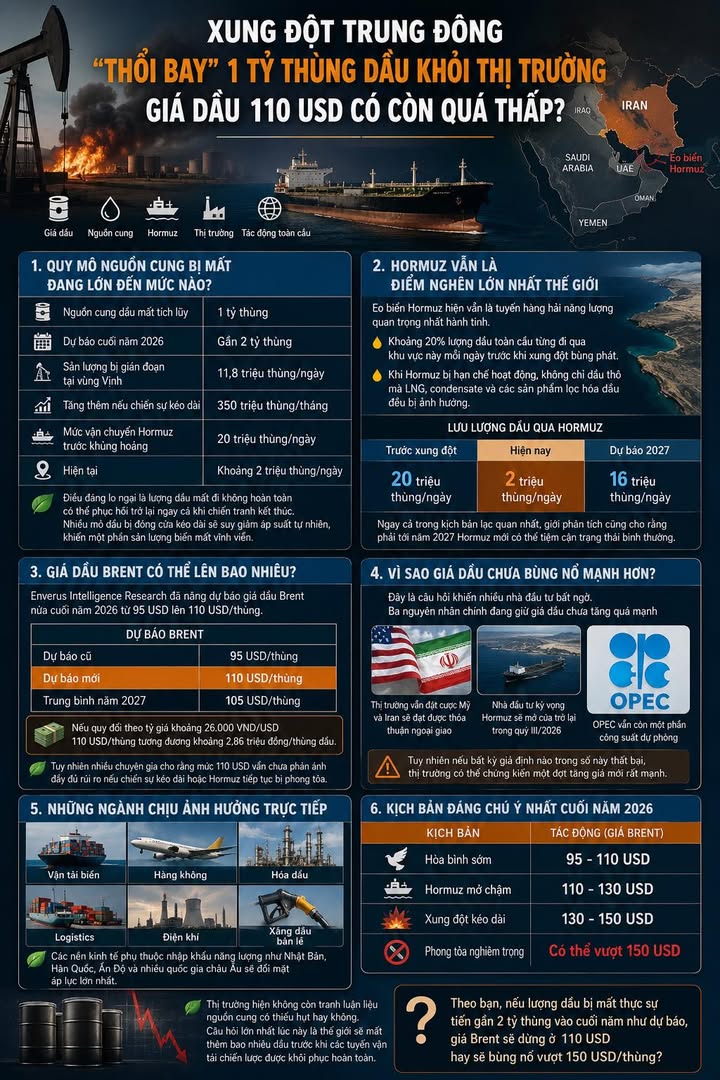
Global Oil Supply Depleted by 1 Billion Barrels Amid Middle East Conflict - Is $110 Oil Still Too Conservative?
Unprecedented Disruption to Global Energy Markets
At 8:01 AM on June 14, 2026, a series of reports from Rystad Energy, Enverus Intelligence Research, Standard Chartered, and the U.S. Energy Information Administration (EIA) issued significant warnings about the global oil market.
According to Aditya Saraswat, Middle East and North Africa Research Director at Rystad Energy, the conflict in the Middle East has caused the global oil market to lose approximately 1 billion barrels of accumulated supply within just three months.
This figure represents about 2.5 times the total remaining oil in the U.S. Strategic Petroleum Reserve.
| Supply Impact Statistics | |
|---|---|
| Current accumulated lost supply | 1 billion barrels |
| Forecast by end of 2026 | Nearly 2 billion barrels |
| Currently disrupted production | 11.8 million barrels/day |
| Countries directly affected | 6 Gulf nations |
| Additional monthly loss | 350 million barrels |
| Hormuz pre-conflict throughput | 20 million barrels/day |
| Hormuz current throughput | Approximately 2 million barrels/day |
According to Aditya Saraswat, each month of prolonged conflict will cause the market to lose an additional approximately 350 million barrels of accumulated oil.
Notably, he described this as the largest supply disruption in the modern history of the oil and gas industry.
The Critical Strait of Hormuz
One of the biggest factors lies in the Strait of Hormuz, the world's most important energy transportation route.
Before the conflict, approximately 20 million barrels of oil passed through Hormuz daily.
Currently, the flow is reduced to about 2 million barrels per day.
Rystad Energy's Supply Recovery Forecast
| Timeline | Regional Production |
|---|---|
| July 2026 | 10-15% recovery |
| August 2026 | 17.3 million barrels/day |
| September 2026 | 20.9 million barrels/day |
| October 2026 | 85% recovery |
| January 2027 | Near complete recovery |
However, experts caution that reopening Hormuz does not immediately restore supply. The lack of oil tankers, marine insurance, security risks, and damaged extraction infrastructure will extend the recovery process over many months.
Enverus Raises Brent Oil Price Forecast
Enverus Intelligence Research has revised its Brent oil price forecast for the second half of 2026 upward from around $95/barrel to $110/barrel.
At an exchange rate of approximately 26,000 VND/USD, Brent oil would be equivalent to about 2,860,000 VND/barrel.
| Brent Oil Price Scenarios | Value |
|---|---|
| Previous forecast | Approximately 2,470,000 VND/barrel |
| New forecast | Approximately 2,860,000 VND/barrel |
| 2027 annual average | Approximately 2,730,000 VND/barrel |
According to Al Salazar, Director of Enverus Intelligence Research, even if the U.S. and Iran reach a peace agreement in June 2026, restoring operations in Hormuz will still require many months.
He believes the market is entering a period of "prolonged high prices" rather than just a short-term shock.
Standard Chartered Warns of Permanent Losses
Emily Ashford, Head of Energy Research at Standard Chartered, suggests that not all lost oil production can be recovered.
| Supply Loss Category | Recovery Timeline |
|---|---|
| 30-40% of losses | Within several weeks |
| 80-90% of losses | After approximately 1 year |
| 10-20% of losses | Requires many years |
| Up to 10% of losses | May be permanent |
Ashford explains that some oil fields may experience pressure depletion, damaged extraction facilities, or reduced economic efficiency after prolonged shutdowns.
This is why global oil reserves are at risk of long-term depletion.
U.S. EIA Maintains Cautious Outlook
On June 9, 2026, the EIA released its Short-Term Energy Outlook report.
The agency forecasts that oil transport through Hormuz will only begin to recover in Q3 2026.
A return to pre-conflict levels is unlikely to be achieved before early 2027.
Industries Facing the Greatest Pressure
| Industry | Impact Level |
|---|---|
| Aviation | Very high |
| Sea transport | Very high |
| Petrochemicals | High |
| Electricity and gas | High |
| Logistics | High |
| Industrial manufacturing | Medium to high |
| Consumers | High |
When oil prices rise sharply, fuel transport, electricity, chemicals, and consumer goods prices typically increase with a lag of several weeks to months.
Market Analysis
The current oil market no longer reacts only to airstrikes or diplomatic statements between the U.S. and Iran.
More concerning is that global inventories are being depleted faster than supply can recover.
If Rystad Energy's scenario becomes a reality and the total lost supply approaches 2 billion barrels by the end of 2026, the global energy market could enter a prolonged shortage period not seen since major oil crises in modern history.