#MyIran #Hormuz #DonaldTrump #JDVance #HoaBinhTrungDong #GiaDau #NangLuong #TheGioi #TimKiemTop
If this agreement is truly fully implemented, could oil prices plummet tens of percent and change the entire world energy balance in just a few months?
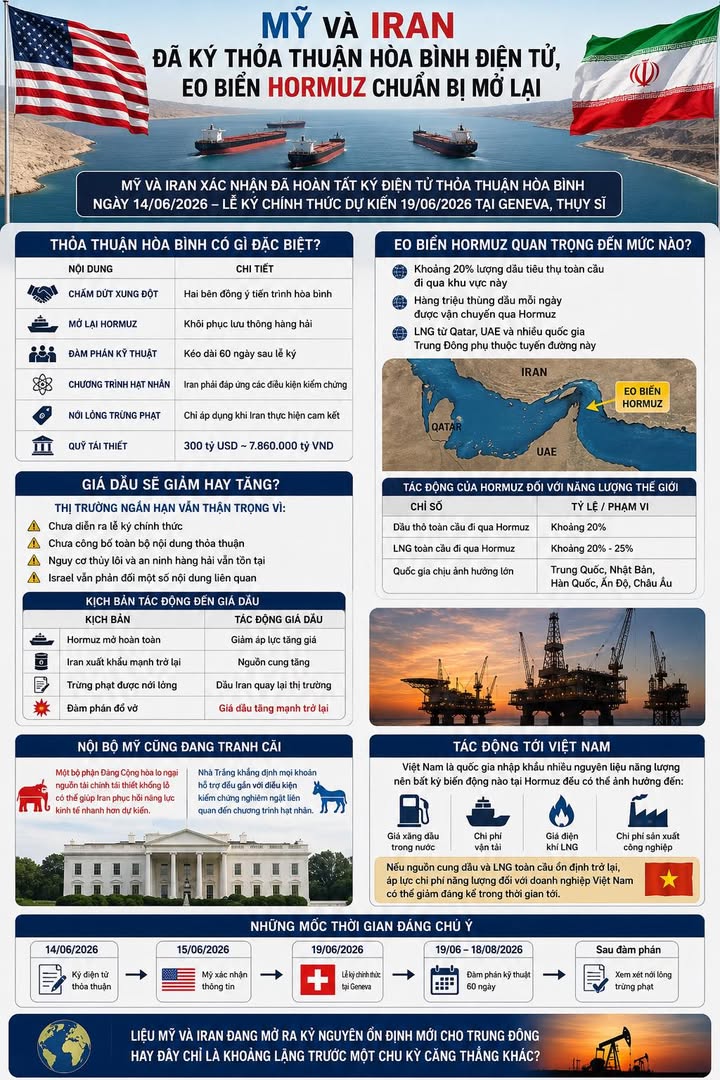
A major geopolitical turning point has just occurred when the US and Iran confirmed that they have completed the electronic signing of the peace agreement on June 14, 2026, before the official signing ceremony scheduled to take place on June 19, 2026 in Geneva, Switzerland.
The information announced by US Vice President JD Vance on US television quickly became a global focus because it was not only related to war, nuclear or diplomacy but also had a direct impact on the oil and gas market, shipping and the world economy.
What is special about the peace agreement?
According to published information, the US and Iran have agreed on basic principles to end the conflict and restore stability in the Middle East.
The main contents include:
Content Details
Ending the conflict Both sides agreed to the peace process
Reopen Hormuz Restore maritime traffic
Technical negotiations last 60 days after the signing ceremony
ChapterIran's nuclear program must meet verification conditions
Sanctions easing Only applies when Iran fulfills its commitments
The reconstruction fund is 300 billion USD, equivalent to about 7,860,000 billion VND
The most notable point is that Iran can access a reconstruction fund of up to about 7.86 million billion VND if it fully meets the conditions related to its nuclear program.
How important is the Strait of Hormuz?
Hormuz is considered the most strategic energy route on the planet.
About 20% of global oil consumption passes through this region
Millions of barrels of oil per day are transported through Hormuz
LNG from Qatar, UAE and many Middle Eastern countries depends on this route
Hormuz's impact on world energy
Ratio Index
About 20% of global crude oil passes through Hormuz
Global LNG passes through Hormuz About 20% - 25%
Countries heavily influenced by China, Japan, Korea, India, and Europe
The return of this transportation route to normal operation is considered the most positive signal for the energy market since the beginning of 2026.
Will oil prices decrease or increase?
This is the question that investors are most interested in.
In the short term, the market is still cautious because
✔ The official signing ceremony has not yet taken place
✔ Not announced yetentire content of the agreement
✔ The risk of mines and maritime security still exists
✔ Israel still objects to some related content
However, in the medium and long term, if the agreement is successfully implemented, the pressure to increase oil prices can be significantly reduced.
Oil price impact scenario
Hormuz fully open Reduces upward price pressure
Iran's strong exports return. Supply increases
Sanctions are eased. Iranian oil returns to the market
Negotiations broke down and oil prices increased sharply again
There is also debate within the US
Although considered a great diplomatic success of the Donald Trump administration, this agreement is creating fierce debate within the US.
A segment of Republican politicians worry that huge amounts of reconstruction finance could help Iran restore its economic capacity faster than expected.
Meanwhile, the White House affirms that all support is tied to strict verification conditions related to the nuclear program.
Impact on Vietnam
Vietnam is a country that imports a lot of energy materials, so any fluctuations in Hormuz could affect
Domestic gasoline prices
Transportation costs
LNG electricity price
Industrial production costs
If global oil and LNG supplies stabilize again, pressure cEnergy costs for Vietnamese businesses can be significantly reduced in the near future.
Notable timelines
Event Time
June 14, 2026 Electronically sign the agreement
June 15, 2026 The US confirmed the information
June 19, 2026 Official signing ceremony in Geneva
June 19 - August 18, 2026 60-day technical negotiation
After negotiations Consider easing sanctions
A peace deal could change the global energy landscape, but the biggest question remains open.
Are the US and Iran ushering in a new era of stability for the Middle East or is this just a lull before another cycle of tension?
#USIran #Hormuz #OilPrice #CrudeOil #LNG #DonaldTrump #JDVance #Iran #China #Energy #WorldEconomy #TimKiemTop #HotNews #World #Geopolitics