The Mysterious Journey of Petroleum Underground: Why Some Discoveries Yield Billions While Others Find Nothing
If petroleum is generated in numerous locations beneath the Earth's surface, why do only a tiny fraction accumulate into massive oil fields capable of generating hundreds of trillions of dollars in revenue?
On June 17, 2026, the international petroleum geology community continued to share and discuss one of the most important concepts in the energy industry: the migration process of hydrocarbons from source rock to reservoir trap. This is considered the key determinant of success or failure for billions of dollars in exploration investments worldwide.
Many people believe that as long as there is oil underground, it can be extracted. The reality is completely different.
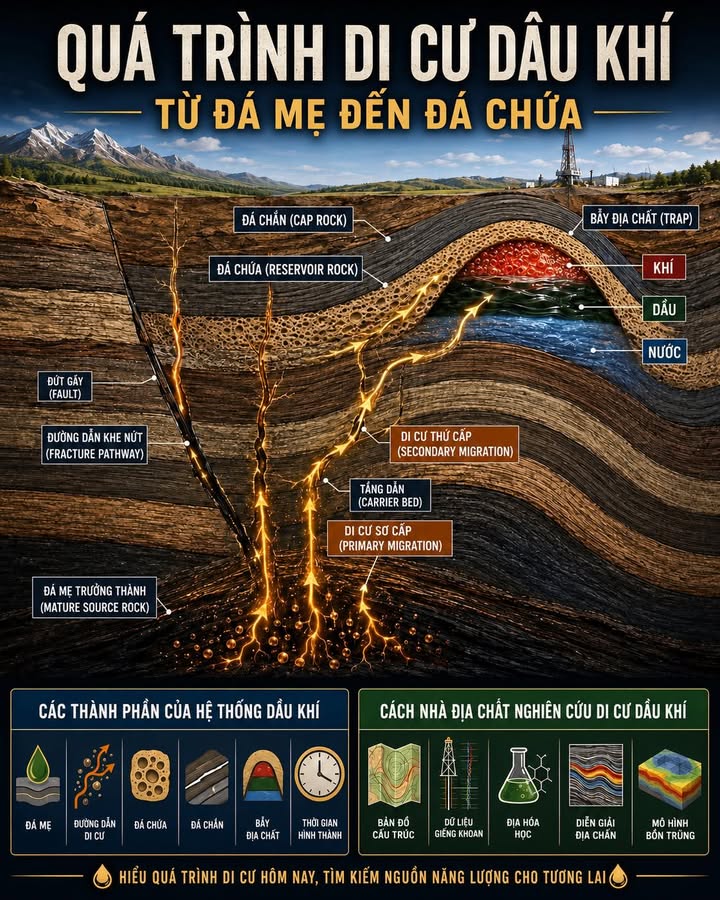
Oil and natural gas are typically generated in organic-rich source rocks located thousands of meters beneath the Earth's surface. After millions of years of temperature and pressure effects, hydrocarbons begin to form and find their way upward.
Without suitable geological conditions, these hydrocarbons would completely escape into the natural environment.
Components of a Successful Petroleum System
| Component | Role |
|---|---|
| Source Rock | Where hydrocarbons are generated |
| Migration Pathways | Allow hydrocarbons to move |
| Reservoir Rock | Stores hydrocarbons |
| Seal Rock | Prevents hydrocarbons from escaping |
| Geological Trap | Concentrates hydrocarbons into a commercial accumulation |
| Timing | Determines accumulation potential |
If even one component is missing, the entire petroleum system can fail.
The Journey of a Single Drop of Oil: Tens of Millions of Years
Stage 1: Generation
Hydrocarbons are generated within mature source rocks deep underground.
Stage 2: Expulsion
Hydrocarbons escape from the source rock through micro-fractures.
Stage 3: Migration
Hydrocarbons continue moving along faults and carrier beds.
Stage 4: Entrapment
When encountering an impermeable seal rock, hydrocarbons are trapped beneath it.
Stage 5: Accumulation
Formation of geological traps and accumulation into commercial oil and gas fields.
Structure of a Typical Oil Reservoir
Due to differences in density, hydrocarbons in a reservoir arrange themselves in distinct layers:
| Component | Position | Reason |
|---|---|---|
| Natural Gas | Top Layer | Lightest hydrocarbon |
| Crude Oil | Middle Layer | Denser than gas but less dense than water |
| Formation Water | Bottom Layer | Densest component |
Why Oil Companies Spend Trillions on Seismic Surveys
A modern offshore well can cost anywhere from 1 trillion to over 5 trillion Vietnamese Dong (approximately $40-200 million USD) depending on the region.
Pre-drilling 3D seismic surveys often cost hundreds of billions of Vietnamese Dong (approximately $10-40 million USD).
The objective is to accurately determine the following factors:
| Survey Item | Significance |
|---|---|
| Structural Traps | Identify accumulation locations |
| Faults | Check migration pathways |
| Reservoir Rocks | Evaluate storage capacity |
| Seal Rocks | Assess seal integrity |
| Basin Modeling | Predict petroleum potential |
Famous Oil Fields Formed Through Hydrocarbon Migration
| Oil Field | Location |
|---|---|
| Ghawar | Saudi Arabia |
| Burgan | Kuwait |
| Rumaila | Iraq |
| Prudhoe Bay | United States |
| White Tiger (Bạch Hổ) | Vietnam |
These fields all share the common characteristic of having complete source rocks, migration pathways, reservoir rocks, seal rocks, and geological traps within the same petroleum system.
The Enormous Economic Value of a Successful Petroleum System
Consider a field with recoverable reserves of 500 million barrels of oil.
If Brent crude oil prices are approximately 2,470,000 Vietnamese Dong per barrel, the total value of the recoverable oil could be:
| Calculation | Result |
|---|---|
| 500,000,000 barrels × 2,470,000 VND/barrel | 1,235,000,000,000,000 VND |
Equivalent to approximately 1.235 quadrillion Vietnamese Dong in theoretical revenue before deducting production, operating costs, and taxes.
This is why corporations like ExxonMobil, Chevron, Shell, BP, TotalEnergies, Saudi Aramco, and PetroVietnam always heavily invest in geological research and basin modeling.
Conclusion
The story of hydrocarbon migration demonstrates that petroleum is not merely a resource lying underground. It is the result of tens of millions of years of geological movement, where even a slight deviation in formation time or stratigraphic structure can cause the entire system to fail.
A billion-dollar oil field doesn't begin with the drill bit; it begins with understanding the mysterious journey of each hydrocarbon molecule beneath the Earth's surface.