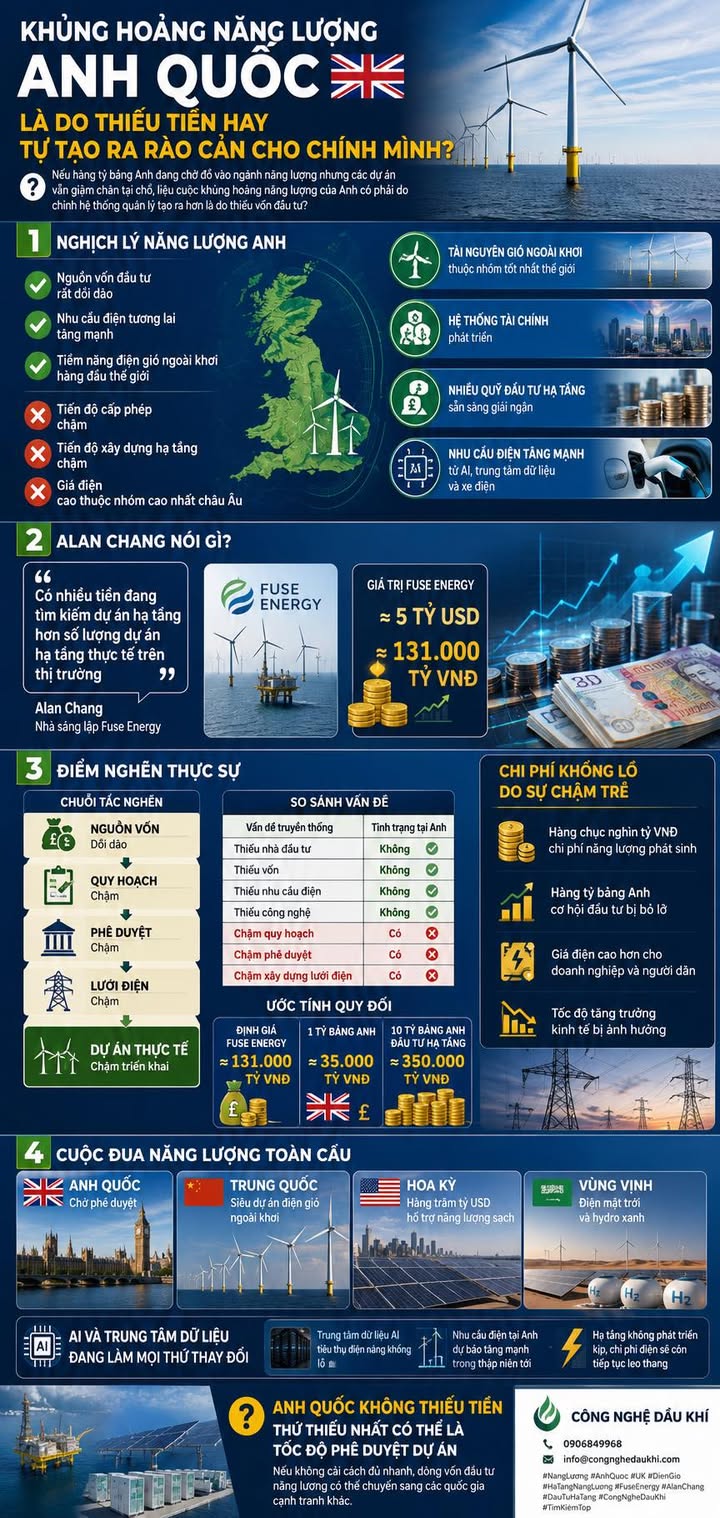
UK Energy Crisis: Lack of Funding or Self-Imposed Barriers?
In a striking paradox for the United Kingdom's energy sector, billions of pounds are waiting to be invested yet projects remain stalled. As electricity prices in the UK continue to rank among the highest in Europe and pressure mounts to ensure energy security, a provocative perspective has emerged from Alan Chang, founder of Fuse Energy, an energy company valued at approximately $5 billion (around 131,000 billion VND).
According to Alan Chang, the primary difficulties facing the UK's energy sector today do not stem from a lack of money or investors. Instead, the market has an abundance of capital seeking opportunities but insufficient approved projects to deploy this funding. He describes this as a "self-created bottleneck" that is slowing economic growth and hindering the energy transition.
The Paradoxical State of UK Energy
| Factor | Current Status |
|---|---|
| Investment Capital | Abundant |
| Future Electricity Demand | Strongly Increasing |
| Offshore Wind Potential | World-Class |
| Permitting Progress | Slow |
| Infrastructure Development | Slow |
| Electricity Prices | High |
Notably, the UK currently possesses numerous advantages that many other countries desire:
- Some of the world's best offshore wind resources
- A well-developed financial system
- Many infrastructure investment funds ready to deploy capital
- Strong growth in electricity demand from AI, data centers, and electric vehicles
Despite these advantages, numerous projects still wait years to complete administrative procedures.
Capital Awaiting, Projects Unable to Launch
Alan Chang observes:
"There is currently more capital seeking infrastructure projects than there are actual infrastructure projects available in the market."
This creates a rare paradox. Typically, countries struggle with a lack of investment capital. In the UK's case, capital is available, but administrative procedures, planning, and approval processes have become the bottleneck.
| Traditional Challenges | UK's Situation |
|---|---|
| Lack of investors | No |
| Lack of capital | No |
| Lack of electricity demand | No |
| Lack of technology | No |
| Slow planning | Yes |
| Slow approvals | Yes |
| Slow grid construction | Yes |
Exorbitant Costs of Delays
Each year of delay for wind, solar, and transmission infrastructure projects results in:
- Tens of billions of VND in additional energy costs
- Billions of pounds in missed investment opportunities
- Higher electricity prices for businesses and consumers
- Impacted economic growth rates
Estimated conversions:
| Item | Value |
|---|---|
| Fuse Energy valuation | Approximately 131,000 billion VND |
| 1 billion GBP | Approximately 35,000 billion VND |
| 10 billion GBP in infrastructure investment | Approximately 350,000 billion VND |
The Global Energy Race Accelerates
While the UK struggles with approval processes, other countries are accelerating their energy investments:
- China continuously constructing massive offshore wind projects
- United States implementing programs with hundreds of billions in support for clean energy
- Gulf countries using oil and gas revenues to heavily invest in solar power and green hydrogen
This creates significant pressure on the UK if it wishes to maintain its position as Europe's financial and technology hub.
AI and Data Centers Are Changing the Equation
A new factor rapidly increasing electricity demand is the explosion of artificial intelligence. AI data centers consume enormous amounts of electricity. Many experts forecast that electricity demand in the UK could surge dramatically in the coming decade as numerous AI and cloud computing projects are implemented. If energy infrastructure doesn't develop quickly enough, electricity costs may continue to escalate.
Alan Chang's Perspective
The message from Fuse Energy's founder is quite clear:
The UK does not lack capital. It does not lack technology. It does lack demand. What is missing is a planning and permitting system fast enough to turn potential into actual projects.
If this bottleneck is removed, hundreds of billions of VND in investment capital could quickly be deployed into offshore wind, solar energy, energy storage, and new grid infrastructure.
The major question now is whether the UK can reform quickly enough to capitalize on the wave of energy investment waiting on the sidelines, or if it will continue to let these opportunities flow to competing nations.