Amending Vietnam's Petroleum Law: Transition from Control to Development-Oriented Approach
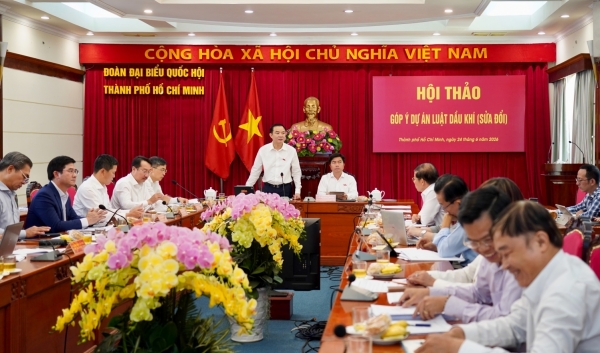
The amendment of Vietnam's Petroleum Law is poised to create a significant paradigm shift, transitioning from a control-oriented mindset to a development-oriented institutional framework aimed at promoting effective and sustainable development of the country's oil and gas sector. This represents the core message discussed at the seminar on the draft amended Petroleum Law held on June 24 in Ho Chi Minh City.
Seminar on Draft Amended Petroleum Law
Organized by the National Assembly Delegation of Ho Chi Minh City in collaboration with the Vietnam National Oil and Gas Group (Petrovietnam), the seminar brought together numerous National Assembly delegates, policymakers, and industry experts. The event took place against the backdrop of new challenges facing Vietnam's oil and gas sector from the international context and domestic energy development needs.
Mr. Nguyen Huu Dung, Deputy Head of the National Assembly Delegation of Ho Chi Minh City, emphasized: "Amending the Petroleum Law is not merely a legal adjustment but an opportunity to change our management philosophy and create a favorable environment for oil and gas activities in this new phase."
Shift in Management Philosophy
At the seminar, many opinions expressed that the oil and gas sector needs a strong transition from a control-oriented approach to a development-oriented mindset. According to experts, the previous control-based approach has created unnecessary barriers, slowing down project implementation and reducing operational efficiency in the sector.
| Comparison of Two Oil and Gas Management Philosophies | |
|---|---|
| Control-Oriented Approach | Development-Oriented Approach |
| Focused on strict management | Focused on creating favorable environment |
| Complex and overlapping regulations | Simplified administrative procedures |
| Extended project approval timeline | Accelerated project implementation |
| Reduced corporate autonomy | Enhanced proactive role of enterprises |
Expert Opinions
Dr. Nguyen Dinh Trung, an energy expert, stated: "The oil and gas sector needs a flexible legal framework capable of adapting to market and technological changes. Shifting to a development-oriented approach will help Vietnam's oil and gas sector better leverage its potential."
Ms. Tran Thi Thu Trang, representing a private oil and gas enterprise, shared: "We hope the amended Petroleum Law will create a level playing field with transparency among different economic components, while also encouraging investment in high-tech and renewable energy sectors."
Key Content of Proposed Amendments
According to the draft amended Petroleum Law, key proposed content includes:
- Legal Spirit: Clearly defining the State's role in creating a favorable environment for oil and gas activities.
- Development Planning: Building flexible planning capabilities that can be adjusted according to actual situations and market demands.
- Cooperation Mechanisms: Expanding cooperation space with foreign partners, especially in high-tech sectors.
- Sustainable Development: Strengthening regulations on environmental protection and efficient resource utilization.
- Energy Security: Ensuring national energy security in the new context.
Petroleum Cooperation Issues
One of the most discussed topics at the seminar was petroleum cooperation mechanisms. According to delegates, the amended Petroleum Law needs to create a flexible legal framework to attract foreign investment while protecting national interests.
Mr. Le Manh Hung, Chairman of the Board of Directors of Petrovietnam, emphasized: "We propose that the amended Petroleum Law should have special mechanisms for new oil and gas exploration and exploitation projects, especially those in deep-water and offshore areas. At the same time, there should be policies encouraging investment in high technology and energy transition."
Impact on Vietnam's Oil and Gas Sector
The amendment of the Petroleum Law with a development-oriented approach is expected to bring many positive impacts to Vietnam's oil and gas sector:
- Accelerated Project Implementation: Reducing approval time and creating favorable conditions for oil and gas activities.
- Expanded Development Space: Creating opportunities for enterprises to participate in the oil and gas value chain.
- Enhanced Operational Efficiency: Increasing autonomy and competitiveness of oil and gas enterprises.
- Foreign Investment Attraction: Creating an attractive legal environment for strategic investors.
- Energy Transition Promotion: Establishing a legal basis for renewable energy development within the oil and gas sector.
Conclusion and Future Outlook
The seminar on the draft amended Petroleum Law received many practical contributions, reflecting consensus on the transition from a control-oriented to a development-oriented mindset. This is considered an important step for Vietnam's oil and gas sector to adapt to new contexts and develop sustainably.
According to the plan, the draft amended Petroleum Law will be submitted to the National Assembly for consideration and adoption at the 7th session of the 15th National Assembly. The completion and issuance of the amended Petroleum Law with a development-oriented spirit will open a new phase for Vietnam's oil and gas sector, contributing to the country's socio-economic development.
Mr. Nguyen Van Nen, Secretary of the Ho Chi Minh City Party Committee, affirmed: "Ho Chi Minh City will actively contribute opinions to build a Petroleum Law suitable with practical conditions, creating momentum for the oil and gas sector to develop and contribute to the country's overall development."