Bach Ho Oil Field: Vietnam's Energy Legacy and Future Challenges
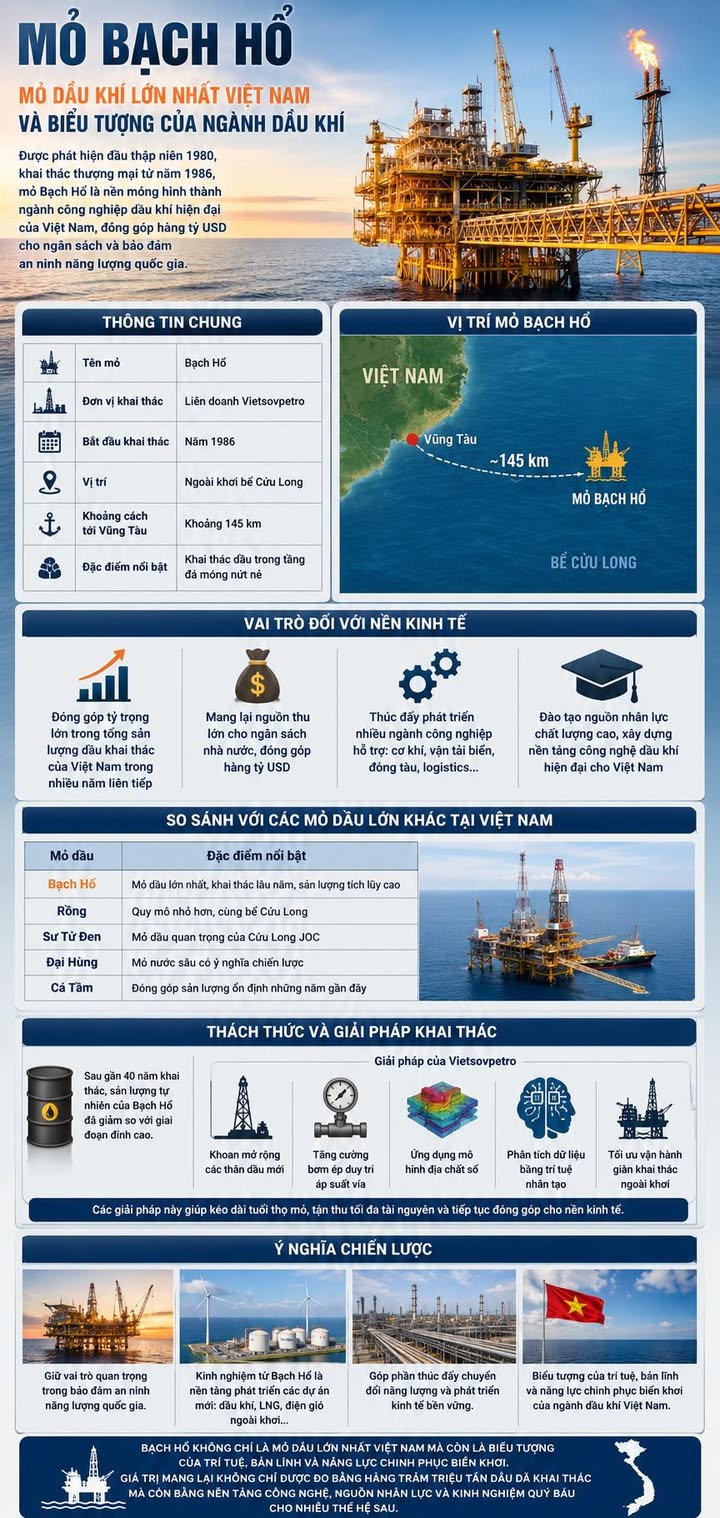
For nearly four decades, the Bach Ho (White Tiger) oil field has stood as a towering symbol of Vietnam's oil and gas industry, maintaining its position as the country's largest oil and gas field in terms of production scale. Beyond its economic significance, Bach Ho represents the foundation upon which Vietnam's modern oil and gas industry was built, contributing billions of dollars to the national budget and ensuring energy security for the nation.
Historical Background and Development
Discovered in the early 1980s and commencing commercial production in 1986, the Bach Ho oil field is located in the offshore Cuu Long (Mekong) Basin, approximately 145 kilometers from Vung Tau city. This landmark project emerged as a joint venture between Petrovietnam and the Vietsovpetro consortium, quickly establishing itself as one of the most successful oil and gas ventures in Southeast Asia.
The field's development coincided with a critical period in Vietnam's economic history, occurring during the country's Đổi Mới (Renovation) economic reforms. At a time when Vietnam was opening up to international cooperation and seeking to develop its natural resources, Bach Ho provided the much-needed capital and technological foundation for the nation's industrial development.
Technical Breakthrough: Redefining Petroleum Geology
One of the most remarkable aspects of Bach Ho's legacy is its contribution to global petroleum geology. The field gained international recognition for successfully extracting oil from fractured basement rock formations. Prior to this achievement, many international experts considered basement rock virtually incapable of containing commercially viable oil deposits.
This breakthrough fundamentally changed global perceptions of petroleum geology and opened new possibilities for exploration in previously overlooked geological formations. The success of Bach Ho demonstrated that with advanced technology and innovative approaches, unconventional reservoirs could become significant contributors to global energy supplies.
Economic Impact and Industrial Development
For many consecutive years, production from Bach Ho constituted a substantial portion of Vietnam's total oil output, serving as a primary revenue source for the national budget. The field's economic contributions extended far beyond direct hydrocarbon revenues, catalyzing the development of numerous supporting industries.
The establishment and operation of Bach Ho spurred growth in sectors such as mechanical manufacturing, maritime transportation, shipbuilding, logistics, offshore engineering, and the development of highly skilled human resources. These industries formed an ecosystem that continues to support Vietnam's energy sector and broader industrial base.
Statistical Overview of Bach Ho
| Parameter | Information |
|---|---|
| Field Name | Bach Ho (White Tiger) |
| Operator | Vietsovpetro Joint Venture |
| Commencement of Production | 1986 |
| Location | Offshore Cuu Long Basin |
| Distance from Vung Tau | Approximately 145 km |
| Notable Feature | Oil extraction from fractured basement rock |
Comparative Analysis with Vietnam's Other Major Oil Fields
While numerous new oil fields have been brought into production in Vietnam, none have surpassed Bach Ho in terms of historical significance or cumulative production volume. The following table compares Bach Ho with other major oil fields in Vietnam:
| Oil Field | Key Characteristics |
|---|---|
| Bach Ho | Largest oil field, longest production history, highest cumulative production |
| Rong (Dragon) | Smaller scale, located in the same Cuu Long Basin |
| Su Den (Black Lion) | Important field operated by Cuu Long Joint Operating Company (CLJOC) |
| Dai Hung (Great Bear) | Strategically significant deepwater field |
| Ca Nguon (Source) | Stable production contributor in recent years |
Current Challenges and Technological Solutions
After nearly four decades of production, Bach Ho's natural flow rate has declined from its peak levels. To maintain operational efficiency and extend the field's lifespan, Vietsovpetro has implemented a range of advanced technical solutions:
- Drilling and developing new oil reservoirs
- Enhancing water injection to maintain reservoir pressure
- Implementing digital geological modeling
- Leveraging artificial intelligence for data analysis
- Optimizing offshore production platform operations
These technological interventions have successfully extended the field's productive life and maximized resource recovery. The experience gained from implementing these solutions has created valuable technical expertise that can be applied to other mature fields and new development projects.
Technological Evolution at Bach Ho
The field's operational history reflects the evolution of petroleum engineering technology. From conventional extraction methods in the early years to the implementation of digital twins, AI-driven reservoir management, and advanced subsea systems in recent years, Bach Ho has continuously adapted to technological advancements. This evolution has not only extended the field's life but has also positioned Vietnam's oil and gas sector as technologically capable in the global context.
Strategic Importance in the Energy Transition Era
In the context of rising global energy demand and accelerating energy transition, Bach Ho continues to play a crucial role in Vietnam's energy security. At the same time, the experience accumulated from this project serves as a foundation for Vietnam to develop new ventures in liquefied natural gas (LNG), offshore wind power, and other modern energy sectors.
The field's significance extends beyond its hydrocarbon production. It represents a symbol of Vietnamese ingenuity, resilience, and capability in conquering offshore challenges. The value generated by Bach Ho cannot be measured solely in the hundreds of millions of tons of oil produced but also in the technological foundation, skilled workforce, and invaluable experience it has provided for generations of Vietnamese energy professionals.
Energy Security and Geopolitical Context
Located in the South China Sea (Bien Dong), Bach Ho operates in a region of complex geopolitical dynamics. The field's continued operation underscores Vietnam's commitment to developing its resources while maintaining diplomatic relations with international partners. As energy security becomes increasingly intertwined with national security, Bach Ho's role in Vietnam's strategic planning remains paramount, even as the country explores renewable energy alternatives.
Future Outlook and Conclusion
As Vietnam progresses toward its net-zero emissions goals, the role of traditional oil fields like Bach Ho will inevitably evolve. While the field will continue to contribute to Vietnam's energy mix for the foreseeable future, its greatest legacy may be the technological expertise and industrial capabilities it has developed.
The transition to a diversified energy portfolio presents both challenges and opportunities. Vietnam's experience with Bach Ho provides a solid foundation for developing new energy projects while maintaining energy security during the transition. The field's operational history demonstrates the importance of technological innovation, human resource development, and international cooperation in managing natural resources effectively.
Ultimately, Bach Ho stands as more than just an oil field—it represents a chapter in Vietnam's journey toward energy independence and industrial self-sufficiency. As the country navigates the complexities of the global energy transition, the lessons learned from decades of operating this remarkable field will continue to inform Vietnam's energy strategy for generations to come.