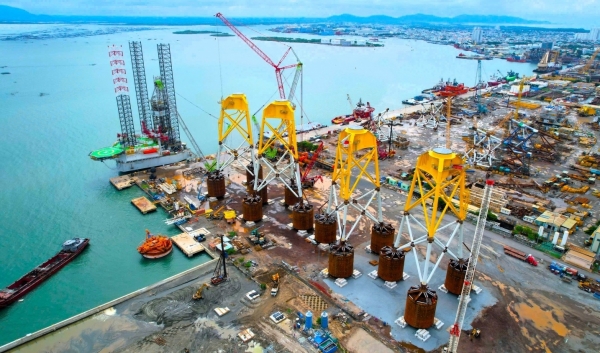
Exploring New Development Frontiers from the Sea: Petrovietnam's Mission
In the context of global energy transition, maritime space is emerging as a new strategic development area where oil and gas, offshore wind power, LNG, green hydrogen, and CCS converge. With its long coastline and well-established oil and gas industrial foundation, Vietnam has the opportunity to form a new marine economic growth pole. In this landscape, the Vietnam National Oil and Gas Group (Petrovietnam) is expected to play a central role in ensuring energy security and leading the development of a sustainable ecosystem.
Global Energy Transition and Maritime Opportunities
The world is entering a phase of profound energy transition, moving toward the goal of carbon neutrality by 2050. In this context, marine-based energy sources are receiving significant attention as a strategic direction. Beyond providing traditional oil and gas, the ocean also offers tremendous potential from renewable energy sources such as offshore wind, green hydrogen, and industrial solutions like CCS (Carbon Capture and Storage).
With a coastline stretching over 3,260 km and an extensive exclusive economic zone, Vietnam is recognized as one of the countries with the highest potential for marine economic development in the region. The combination of a long-developed oil and gas industrial base and favorable natural conditions has created a competitive advantage for Vietnam in the global energy transition race.
The Central Role of Petrovietnam
With over 60 years of formation and development, Petrovietnam has established its position as the leading enterprise in Vietnam's oil and gas and energy sectors. In this new context, Petrovietnam is expected to continue playing a central role in leading the country's marine economic development ecosystem.
Mr. Le Manh Hung, Chairman of the Board of Directors of Petrovietnam, emphasized: "We identify the sea not only as a traditional development space but also as the future of the energy industry. Petrovietnam is committed to sustainable development while ensuring national energy security, contributing to Vietnam's goal of sustainable marine economic development."
Strategic Development Areas
1. Traditional Oil and Gas Transition
Oil and gas will remain a cornerstone in Petrovietnam's development strategy in the coming period. However, the corporation is strongly transitioning toward exploiting natural gas fields to meet the growing demand for clean energy and industrial raw materials.
According to plan, Petrovietnam will focus on gas exploitation from projects such as Nam Con Son, Moc Son, and especially the B-O Mon block with gas reserves expected to reach hundreds of billions of cubic meters. These gas sources will not only serve power generation but also serve as crucial raw materials for chemical, fertilizer, and liquefied natural gas (LNG) industries.
2. Offshore Wind Power
Vietnam has offshore wind potential reaching up to 475 GW, with technical potential of approximately 160 GW. This is a sector where Petrovietnam is making substantial investments, with the goal of becoming one of the leading offshore wind developers in the region.
To date, Petrovietnam has implemented numerous large-scale offshore wind projects with a total registered capacity of several thousand MW. Notably, the Quy Nhon offshore wind power project (Binh Dinh) with a capacity of 3,400 MW is expected to become the largest offshore wind project in Southeast Asia upon completion.
3. LNG and Liquefied Natural Gas
LNG (Liquefied Natural Gas) is becoming a crucial energy source in the transition from coal to natural gas. Petrovietnam has identified LNG as one of its strategic pillars for the future, with plans to build LNG centers across the country.
The corporation is accelerating progress on LNG projects such as Cai Mep - Thi Vai, Soc Trang, and especially the Long Son LNG project with total investment of $2 billion. Upon completion, these projects will help diversify energy supply sources and ensure national energy security.
4. Green Hydrogen
Green hydrogen is considered the future of the global energy industry. With abundant renewable energy resources, Vietnam has the opportunity to become one of the leading green hydrogen production centers in the region.
Petrovietnam is researching and implementing pilot green hydrogen production projects using renewable energy. Notably, the green hydrogen production project at Nghi Son (Thanh Hoa) with a capacity of 100,000 tons/year is expected to become operational between 2025-2030, opening new directions for Vietnam's energy sector.
5. Carbon Capture and Storage (CCS) Technology
CCS technology is emerging as an important solution to reduce carbon emissions in heavy industries. Petrovietnam is studying the implementation of CCS projects at key industrial zones such as Dung Quat, Nghi Son, and Vung Ang.
According to plan, Petrovietnam's first CCS projects will be implemented at natural gas-fired power plants and oil refineries, targeting a 50-70% reduction in CO2 emissions. This is not only an environmental protection solution but also creates new opportunities for the green carbon industry.
Prospects and Challenges
Petrovietnam and Vietnam's marine economic development strategy face significant opportunities. According to experts, if effectively implemented, the marine economy could contribute 10-15% of Vietnam's GDP by 2030, create hundreds of thousands of jobs, and promote supporting industries.
However, challenges are not insignificant. Key issues to address include:
- Large investment capital for marine energy projects
- Technical infrastructure and logistics preparation
- Development of high-quality human resources
- Establishment of appropriate legal frameworks
- Ensuring maritime security, safety, and environmental protection
Development Strategy Until 2030
To realize this vision, Petrovietnam has outlined a development strategy until 2030 with specific targets:
| Sector | 2030 Targets |
|---|---|
| Oil and Gas | Maintain production of 15-17 million tons of oil equivalent/year |
| Offshore Wind Power | Achieve installed capacity of 5-7 GW |
| LNG | Build 2-3 LNG centers nationwide |
| Green Hydrogen | Produce 500,000 tons/year |
| CCS | Capture and process 10-15 million tons of CO2/year |
Conclusion
The maritime space is opening up a new development phase for Vietnam's energy industry, with Petrovietnam playing a central role in this transition. With advantages in geographical location, long-standing industrial foundation, and strategic vision, Petrovietnam has the opportunity to become one of the leading energy corporations in the region, making significant contributions to ensuring energy security and promoting sustainable marine economic development in Vietnam.
However, to realize this potential, coordination from multiple stakeholders is essential: from the government's macro policies, substantial investments from the private sector, and particularly innovation efforts from energy enterprises like Petrovietnam. Only then can Vietnam fully leverage opportunities from maritime space, turning challenges into drivers for development.
Keywords: #Petrovietnam #marine_economy #energy_transition #offshore_wind #LNG #green_hydrogen #CCS #energy_security