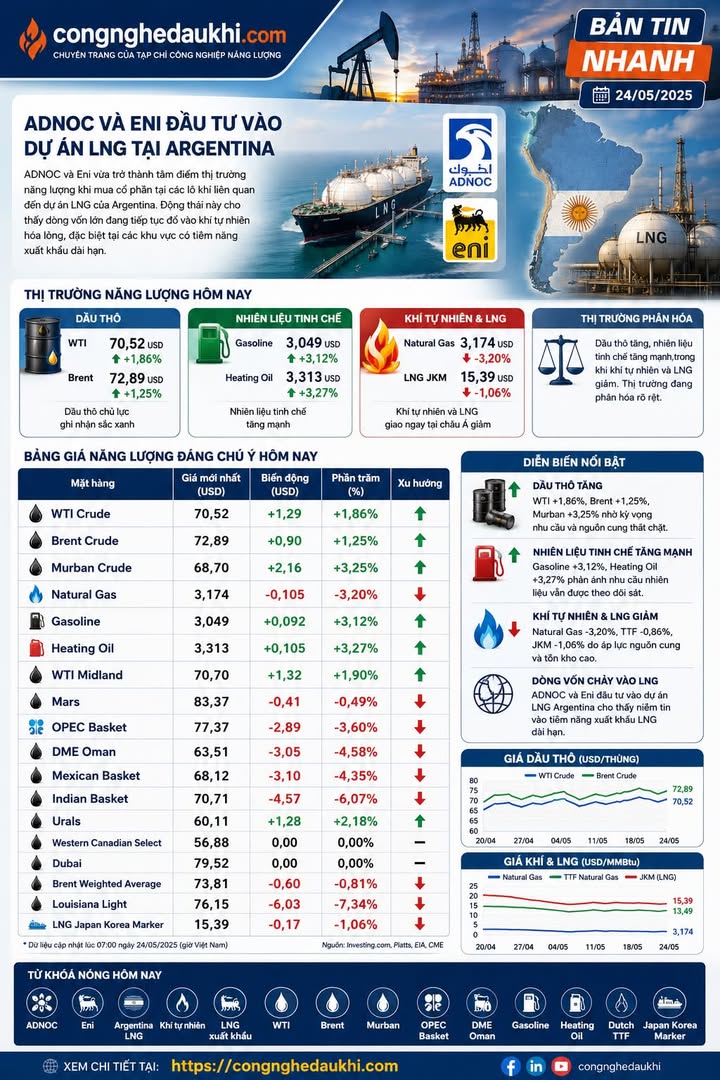
Global Energy Market Shows Divergent Trends as Major Players Invest in LNG Future
The global energy market continues to exhibit complex dynamics with contrasting movements across different commodity segments. While crude oil prices show strength, natural gas and spot LNG markets face downward pressure, creating a bifurcated landscape that reflects varying demand-supply fundamentals and regional market conditions.
Strategic Investments Highlight LNG's Long-Term Appeal
In a significant development underscoring the long-term confidence in liquefied natural gas (LNG), Abu Dhabi National Oil Company (ADNOC) and Italian energy major Eni have become central figures in the energy market through their acquisition of equity stakes in gas blocks related to Argentina's LNG project. This strategic move signals continued substantial capital flowing into the LNG sector, particularly in regions demonstrating long-term export potential.
The investment pattern indicates that while short-term market volatility persists, energy companies remain committed to developing LNG infrastructure that will serve global demand for decades to come. Argentina, with its vast unconventional gas resources, represents an emerging player in the global LNG export landscape, attracting interest from established industry players.
Crude Oil Market Shows Strength Across Benchmarks
The crude oil market demonstrated resilience today with notable gains across major benchmarks. West Texas Intermediate (WTI) crude rose to $70.52 per barrel, representing an increase of 1.86%. Similarly, Brent crude reached $72.89 per barrel, up 1.25% on the day.
Regional benchmarks also showed strong performance, with Murban Crude experiencing a significant jump of 3.25% to $68.70 per barrel. WTI Midland followed a similar trajectory, increasing 1.90% to reach $70.70 per barrel. These gains reflect ongoing market confidence in oil demand despite various economic uncertainties.
Refined Products Experience Notable Price Increases
The refined products segment saw significant price appreciation today, with gasoline and heating oil leading the upward trend. Gasoline prices climbed to $3.049 per gallon, marking a 3.12% increase. Heating oil followed suit, rising 3.27% to $3.313 per gallon.
The strength in refined product prices indicates robust demand in the transportation and heating sectors. Market participants continue to monitor consumption patterns closely, particularly as seasonal demand shifts and economic activity levels influence product requirements.
Natural Gas and Spot LNG Markets Face Downward Pressure
In contrast to the oil market, natural gas and spot LNG segments experienced price declines today. Henry Hub natural gas fell to $3.174 per MMBtu, a decrease of 3.20%. European benchmark Dutch TTF Natural Gas declined 0.86% to $13.49 per MMBtu, while the LNG Japan Korea Marker decreased 1.06% to $15.39 per MMBtu.
These movements suggest that despite strong long-term LNG investment fundamentals, the spot market continues to grapple with oversupply concerns and regional demand variations. The divergence between long-term LNG development trends and short-term spot price volatility remains a key characteristic of today's gas markets.
Energy Market Performance Summary
The following table provides a comprehensive overview of today's energy market performance across various commodities:
| Commodity | Latest Price (USD) | Change (USD) | Percentage Change (%) |
|---|---|---|---|
| WTI Crude | 70.52 | +1.29 | +1.86% |
| Brent Crude | 72.89 | +0.90 | +1.25% |
| Murban Crude | 68.70 | +2.16 | +3.25% |
| WTI Midland | 70.70 | +1.32 | +1.90% |
| Natural Gas | 3.174 | -0.105 | -3.20% |
| Gasoline | 3.049 | +0.092 | +3.12% |
| Heating Oil | 3.313 | +0.105 | +3.27% |
| OPEC Basket | 77.37 | -2.89 | -3.60% |
| LNG Japan Korea Marker | 15.39 | -0.17 | -1.06% |
Market Analysis: Divergent Trends Reflect Different Fundamentals
Today's energy market landscape reveals a clear differentiation between oil and gas segments. The strength in crude oil prices and refined products suggests positive market sentiment regarding near-term oil demand, potentially driven by seasonal factors and economic recovery indicators.
Concurrently, the downward pressure on natural gas and spot LNG prices indicates ongoing adjustments in the gas market, despite significant long-term investments in LNG infrastructure. This divergence highlights how different energy commodities are influenced by distinct supply-demand dynamics, regional factors, and time horizons.
The contrast between short-term spot market movements and long-term investment decisions in LNG projects underscores the complexity of today's energy transition. While the market may experience volatility in the near term, the continued strategic investments by major players like ADNOC and Eni suggest confidence in the long-term role of natural gas and LNG in the global energy mix.
Key Market Indicators to Watch
Energy market participants should continue monitoring several key indicators that may influence future price movements:
- Global economic activity and its impact on energy demand
- OPEC+ production policies and compliance levels
- Weather patterns affecting seasonal demand for heating and cooling
- Infrastructure developments in major LNG exporting regions
- Geopolitical factors affecting energy trade flows
- Environmental policies and their impact on fossil fuel demand
As the energy market continues to evolve, the divergent trends observed today between oil and gas segments may persist, reflecting the complex interplay of factors influencing different parts of the energy value chain.