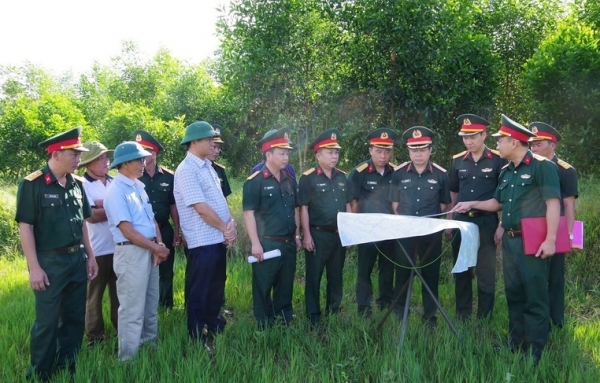
Military Region 4 Implements Advanced Technology in Search for Fallen Soldiers' Remains at Câu Nhi
Modern technology is increasingly being applied across various sectors, including in the crucial work of searching and collecting the remains of fallen soldiers. Recently, Military Region 4 conducted a field survey in the Câu Nhi area (Quảng Trị province) with the support of numerous advanced technologies aimed at locating the remains of soldiers from the historic battle of May 1972.
Historical Context and Significance of the Operation
The Câu Nhi area in Quảng Trị province witnessed fierce fighting by Battalion 6 of Regiment 88, Division 308 in May 1972. This was one of the significant battles during the Spring-Summer 1972 Campaign, contributing to the overall victory of the 1972 Spring General Offensive and Uprising.
Over time, multiple consistent sources have identified numerous locations potentially containing the remains of fallen soldiers in this area. The search and collection of these remains is not only an act of gratitude toward those who sacrificed their lives for the nation but also the responsibility of the current generation.
Technologies Employed in the Search Operation
To enhance the effectiveness of the search operation, Military Region 4 has implemented various modern technologies in the field survey at Câu Nhi:
- Global Positioning System (GPS): Used to accurately record search locations, create detailed maps, and track work progress.
- Modern Metal Detectors: Capable of detecting metallic objects underground at various depths, helping to identify areas that may contain remains.
- Geophysical Sensing Technology: Helps analyze soil and rock properties, detecting underground anomalies that could indicate mass graves or individual burial pits.
- Unmanned Aerial Vehicles (Drones): Utilized to survey terrain from above, facilitating more effective search planning and access to hard-to-reach areas.
- Data and Image Processing Systems: Enable analysis and synthesis of information from multiple sources, creating a comprehensive picture of the search area.
Professional Field Survey Process
The field survey process at Câu Nhi follows a professional workflow, combining traditional experience with modern technology:
| Phase | Key Activities | Technologies Applied |
|---|---|---|
| 1. Preparation | Collecting historical information, identifying potential search areas | |
| 2. Preliminary Survey | Evaluating terrain, identifying focus points for search | |
| 3. In-depth Search | Test excavation at suspected locations with remains | |
| 4. Verification and Processing | Analyzing samples, identifying remains, completing documentation |
Initial Survey Results
According to preliminary survey results, multiple locations suspected of containing fallen soldiers' remains have been identified in the Câu Nhi area. Surveyors have used modern technology to accurately record the geographical coordinates of these areas, providing a foundation for subsequent search operations.
Particularly, the geophysical sensing system has detected several underground anomalies in the area identified as Battalion 6's battlefield position. These signs likely indicate traces of mass graves or individual burial pits from the wartime period.
Significance of Technology Application
The application of advanced technology in the search for fallen soldiers' remains carries several important implications:
- Enhanced Search Efficiency: Technology enables the detection of areas containing remains with higher accuracy, reducing time and costs for search operations.
- Site Preservation: Non-invasive technologies like geophysical sensors allow assessment of areas without immediate excavation, preserving the integrity of historical sites.
- Effective Data Management: Information systems help store and analyze data from multiple search operations, providing a scientific basis for similar activities in the future.
- Tribute to Fallen Soldiers: Technology facilitates more accurate identification of information about fallen soldiers, contributing to better implementation of military family support policies.
Conclusion
Military Region 4's implementation of advanced technology in the search for fallen soldiers' remains at Câu Nhi demonstrates the development of science and technology serving humanitarian efforts. This represents not only a responsibility toward those who sacrificed their lives for the nation but also a way for the current generation to express deep gratitude to previous generations.
It is hoped that with the support of modern technology, the remains of more fallen soldiers will soon be discovered and brought to rest at martyrs' cemeteries, fulfilling the sacred duty of the current generation toward those who fell for the nation's independence and freedom.