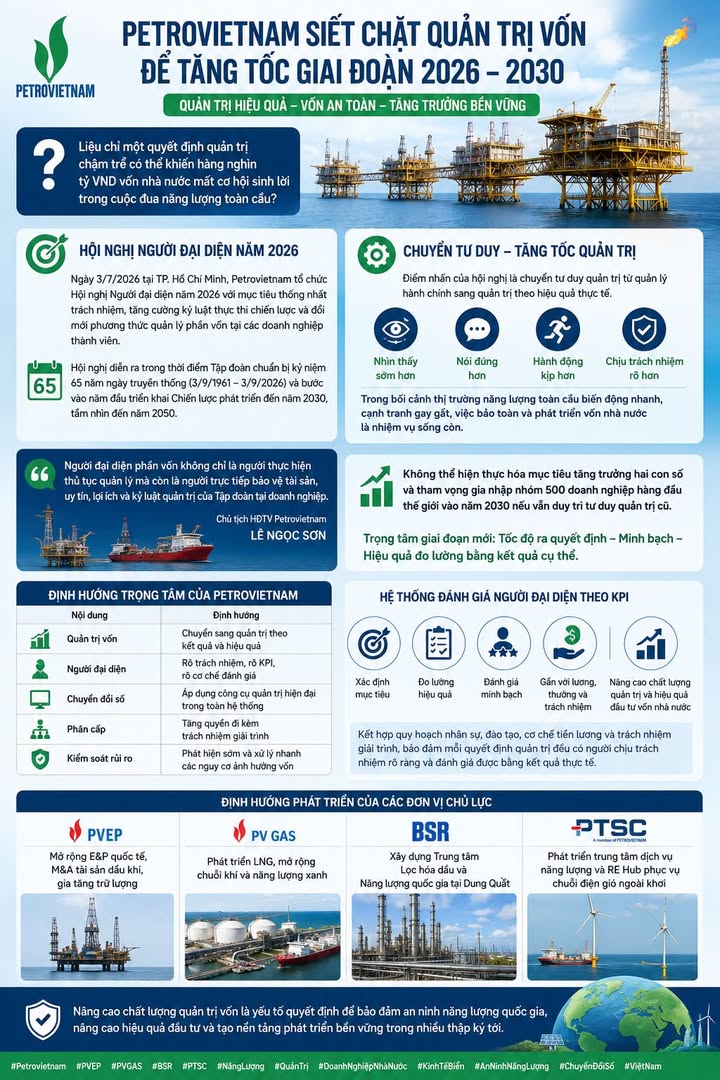
Petrovietnam Implements Governance Reforms to Accelerate Development Through 2030
In the rapidly evolving global energy landscape, Petrovietnam has undertaken significant governance reforms to ensure optimal utilization of state capital and enhance competitiveness. At a pivotal conference held on July 3, 2026, in Ho Chi Minh City, the state-owned energy conglomerate outlined its strategic direction for the 2026-2030 period, emphasizing a fundamental shift in corporate governance.
Shifting Paradigms: From Administrative Management to Performance-Based Governance
The conference, formally titled "Hội nghị Người đại diện năm 2026" (Representatives Conference 2026), marked a critical turning point in Petrovietnam's approach to managing its extensive portfolio of subsidiaries. With the conglomerate preparing to celebrate its 65th anniversary and embark on the first year of its development strategy through 2030—with a vision extending to 2050—leadership identified governance reform as essential for achieving ambitious growth targets.
"Could a delayed governance decision potentially cause trillions of Vietnamese đồng in state capital to miss profit opportunities in the global energy race?" This question framed the discussions at the conference, highlighting the high stakes involved in Petrovietnam's governance transformation.
Four Pillars of Effective Governance
Mr. Lê Ngọc Sơn, Chairman of Petrovietnam's Member Council, articulated a clear vision for the future of governance within the organization. He emphasized that representatives of state capital are not merely administrators but direct stewards of the corporation's assets, reputation, interests, and governance discipline.
The Chairman outlined four critical criteria that representatives must meet:
- See earlier: Anticipating market trends and potential risks
- Speak more accurately: Providing precise, data-driven assessments
- Act more timely: Making decisions promptly when opportunities arise
- Take clearer responsibility: Establishing unambiguous accountability frameworks
Strategic Imperatives for 2026-2030
Petrovietnam's leadership underscored that achieving double-digit growth and the ambitious goal of joining the world's top 500 companies by 2030 would be impossible without fundamental changes to governance thinking. The new approach prioritizes:
- Accelerating decision-making processes
- Enhancing transparency in all operations
- Measuring effectiveness through concrete results rather than administrative procedures
- Strengthening risk management systems
The conference highlighted the urgency of these reforms in the context of rapidly changing global energy markets, intensifying competition, and the growing importance of long-term commercial constraints in gas, electricity, and LNG supply chains.
Key Governance Reform Directions
The following table summarizes Petrovietnam's core governance reform priorities:
| Governance Area | Strategic Direction |
|---|---|
| Capital Governance | Transition to governance based on results and effectiveness |
| Representatives | Clear responsibilities, clear KPIs, clear evaluation mechanisms |
| Digital Transformation | Apply modern governance tools across the entire system |
| Delegation | Increase authority accompanied by accountability reporting |
| Risk Control | Early detection and rapid handling of risks affecting capital |
Building a Performance-Based Evaluation System
One of the most significant announcements at the conference was the establishment of a comprehensive Key Performance Indicator (KPI)-based evaluation system for representatives of state capital. This system will integrate personnel planning, training, salary mechanisms, and accountability frameworks.
This represents a substantial departure from traditional administrative evaluation methods, ensuring that every governance decision has clearly defined responsibility and can be assessed based on actual outcomes. The new system aims to create a direct link between governance actions and measurable results, creating a culture of accountability and performance throughout Petrovietnam's ecosystem.
Strategic Directions for Key Subsidiaries
The conference featured strategic presentations from Petrovietnam's principal subsidiaries, each outlining ambitious plans aligned with the parent company's overall vision:
Petrovietnam Exploration and Production Corporation (PVEP)
PVEP is focusing on expanding international exploration and production activities, pursuing mergers and acquisitions of cash-flow-generating oil and gas assets, and increasing reserves. The company aims to strengthen its position in global upstream operations while maintaining a strong portfolio of domestic assets.
Petrovietnam Gas Corporation (PV GAS)
PV GAS is prioritizing the development of its gas and LNG value chains, expanding international business operations, and increasing investments in green energy. The company is positioning itself as a key player in Vietnam's energy transition while maintaining its core gas distribution and processing capabilities.
Binh Son Refining and Petrochemical Company (BSR)
BSR is working toward establishing a National Refining and Petrochemical Center at Dung Quat. This ambitious project aims to create a comprehensive hub for refining and petrochemical production, enhancing Vietnam's energy security and industrial capabilities.
Petrovietnam Technical Services Corporation (PTSC)
PTSC is developing an energy services center and a Renewable Energy (RE) Hub focused on serving the offshore wind power chain. The company is diversifying its service offerings to support Vietnam's growing renewable energy sector while maintaining its traditional strengths in oil and gas technical services.
The following table provides a comparative overview of the strategic priorities for Petrovietnam's key subsidiaries:
| Subsidiary | Strategic Priorities |
|---|---|
| PVEP | Expand international E&P, pursue M&A of oil/gas assets, increase reserves |
| PV GAS | Develop LNG, expand gas chain and green energy, grow international business |
| BSR | Establish National Refining and Petrochemical Center at Dung Quat |
| PTSC | Develop energy services center and RE Hub for offshore wind power |
National Energy Security and Competitive Positioning
In a global context of rapidly increasing energy demand, accelerating energy transition, and intensifying competition, Petrovietnam has identified enhanced capital governance as a decisive factor for ensuring national energy security, improving investment efficiency, and creating a foundation for sustainable development over several decades.
The governance reforms represent a comprehensive response to both external market pressures and internal organizational needs. By shifting from administrative management to performance-based governance, Petrovietnam aims to create a more agile, responsive, and effective organization capable of navigating the complex energy landscape of the 21st century.
Conclusion: A New Era of Governance for Vietnam's Energy Champion
Petrovietnam's governance reforms signal a significant evolution in how state-owned enterprises in Vietnam approach management and strategic decision-making. The emphasis on accountability, performance measurement, and timely action reflects a broader trend toward more dynamic and results-oriented governance models in state-owned enterprises globally.
As the conglomerate prepares to implement these reforms across its ecosystem, the success of this transformation will be closely watched by energy industry observers, investors, and policymakers. If successfully implemented, these governance changes could position Petrovietnam as a model for other state-owned enterprises undergoing similar transformations while strengthening Vietnam's competitive position in the global energy market.
The journey toward becoming one of the world's top 500 companies by 2030 is ambitious, but with these governance reforms, Petrovietnam has established a solid foundation for achieving this vision while fulfilling its critical role in ensuring Vietnam's energy security and sustainable development.