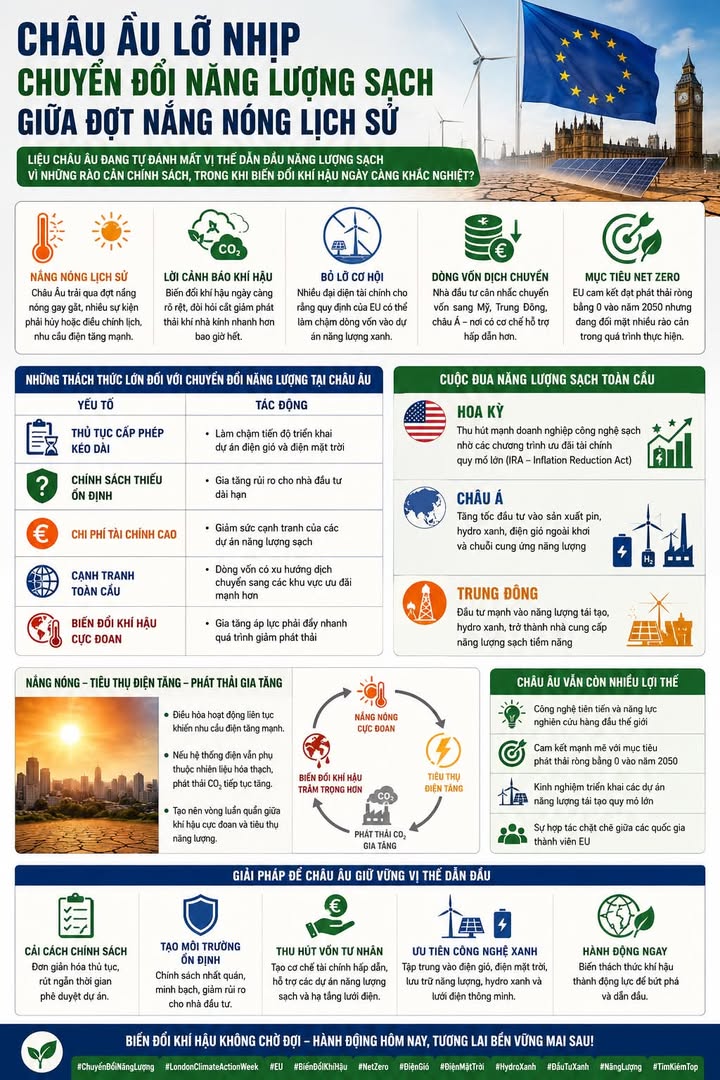
Europe Losing Pace in Clean Energy Transition Amid Historic Heatwave
Climate Crisis Meets Policy Challenges as Europe Faces Critical Juncture
The recent London Climate Action Week unfolded against the backdrop of an unprecedented heatwave sweeping across Europe, forcing numerous events to be canceled or rescheduled. This convergence serves as both a stark reminder of the accelerating climate crisis and a critical examination of whether Europe is losing its pioneering position in the global clean energy transition.
As temperatures soared to record highs across the continent, the physical reality of climate change became impossible to ignore. The extreme weather conditions not only disrupted the conference schedule but also highlighted the urgent need for accelerated decarbonization efforts. Experts warn that without significant policy reforms and increased investment, Europe risks falling behind in the race to develop and deploy clean energy technologies at the scale required to meet climate targets.
Europe's Slowing Momentum in Clean Energy Investment
One of the most concerning messages emerging from the Climate Action Week was the perception that Europe is missing critical opportunities to advance its clean energy transition. Representatives from major financial institutions and banking organizations expressed concerns that current EU regulations may inadvertently slow the flow of capital into green energy projects rather than creating the necessary momentum to maintain the region's leadership position.
"The regulatory environment is becoming increasingly complex," noted one European investment banker who requested anonymity. "While well-intentioned, the current framework creates barriers that make it challenging to deploy capital at the pace required to meet our climate goals."
The concerns raised during the conference point to a systemic issue where policy implementation, while ambitious in principle, faces practical challenges in execution. This has created a perception among investors that Europe is becoming less attractive compared to other regions offering more streamlined approaches and stronger financial incentives for clean energy projects.
Key Challenges Facing Europe's Clean Energy Transition
Several interconnected factors are contributing to Europe's slowing progress in clean energy deployment. These challenges create a complex environment that hinders the rapid scaling of renewable energy projects and clean technologies.
| Challenge Factor | Impact on Clean Energy Transition |
|---|---|
| Lengthy Permitting Processes | Significant delays in wind and solar project deployment, often extending project timelines by 2-3 years |
| Policy Instability | Increased uncertainty for long-term investors, raising the cost of capital for clean energy projects |
| High Compliance Costs | Reduced competitiveness of European clean energy projects compared to those in regions with lighter regulatory burdens |
| Inconsistent National Policies | Fragmented market across EU member states, creating complexity for developers and investors operating across borders |
| Global Competition | Diversification of investment toward markets with more attractive support mechanisms and clearer regulatory frameworks |
| Climate Extremes | Accelerating pressure to reduce emissions while simultaneously increasing energy demand for cooling and adaptation measures |
Global Competition Intensifies as Europe Stalls
While Europe grapples with these challenges, other regions are making significant strides in attracting clean energy investment and developing innovative technologies. The United States, through its Inflation Reduction Act and other large-scale financial incentive programs, is experiencing a surge in clean technology investment. American policymakers have created a more predictable and supportive environment for renewable energy deployment, leading to increased interest from both domestic and international investors.
Simultaneously, many Asian countries are rapidly accelerating their investments in clean energy manufacturing and deployment. Nations like China, South Korea, and Japan are pouring resources into battery production, green hydrogen development, and offshore wind technology. This has created a competitive landscape where Europe risks not only losing investment but also technological leadership in critical clean energy sectors.
Comparative Analysis: Clean Energy Investment Environments
| Region | Policy Approach | Investment Climate | Key Strengths |
|---|---|---|---|
| European Union | Comprehensive but complex regulatory framework with multiple layers of requirements | Increasingly challenging due to administrative burdens and policy inconsistencies | Strong research base, established industrial capacity, ambitious climate targets |
| United States | Market-oriented with substantial financial incentives through legislation like the Inflation Reduction Act | Highly attractive with streamlined permitting and strong federal support | Large domestic market, advanced technology development, significant capital availability |
| Asia | Strategic industrial policy with focused support for specific clean energy technologies | Highly competitive with rapidly improving regulatory environments | Manufacturing scale, cost advantages, rapid deployment capabilities |
The Heatwave-Energy Nexus: A Vicious Cycle
The recent European heatwave provided a stark illustration of the complex relationship between climate change and energy systems. As temperatures soared, electricity demand surged due to the widespread use of air conditioning and cooling systems. This increased demand placed significant strain on power grids across the continent, many of which still rely heavily on fossil fuel generation.
"This creates a dangerous feedback loop," explained Dr. Elena Rodriguez, a climate policy expert at the European Climate Foundation. "Extreme heat increases energy demand for cooling, which often leads to greater reliance on fossil fuel power plants, resulting in higher emissions that contribute further to climate change. Breaking this cycle requires rapid deployment of clean energy alongside improved energy efficiency."
The situation highlights the urgent need for Europe to accelerate its clean energy transition while simultaneously improving grid resilience and implementing demand-side management strategies. Without these measures, the region risks increasing emissions precisely when it should be reducing them, undermining both climate goals and energy security.
Europe's Advantages and the Path Forward
Despite these challenges, Europe retains significant advantages in the global clean energy transition. The region possesses world-class research capabilities, established industrial infrastructure, and ambitious policy frameworks aimed at achieving net-zero emissions. European companies continue to lead in many clean technology sectors, particularly in offshore wind, energy efficiency solutions, and sustainable mobility.
To maintain its competitive edge and leadership position, European policymakers must address the systemic barriers that are slowing clean energy deployment. Key priorities include:
- Simplifying and streamlining permitting processes for renewable energy projects
- Creating more stable and predictable policy environments to reduce investment risk
- Harmonizing regulatory approaches across member states to create a more cohesive market
- Enhancing financial mechanisms to reduce the cost of capital for clean energy projects
- Strengthening grid infrastructure and market designs to accommodate high levels of renewable energy
- Increasing public and private investment in energy storage and grid flexibility solutions
"The events in London demonstrate that climate change is no longer a future risk but a present reality," said Michael Thompson, CEO of a major European renewable energy developer. "This creates both urgency and opportunity. Europe has the technological capabilities and financial resources to lead the clean energy transition, but we need policy frameworks that enable rather than impede deployment at the scale required."
Conclusion: The Imperative for Accelerated Action
The convergence of extreme weather events and policy challenges during London Climate Action Week serves as a powerful reminder that the clean energy transition cannot be delayed. As climate impacts intensify, the window for avoiding the worst consequences of global warming narrows, making effective action more urgent than ever.
Europe stands at a critical juncture where decisive policy action could reaffirm its leadership in the global clean energy transition. Alternatively, continued delays and regulatory complexities could see the region cede ground to more agile competitors, with significant implications for both climate goals and economic competitiveness.
The heatwave that disrupted Climate Action Week should serve as a wake-up call—not just about the physical impacts of climate change, but about the need for corresponding acceleration in the policy and investment responses required to address it. The technologies and solutions exist; what is needed is the political will and effective implementation to deploy them at the speed and scale required.