#Rare Earth #Economy #Technology #AI #Electric Vehicles #China #USA #Semiconductor #Energy #SupplyChain #Geopolitics
If one day China completely tightens the supply of rare earths, will Apple, Tesla, NVIDIA, Lockheed Martin and the entire global AI industry have to "stand still" in just a few months?
On July 11, 2026, competition between great powers is no longer just about oil, gas or semiconductors. Rare earths have become the new “economic weapon,” deciding who will lead in artificial intelligence, electric vehicles, robotics, defense and the digital economy.
If the 19th century was the age of coal, the 20th century belonged to oil, the 21st century is witnessing rare earths becoming one of the strategic resources with the greatest influence on the global balance of power.
It is worth noting that rare earths are not really rare in terms of reserves. The challenge lies in the technology of selecting, separating, refining and producing permanent magnets. This is the link that has the highest value and is also the most difficult to replace. According to new IEA analysis, China still accounts for about 60% of mining output, 91% of refining capacity and about 94% of global rare earth magnet production in 2019.024, creating a huge advantage in the entire value chain.
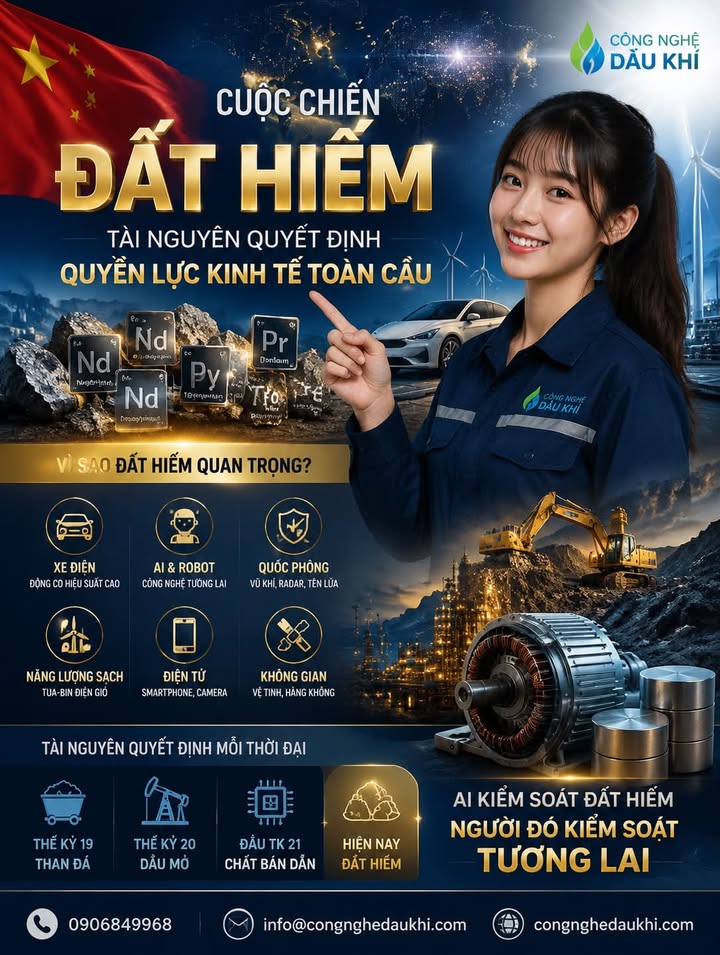
The role of strategic resources through each period
Power Resources stage created
19th century Coal Industrial Revolution, railways, metallurgy
20th century Petroleum Automobiles, aviation, petrochemicals, military
Early 21st century Semiconductors Smartphones, Internet, cloud computing, AI
Period 2025–2035 Rare earth Electric vehicles, robotics, AI, defense, clean energy
Why are rare earths important?
Role Field
Tesla, BYD, Hyundai electric vehicles High performance motor magnets
AI Servers, robots, data centers
Defense Radar, F-35, missiles, submarines
Wind power Large capacity generator
Smartphone Camera, speaker, vibration, sensor
Space Satellites, aero engines
Unlike petroleum, which can be partially replaced by renewable energy or natural gas, many rare earth elements do not yet have equivalent performance replacements in high-tech applications.
What are China and America competing for?
Chinese American content
Exploiting the Expanding Lead
Refinement Absolute leader Strong investment
Rare Earth Magnets Almost Dominate Building New Chains
Complete Supply Chain Reducing Dependencies
Meanwhile, the European Union, Japan, AAustralia, South Korea and Canada are also investing tens of billions of dollars to build independent supply chains to reduce dependence on China. New projects focus on mining, refining, recycling and domestic magnet production.
The war is no longer about exploitation
Many people think the country with many mines will win.
The reality is quite the opposite.
The greatest value lies in the technology of refining and producing materials from rare earths. This is the reason why many countries, despite possessing large reserves, still have to export ore to other places for processing.
According to the IEA, even if many new mines are put into operation in the next decade, the refining and production of magnets will still be the biggest "bottleneck" of the global supply chain.
What happens if the supply is interrupted?
Industry Influence
Electric vehicles Engine costs have increased sharply
AI Missing server components
Robot Reduces Production
Defense Lack of materials for high-tech weapons
Wind power Project progress is slow
Electronics Prices of smartphones and devices increase
The IEA warns that if export control measures are applied comprehensively, the production value in countries outside of China is at risk of being affected by up to 6,500 billion USD per year, of which automobiles, electronics, defense andData centers are the sectors most affected.
The latest developments also show that the competition is heating up. On July 6, 2026, Reuters reported that many Japanese businesses continue to warn about supply risks due to China's export control measures, while the US is still promoting investment in domestic magnet exploitation and production to reduce dependence.
Rare earths are repeating the story that oil created in the last century, but with an even wider reach. Countries that control the value chain from mining to refining and manufacturing materials will have an advantage in AI, electric vehicles, defense, robotics and many core technology industries for decades to come.
This war is not just a race to exploit resources but a competition over technology, production capacity, supply chains and control of the global digital economy.
#RareEarth #RareEarth #AI #Electric Vehicle #Robot #NVIDIA #Tesla #Apple #BYD #Defense #Semiconductor #SupplyChain #China #USA #Energy #TimKiemTop