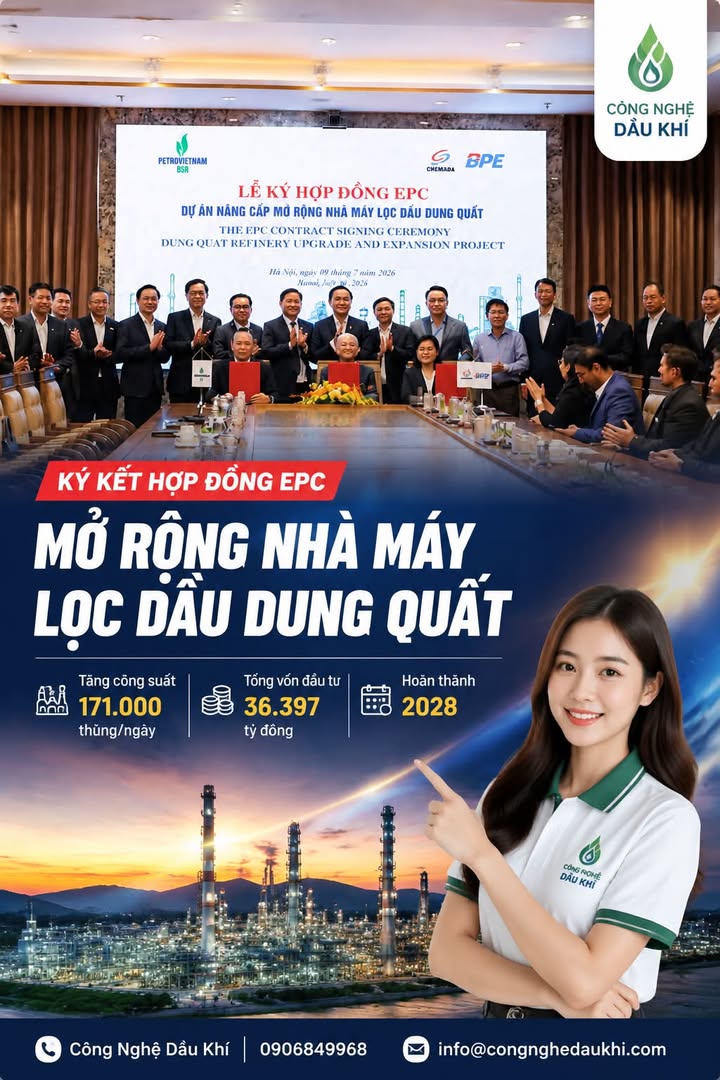
Dung Quat Oil Refinery Expansion Marks New Acceleration Phase for Vietnam's Energy Sector
July 9, 2026 - Hanoi - The signing of the EPC contract for the Dung Quat Oil Refinery Expansion Project marks a significant milestone in Vietnam's energy development, potentially reshaping the nation's refining industry for decades to come and significantly reducing dependence on imported fuel.
At a ceremony in Hanoi, Vietnam Oil and Gas Group Petrovietnam's subsidiary, Binh Son Refinery and Petrochemical Company (BSR), officially signed the Engineering, Procurement, and Construction (EPC) contract and Project Management Consultancy (PMC) contract for the Dung Quat Oil Refinery Upgrade and Expansion Project. This event signals the project's transition from years of preparation in legal, technical, technological, and financial aspects to the implementation phase.
The ceremony was attended by leaders from various ministries, authorities from Quang Ngai Province, representatives from Petrovietnam, BSR, and international partners. BSR's General Director, Nguyen Viet Thang, affirmed that this strategic project will enhance the competitiveness of Vietnam's refining industry during the global energy transition.
Key Project Partners
The joint venture of China Chengda Engineering Co. Ltd and Beijing Petrochemical Engineering Co. Ltd was selected as the EPC general contractor, while Foster Wheeler will serve as the project management consultant (PMC).
Project Specifications and Scale
The Dung Quat Oil Refinery Expansion Project represents one of Vietnam's most significant energy infrastructure investments in recent years. Below are the key specifications:
| Parameter | Details |
|---|---|
| Total Investment | Approximately 36.397 trillion VND (equivalent to about 1.489 billion USD) |
| Current Processing Capacity | 148,000 barrels of crude oil per day |
| Post-Expansion Capacity | 171,000 barrels of crude oil per day |
| Fuel Standard | Euro V standard |
| EPC Implementation Period | 37 months |
| Commercial Operation Expected | 2028 |
Contract Value and Structure
The EPC contract represents a substantial portion of the total project investment, with the bid value of approximately 988.799 million USD (equivalent to about 25.7 trillion VND). The contract was awarded to the joint venture of China Chengda Engineering and Beijing Petrochemical Engineering.
| Contract Component | Value |
|---|---|
| EPC Contract Value | Approximately 988.799 million USD (25.7 trillion VND) |
| Contractor | Joint venture of China Chengda Engineering and Beijing Petrochemical Engineering |
| PMC Consultant | Foster Wheeler |
Strategic Benefits and Implications
The Dung Quat expansion project offers multiple strategic benefits for Vietnam's energy sector and economy:
| Objective | Expected Impact |
|---|---|
| Increased Processing Capacity | Meets growing domestic fuel demand |
| Diversified Crude Sources | Ability to process various domestic and imported crude types |
| Enhanced Product Quality | Meets Euro V emission standards |
| Improved Efficiency | Reduces production costs and enhances competitiveness |
| Energy Security | Ensures stable energy supply for the national economy |
Broader Economic Impact
Beyond upgrading the refinery's technology, the project is expected to stimulate development in the Dung Quat Economic Zone, supporting auxiliary industries, logistics, mechanical manufacturing, and domestic petrochemical supply chains. Upon completion, Dung Quat is poised to become Vietnam's large-scale refining and energy center, playing a crucial role in the national energy security strategy.
Industry Transformation
The expansion represents a significant step forward for Vietnam's refining capabilities. By increasing capacity and upgrading to Euro V standards, the refinery will not only meet domestic demand more effectively but also potentially create opportunities for fuel exports to neighboring countries with stricter environmental standards.
Energy Independence
One of the most significant potential impacts of this project is its contribution to Vietnam's energy independence. Currently, Vietnam imports a substantial portion of its refined petroleum products. The expanded Dung Quat refinery could substantially reduce this dependency, insulating the national economy from global price fluctuations and supply disruptions.
Implementation Timeline and Next Steps
The signing of the EPC contract indicates that the project is progressing rapidly after the completion of contractor selection and investment procedures. The next phase will involve large-scale construction activities over the 37-month implementation period.
With commercial operation expected in 2028, the project is well-positioned to contribute to Vietnam's economic development goals during the latter half of this decade. The timeline aligns with Vietnam's broader energy transition strategy, positioning the country to meet both current energy demands and future environmental standards.
Conclusion
The Dung Quat Oil Refinery Expansion Project represents a pivotal moment in Vietnam's energy sector development. By significantly increasing processing capacity, upgrading technology, and meeting higher environmental standards, the project will enhance Vietnam's energy security, support economic growth, and position the country more favorably in the global energy market.
As implementation begins, all eyes will be on this strategic infrastructure project and its potential to transform Vietnam's energy landscape for decades to come.