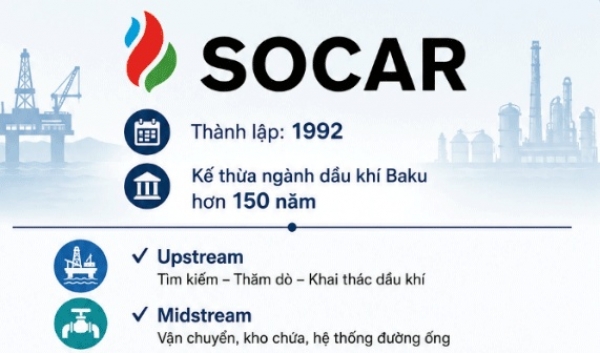
In the context of the world's accelerating energy transition, many traditional oil and gas companies are restructuring to become integrated energy enterprises. SOCAR - the State Oil Company of the Azerbaijan Republic - stands as a prime example of this transformation.
About a decade ago, if a national oil and gas company announced investments in offshore wind, hydrogen, carbon capture and storage (CCUS), or low-carbon energy solutions, many might have interpreted this as a sign of the declining role of oil and gas. However, reality is unfolding differently. It is precisely the major oil and gas companies worldwide that are becoming crucial forces in the energy transition—not by completely abandoning oil and gas, but by integrating renewable energy sources and new technologies into their investment portfolios.
SOCAR - Azerbaijan's National Oil and Gas Company
SOCAR (State Oil Company of the Azerbaijan Republic) is Azerbaijan's national oil and gas conglomerate, established in 1992. Initially, SOCAR primarily operated in the exploration, production, manufacturing, and marketing of oil and gas products. However, with strategic foresight, SOCAR recognized the necessity of diversifying its business operations to adapt to global energy transition trends.
Energy Transition Strategy
SOCAR is implementing its energy transition strategy systematically, with the goal of becoming an integrated energy enterprise that combines fossil fuels with renewable energy. This strategy includes:
- Developing large-scale renewable energy projects
- Investing in green hydrogen technology
- Participating in carbon capture and storage (CCUS) projects
- Developing natural gas infrastructure to support the transition
- Investing in low-carbon energy solutions
Offshore Wind Power - A Strategic Pillar
Among its renewable energy projects, offshore wind power has become a strategic pillar for SOCAR. The company has launched the 240 MW Absheron offshore wind project, considered the first offshore wind project in the Caspian Sea region. This project not only demonstrates SOCAR's commitment to clean energy but also opens opportunities for international cooperation in the renewable energy sector.
Beyond this, SOCAR is exploring the development of larger-scale offshore wind projects in other areas of Azerbaijan, with a target of achieving 2-3 GW capacity in the next decade.
Green Hydrogen - A Future Direction
Green hydrogen has become an important component of SOCAR's energy transition strategy. The company is investing in research and development of green hydrogen production technology using renewable energy to split water into hydrogen and oxygen.
Azerbaijan has significant potential for solar and wind energy, creating favorable conditions for green hydrogen production. SOCAR aims to become a leading green hydrogen producer in the region, meeting the growing global demand for clean energy.
Carbon Capture and Storage (CCUS)
One of SOCAR's most significant initiatives in its energy transition is the implementation of carbon capture and storage (CCUS) projects. This technology captures CO2 from industrial activities and stores it underground, reducing greenhouse gas emissions while maintaining energy production from fossil fuels.
SOCAR has collaborated with international partners to develop CCUS projects at its oil and gas production facilities. The company is also researching the potential to expand this technology to other industries in Azerbaijan.
Economic and Environmental Impact
SOCAR's energy transition brings not only environmental benefits but also creates new economic opportunities. The table below summarizes the key impacts:
| Area | Economic Impact | Environmental Impact |
|---|---|---|
| Offshore Wind Power | Creates new jobs, attracts foreign investment, develops local energy industry | Reduces CO2 emissions, decreases dependence on fossil fuels |
| Green Hydrogen | Promotes clean energy exports, creates new industries, enhances national standing | Significantly reduces carbon emissions across industries |
| CCUS | Extends the life of existing oil fields, reduces compliance costs for environmental regulations | Significantly reduces CO2 emissions from industrial activities |
Future Prospects
The transition from a pure oil and gas company to an integrated energy enterprise presents numerous challenges for SOCAR, but it also opens up many opportunities. The company needs to make substantial investments in new technologies, develop a workforce with appropriate skills, and build supporting infrastructure for renewable energy sources.
However, with its position as Azerbaijan's national oil company in a resource-rich nation of significant geopolitical importance, SOCAR has several advantages to succeed in this transition. Support from the Azerbaijani government and international partners is also a crucial factor enabling SOCAR to implement its integrated energy strategy.
Conclusion
SOCAR's transformation from a traditional national oil company to an integrated energy enterprise is not merely a trend but a necessary strategy in the context of the global energy transition. By combining fossil fuels with renewable energy, SOCAR is shaping the future of Azerbaijan's energy sector and contributing to global efforts against climate change.
This transition demonstrates that traditional oil and gas companies do not necessarily need to completely abandon oil and gas but can play a significant role in the energy transition by integrating renewable energy sources and new technologies. This is an important lesson for other oil and gas companies worldwide facing similar challenges.
#SOCAR #EnergyTransition #OilAndGas #RenewableEnergy #WindPower #GreenHydrogen #CCUS