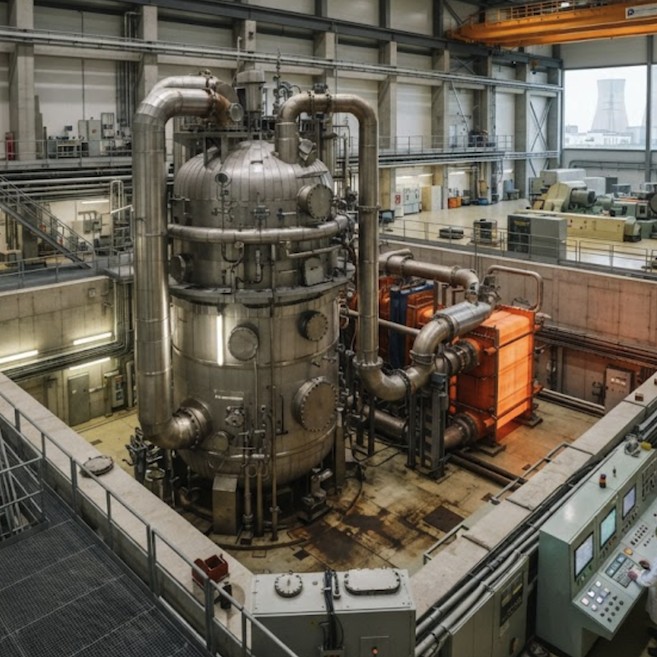
Domestic Parody Grain Energy Industry's Return to Molten Salt Technology
The domestic nuclear energy industry is preparing for a strong recovery as this technology receives support from the public and policymakers thanks to its ability to provide clean energy 24/7. As mega data centers push up energy insecurity and climate restrictions inch ever closer, nuclear power options are more attractive than ever. Not only is the United States trying to promote the expansion of conventional nuclear power, the country is also trying to establish a pioneering position in next-generation nuclear energy technologies.
Just this month, in a historic step, the Department of Energy approved the Nuclear Energy Design Agreement for a molten salt reactor currently being developed by researchers at Abilene Christian University in Abilene, Texas. Molten salt reactors (MSRs) are emerging as one of the leading potential technologies that could one day replace the global nuclear energy industry, as they can solve or circumvent many of the weaknesses associated with traditional nuclear power.
Molten Salt Technology: Future Solutions
"Fluent salt reactors are designed to use less fuel and produce shorter-lived radioactive waste than other types of reactors," describes the U.S. Department of Energy. "They have the potential to significantly change the security and economic position of nuclear energy production by on-line fuel processing, waste product removal and fresh fuel addition without the need for lengthy refueling maintenance periods." In other words, molten salt reactors are cheaper and safer than standard nuclear fission reactors.
| Comparison of Traditional and Molten Salt Reactors | |
|---|---|
| Traditional Reactor | Molten Salt Reactor (MSR) |
| Use water as coolant | Use molten salt as a fuel intermediate and coolant |
| Long fuel refill maintenance time | Fuel processing is possible online |
| Radioactive waste has a long lifetime | Generates shorter-lived radioactive waste |
| Requires more water, susceptible to drought | Higher resource efficiency |
Molten salt reactors are also resource efficient, with molten salt serving as both a fuel medium and a coolant for the reactor. This also enhances the security and reliability of these models. Typically, nuclear reactors use water for cooling, which can lead to water stress in arid regions and leave traditional power plants vulnerable to drought conditions and heat waves. Just this month, France was forced to shut down a series of nuclear reactors when an intense heat wave made the country's rivers too hot to be safely used for cooling.
Advances in Research and Development
These reactors are still in the testing phase, but research labs like those at Abilene Christian University and Oak Ridge National Laboratory (ORNL) in Tennessee are pushing the technology closer to a commercial reality. ORNL has made important strides in modeling and understanding molten salt behavior to better design reactors for practical applications, while Abilene is making great strides when it comes to management practices. By granting key safety approvals earlier this month, the lab established "the basic parameters needed for federal authorization of facility construction and system testing," according to a recent report from Interesting Engineering.
| Leading Molten Salt Reactor Research Centers in the US | |
|---|---|
| Abilene Christian University | Oak Ridge National Laboratory (ORNL) |
| Location: Abilene, Texas | Location: Tennessee |
| Focus on management measures | Focus on modeling and understanding flowing salt behavior |
| Obtain design safety approval | Reactor design for practical applications |
| Develop basic parameters for federal authorization | Pushing technology closer to commercial reality |
Support From the Trump Administration
These developments come amid a major push for advanced nuclear energy innovation from the Trump administration. The administration has said it aims for "sustained U.S. dominance in the global nuclear energy market" and has allocated federal funds from the U.S. Department of Energy's Experimental Reactor Program to accelerate the testing and commercialization of advanced nuclear energy technologies to bring them to scale through Executive Order 14301.
Critical Perspective
However, critics have pointed out that the focus on next-generation nuclear power technologies like MSR may actually be undermining Trump's broader goal of quadrupling domestic nuclear power generation capacity by 2050. A recent commentary in the Wall Street Journal argued that "The government is pursuing unproven technology when it could encourage Wall Street investment in large-scale reactors," and as a result, the Trump's nuclear recovery is stalling.
China's Position in the Nuclear Energy Industry
Furthermore, when it comes to 'durable US dominance', Trump's aggressive approach may be too late. Half of the world's nuclear reactors under construction are in China, and the country is on track to surpass the United States and France as the world's largest producer of nuclear energy within the next ten years. And Beijing is also at the vanguard of next-generation nuclear energy technologies. China claims to have successfully built an operational thorium-based molten salt reactor (TMSR) that is said to have achieved "first nuclear reaction on October 11, 2023" and has since "generated steady heat through nuclear fission".
The development of nuclear energy technology, especially molten salt reactors, could open a new chapter in global energy history. With both the United States and China competing for leadership in the field, the future of clean, reliable and efficient energy may depend on who can convert cutting-edge technologies into successful commercial solutions first.
Meanwhile, critics continue to question the practicality of focusing on unproven technologies, especially when proven conventional nuclear solutions can still contribute significantly to reducing greenhouse gas emissions and meeting the world's growing energy needs.