Unitree Robotics Poised for IPO: China's Humanoid Robot Boom Captures Global Attention
The Chinese Robotics Giant's Ambitious Path to Public Markets
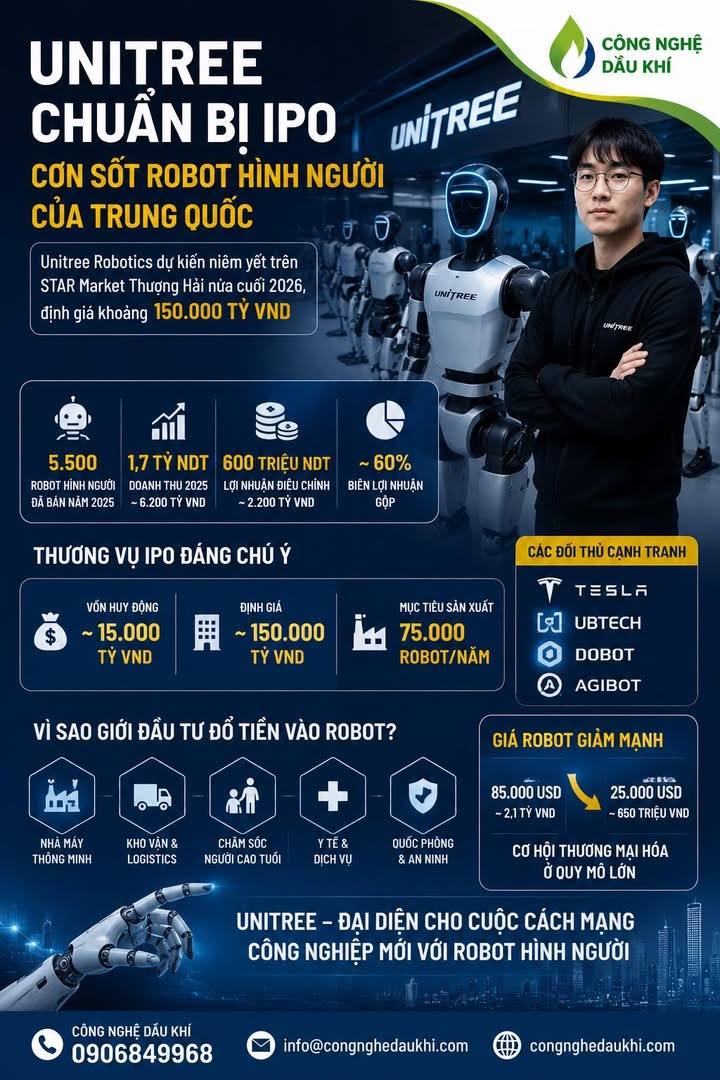
Unitree Robotics, the world's largest manufacturer of humanoid robots, is preparing for what could be one of the most significant initial public offerings in the technology sector. The Beijing-based company plans to list on Shanghai's STAR Market in the latter half of 2026, with an estimated valuation of 40 billion yuan (approximately 150,000 billion VND). This development has sent ripples through global investment circles, signaling the maturation of the physical artificial intelligence industry.
The IPO represents a critical milestone not only for Unitree but for the entire humanoid robotics sector. As the industry transitions from experimental laboratory projects to commercially viable products, Unitree's success could catalyze unprecedented investment in physical AI, industrial automation, and advanced chip technologies.
Unitree's Market Position and Financial Performance
Founded in 2016 by Wang Xingxing, Unitree has rapidly emerged as a dominant force in the humanoid robotics landscape. The company's remarkable financial metrics underscore its industry leadership:
| Financial Metric | Value |
|---|---|
| Annual Revenue (2025) | 1.7 billion yuan (6,200 billion VND) |
| Adjusted Profit (2025) | 600 million yuan (2,200 billion VND) |
| Gross Profit Margin | Nearly 60% |
| Units Sold (2025) | 5,500 humanoid robots |
What sets Unitree apart from many technology startups is its demonstrated profitability. While numerous AI companies continue to operate at a loss, burning through investor capital with no clear path to profitability, Unitree has achieved sustainable financial performance. This business viability has positioned the company as a bellwether for the entire physical AI sector.
Strategic Market Position
Unitree's market dominance is built on several strategic advantages:
- Manufacturing Scale: The company has established the most advanced production facilities for humanoid robots globally, enabling both quality control and cost efficiency.
- Technological Integration: Unitree has vertically integrated key components from actuators to control systems, reducing dependency on external suppliers.
- Application Diversity: Unlike competitors focused on narrow applications, Unitree's robots are designed for multiple use cases, from industrial environments to service sectors.
The IPO Details: Ambitious Valuation and Growth Targets
Unitree's planned IPO comes with ambitious financial targets and growth projections that reflect confidence in the company's trajectory:
| Financial Target | Projected Value |
|---|---|
| Fundraising Amount | Approximately 15,000 billion VND |
| Company Valuation | Approximately 150,000 billion VND |
| 2025 Production Volume | 5,500 units |
| Future Annual Target | 75,000 units within several years |
The planned production increase represents more than thirteen-fold growth from 2025 levels, indicating Unitree's confidence in market demand and its ability to scale operations efficiently. This aggressive expansion plan aligns with the company's strategy to achieve economies of scale and further reduce production costs.
Competitive Landscape in the Humanoid Robotics Sector
The humanoid robotics field has attracted significant investment from technology giants and specialized startups alike. Unitree faces competition from several notable players:
- Tesla: With its Optimus robot, Tesla brings automotive manufacturing expertise and vast resources to the humanoid robotics space.
- UBTech Robotics: A Chinese competitor with strong presence in educational and service robotics applications.
- Dobot: Specializes in industrial robotic arms with growing humanoid robotics development.
- AgiBot: Focuses on AI-powered autonomous systems with humanoid applications.
Despite this competitive landscape, Unitree has maintained its position through superior manufacturing capabilities and technological innovation. The company's focus on practical applications rather than experimental demonstrations has provided a clear differentiation strategy.
Market Dynamics: Declining Costs and Expanding Applications
One of the most significant developments in the humanoid robotics sector has been the dramatic reduction in production costs. Unitree has successfully lowered the average price of its humanoid robots from approximately $85,000 to around $25,000 (equivalent to about 650,000,000 VND). This cost reduction has been achieved through:
- Manufacturing process optimization
- Component standardization
- Economies of scale in production
- Vertical integration of supply chain
These cost reductions have made humanoid robots commercially viable for a wider range of applications, including:
- Smart Manufacturing: Assembly lines, quality control, and material handling in industrial settings
- Warehousing and Logistics: Inventory management, order fulfillment, and transportation within facilities
- Elderly Care: Assistance with daily activities, monitoring, and companionship for seniors
- Healthcare and Services: Patient care, rehabilitation support, and customer service
- Defense and Security: Surveillance, reconnaissance, and hazardous environment operations
Investment Implications and Market Impact
Unitree's planned IPO is being closely watched by investors as a potential catalyst for broader investment in the physical AI sector. If successful, this offering could trigger significant capital flows into related technologies including:
- Physical artificial intelligence systems
- Industrial automation solutions
- AI processing chips
- Sensors and mechatronics
The valuation of 150,000 billion VND (approximately $6 billion) reflects market optimism about the long-term potential of humanoid robotics. This valuation is particularly notable given that many AI-focused companies continue to operate without profitability, making Unitree's demonstrated earnings all the more impressive to investors.
Global Economic Implications
The commercialization of humanoid robotics at scale could have profound implications for global labor markets and economic structures. With production targets reaching 75,000 units annually, Unitree's robots could potentially replace millions of human workers across various industries within the next decade.
This transition represents both challenges and opportunities:
- Workforce displacement in certain sectors
- Creation of new jobs in robotics maintenance, programming, and oversight
- Increased productivity and reduced operational costs for businesses
- Potential for higher quality and consistency in service delivery
The Future of Humanoid Robotics: Unitree's Vision
Unitree's leadership has articulated a vision for humanoid robots that extends beyond mere automation. The company envisions a future where robots and humans collaborate to address complex challenges across multiple domains. This collaborative approach differentiates Unitree from competitors focusing solely on replacement rather than augmentation of human capabilities.
The company's research and development efforts are concentrated on several key technological areas:
- Advanced motion control and balance systems
- Natural human-robot interaction interfaces
- Adaptive learning capabilities for diverse environments
- Energy efficiency and extended operational duration
Conclusion: A Pivotal Moment for Robotics and AI
Unitree Robotics' planned IPO represents more than just a corporate milestone; it signals the emergence of humanoid robotics as a commercially viable and economically significant industry. With demonstrated profitability, ambitious growth targets, and technological leadership, Unitree has positioned itself at the forefront of what may become the next major technological revolution.
If the IPO achieves its projected valuation and the company meets its production targets, we may be witnessing the dawn of a new industrial era—one where humanoid robots become an integral part of global workforce infrastructure. The success of Unitree could validate the entire physical AI sector, unlocking unprecedented investment and accelerating technological advancement across multiple industries.
As we approach what may be a pivotal moment in technological history, the question is no longer whether humanoid robots will transform our world, but rather how quickly and comprehensively this transformation will occur. Unitree's journey from startup to potential public market giant offers a compelling case study in the commercialization of cutting-edge technology and its profound implications for our collective future.