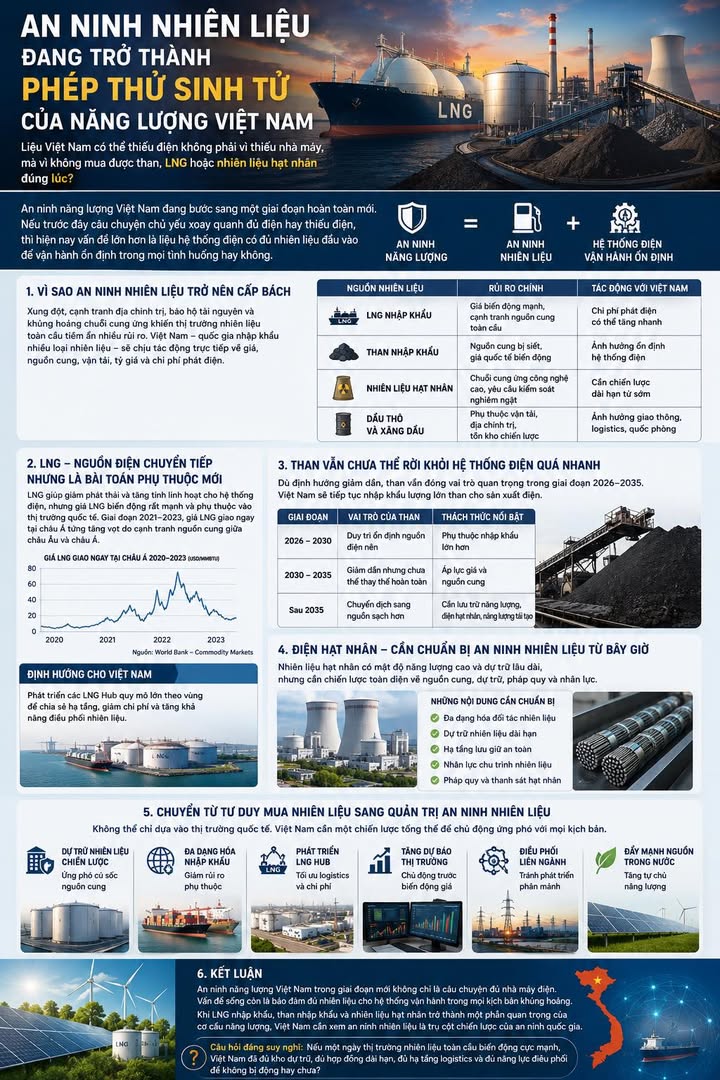
Energy Security Becomes the Lifeline of Vietnam's Energy Future
The question of whether Vietnam might face power shortages is no longer about insufficient power plants but rather about the ability to procure coal, LNG, or nuclear fuel at the right time. Vietnam's energy security is entering a completely new phase. While the conversation previously focused on having enough electricity or facing shortages, the current challenge is whether the power system has adequate fuel inputs to operate stably under all circumstances.
According to analysis from the Vietnam Energy Journal Scientific Council, as the proportion of imported LNG, imported coal, and future nuclear fuel increases, Vietnam will face a new strategic challenge: national fuel security.
Why Fuel Security Has Become Urgent
The Russia-Ukraine conflict, Middle East tensions, risks in the Red Sea, and the trend toward resource protection have shown that international fuel markets no longer operate purely on economic supply and demand. During crises, many countries will prioritize domestic energy security. At that time, fuel-importing countries like Vietnam may face significant pressure regarding prices, supply sources, sea transport, insurance, and exchange rates.
| Energy Source | Main Risks | Impact on Vietnam |
|---|---|---|
| Imported LNG | Strong price fluctuations, global supply competition | Electricity generation costs could rise rapidly |
| Imported Coal | Tightened supply, international price volatility | Affects power system stability |
| Nuclear Fuel | High-tech supply chains, strict control requirements | Requires long-term strategy from an early stage |
| Crude Oil and Petroleum Products | Transport dependency, geopolitical factors, strategic reserves | Affects transportation, logistics, and national defense |
LNG: Not Just Cleaner Power, But a New Dependency Challenge
LNG power is considered an important transitional source to reduce emissions and support the power system. However, LNG is also a fuel with extremely strong price volatility. The period from 2021 to 2023 showed that spot LNG prices in Asia could surge when Europe and Asia competed for the same supply following the Russia-Ukraine conflict. This places Vietnam in a difficult position when developing large-scale LNG power projects.
If each LNG project builds its own port, storage, and logistics chain separately, social costs will increase significantly. Therefore, forming large-scale regional LNG hubs is a necessary direction to share infrastructure, reduce costs, and increase fuel coordination capabilities.
Coal Cannot Leave the Power System Too Quickly
Although Vietnam is oriented toward gradually reducing coal-fired power, coal will still play an important role in the stability of the national power system from 2026 to 2035.
The issue lies in the fact that domestic coal production is becoming increasingly difficult to expand due to deeper mining, rising costs, and stricter environmental requirements. This keeps the demand for imported coal high.
| Period | Role of Coal | Key Challenges |
|---|---|---|
| 2026 to 2030 | Maintaining power system stability | Greater import dependency |
| 2030 to 2035 | Gradual reduction but not complete replacement | Price and supply pressure |
| After 2035 | Transition to cleaner sources | Need for energy storage, nuclear power, renewable energy |
Nuclear Power Requires Fuel Security Preparation Now
The restart of the Ninh Thuan nuclear power program and research into small modular reactor technology open up a new requirement for Vietnam. Nuclear power is not just about building power plants but also involves fuel strategy, regulations, human resources, international cooperation, and long-term reserves.
Nuclear fuel has very high energy density and can be stored longer than LNG or coal. However, if there is excessive dependence on a single supply source, strategic risks may still emerge.
| Preparation Needed | Strategic Significance |
|---|---|
| Diversifying fuel partners | Avoiding dependence on a single supply source |
| Long-term fuel reserves | Increasing crisis resilience |
| Safe storage infrastructure | Ensuring stable operation |
| Nuclear fuel cycle workforce | Mastering technical capabilities |
| Nuclear regulations and oversight | Complying with international commitments |
Vietnam Needs to Shift from Fuel Purchasing to Fuel Security Governance
The biggest lesson from recent energy crises is that we cannot rely solely on international markets. When fluctuations occur, prices can spike sharply, transport can be disrupted, and supplies can be prioritized for countries with higher purchasing power.
Vietnam needs a comprehensive strategy including national fuel reserves, diversified import sources, LNG hub development, enhanced market forecasting capabilities, increased crude oil and refined product reserves, and coordinated planning between electricity, coal, gas, and nuclear power.
| Pillar of Solution | Objective |
|---|---|
| Strategic fuel reserves | Responding to supply shocks |
| Diversified imports | Reducing dependency risks |
| LNG Hub development | Optimizing logistics and costs |
| Enhanced market forecasting | Proactive response to price fluctuations |
| Inter-sector coordination | Avoiding fragmented development |
| Strengthening domestic sources | Increasing energy self-sufficiency |
Conclusion
Vietnam's energy security in this new phase is not just a story of having enough power plants. The critical issue is ensuring adequate fuel for the system to operate in all crisis scenarios. When imported LNG, imported coal, and nuclear fuel become important parts of the energy structure, Vietnam must consider fuel security as a strategic pillar of national security.
The thought-provoking question is: if one day the global fuel market experiences extreme fluctuations, does Vietnam have sufficient reserves, long-term contracts, logistics infrastructure, and coordination capabilities to remain proactive rather than reactive?