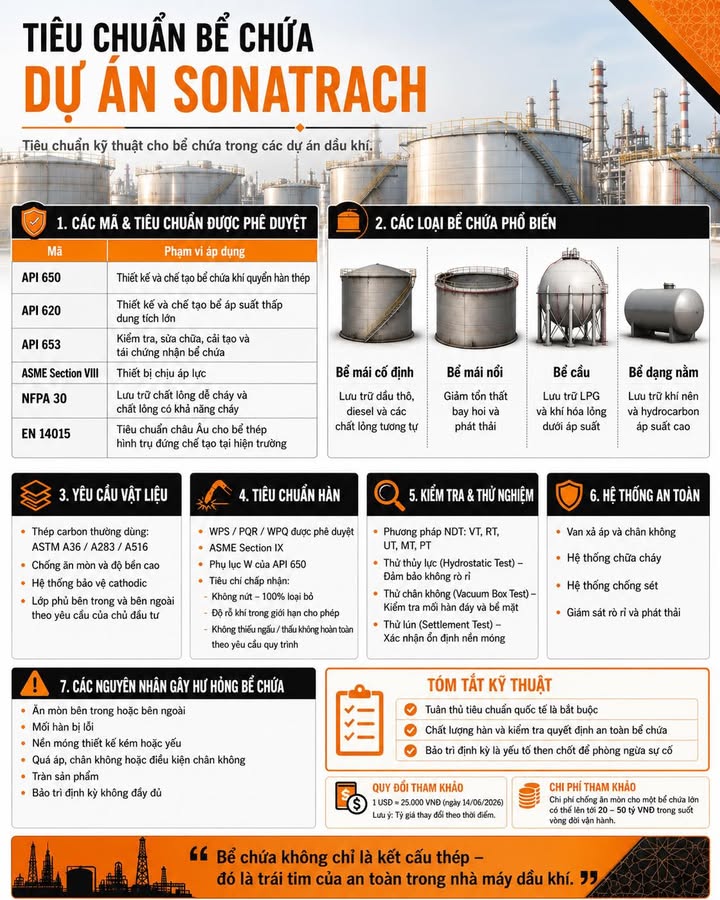
International Oil Storage Tank Standards: How a Single Welding Defect Could Cause Trillions in Damages
In the high-stakes world of oil and gas, storage tanks represent not just massive steel structures but critical safety assets where a single welding defect could potentially lead to environmental disasters and financial losses amounting to trillions of Vietnamese đồng.
On June 14, 2026, the international oil and gas engineering community continues to widely share the design and operational standards for petroleum storage tanks being implemented in major projects of Sonatrach Algeria, one of Africa's largest energy corporations.
The Critical Role of Oil Storage Tanks
In the oil and gas industry, storage tanks are not merely massive steel structures for storing crude oil, diesel, or LPG. These are critical safety assets where even minor errors in design, fabrication, or maintenance can lead to industrial disasters.
According to technical experts, most serious incidents worldwide originate from seemingly small issues such as undetected corrosion, substandard welds, or improperly designed pressure protection systems. The consequences can be devastating, affecting not only company finances but also causing severe environmental damage and potential loss of life.
International Standards in Widespread Use
The oil and gas industry relies on a comprehensive set of international standards to ensure the safety and integrity of storage tanks. These standards are not merely recommendations but mandatory requirements in most jurisdictions.
| Standard | Scope of Application |
|---|---|
| API 650 | Welded Tanks for Oil Storage - Atmospheric tanks |
| API 620 | Design and Construction of Large, Welded, Low-Pressure Storage Tanks |
| API 653 | Tank Inspection, Repair, Alteration, and Reconstruction |
| ASME Section VIII | Pressure Vessels |
| NFPA 30 | Flammable and Combustible Liquids Code |
| EN 14015 | Specification for the design and manufacture of site built, vertical, cylindrical, flat-bottomed, above ground, welded tanks for the storage of liquids at ambient temperature and above |
These standards are commonly applied in major projects of Sonatrach, Saudi Aramco, ADNOC, QatarEnergy, ExxonMobil, Chevron, Shell, and Petronas, among others.
Most Common Types of Storage Tanks
The oil and gas industry utilizes various types of storage tanks, each designed for specific applications and products:
| Type of Tank | Applications |
|---|---|
| Fixed Roof Tank | Crude oil, diesel, liquid fuels |
| Floating Roof Tank | Reduces hydrocarbon evaporation losses |
| Spherical Tank | LPG and liquefied natural gas (LNG) |
| Bullet Tank | Compressed gases and pressurized hydrocarbons |
Among these, the Floating Roof Tank is evaluated as the most effective solution for reducing evaporation losses of petroleum products and limiting VOC emissions into the environment.
Strict Material Requirements
A petroleum storage tank with a lifespan of 20 to 50 years must meet multiple technical requirements simultaneously:
- ASTM A36 steel
- ASTM A283 steel
- ASTM A516 steel
- Specialized corrosion-resistant coatings
- Cathodic protection systems
- Internal and external corrosion protection layers
For offshore oil and gas projects, the corrosion protection cost alone for a large storage tank can amount to tens of billions of Vietnamese đồng throughout its operational lifecycle.
Welding: The Decisive Factor in Tank Integrity
According to API 650 and ASME Section IX, all welding procedures must be approved before implementation. The welding process represents one of the most critical stages in tank construction, as improperly executed welds can become failure points years later.
| Technical Requirement | Specification |
|---|---|
| WPS | Approved Welding Procedure Specification |
| PQR | Procedure Qualification Record |
| WPQ | Welder Performance Qualification |
| Crack Inspection | Not acceptable |
| Incomplete Fusion | Not acceptable |
| Excessive Porosity | Must be removed |
A single non-compliant weld can become the initiation point for a leakage incident after many years of operation, potentially leading to catastrophic failures.
Non-Destructive Testing: Mandatory for Safety Assurance
To ensure safety, modern oil and gas projects implement a range of Non-Destructive Testing (NDT) methods:
| Method | Purpose |
|---|---|
| VT (Visual Testing) | Direct visual inspection |
| RT (Radiographic Testing) | X-ray imaging of internal structures |
| UT (Ultrasonic Testing) | Ultrasonic wave analysis |
| MT (Magnetic Particle Testing) | Detect surface and near-surface defects in ferromagnetic materials |
| PT (Penetrant Testing) | Detect surface-breaking defects |
In addition to these methods, a hydrostatic test is mandatory to confirm leak-tightness before putting the tank into operation.
Most Common Causes of Tank Failures
Statistics from numerous industrial projects indicate the following common causes of tank failures:
- Internal and external corrosion
- Faulty welds
- Weak foundations
- Overpressure or vacuum conditions
- Product spills
- Inadequate maintenance
Several major incidents worldwide have caused damages ranging from hundreds of billions to tens of trillions of Vietnamese đồng due to fires, explosions, or petroleum product leaks.
Technical Summary
Oil storage tanks are not components where costs can be cut by skipping inspections or reducing technical standards. The three most important factors determining lifespan and safety include:
- Proper design according to international standards
- Quality welding and NDT inspection
- Strict regular maintenance programs
In the context of rapidly developing LNG projects, strategic oil storage facilities, and energy centers globally, compliance with API 650, API 653, API 620, and other international standards has increasingly become a mandatory requirement rather than an option.
The financial and environmental consequences of tank failures are too severe to ignore, making adherence to these standards not just a matter of regulatory compliance but a fundamental responsibility to safety and environmental stewardship.
Conclusion
As global energy demands continue to rise and storage infrastructure expands, the importance of proper tank construction, inspection, and maintenance becomes increasingly critical. The oil and gas industry must recognize that every weld, every inspection, and every maintenance procedure plays a vital role in preventing potentially catastrophic incidents.
The trillions of Vietnamese đồng potentially at stake represent not just financial losses but environmental damage, reputational harm, and most importantly, the potential loss of human life. In this high-stakes environment, international standards are not merely guidelines but essential safeguards protecting both industry and society.