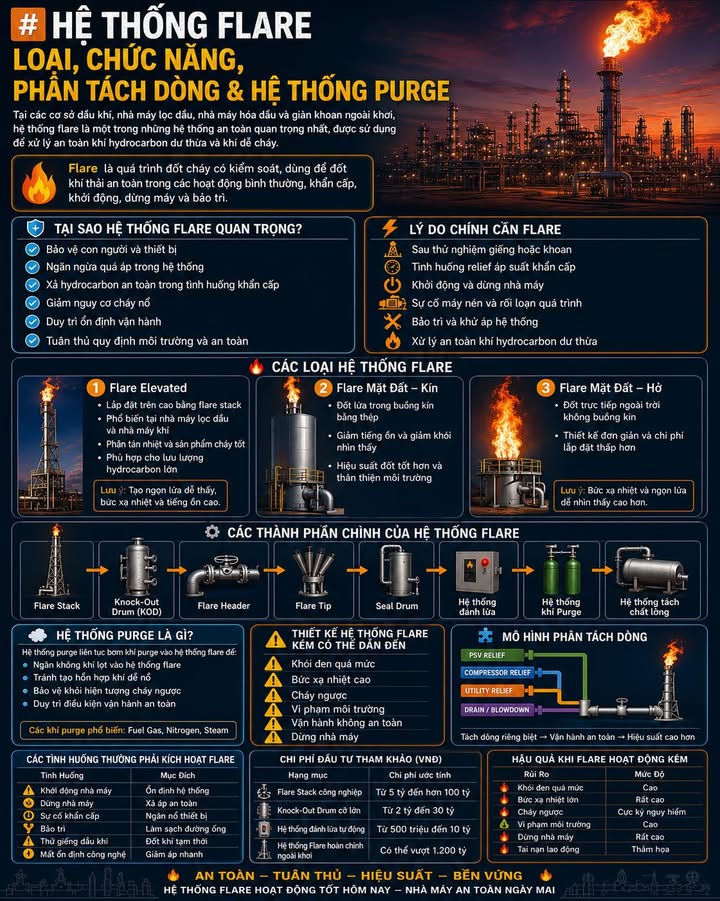
Flare Systems in the Oil & Gas Industry: The "Lifesaving Barrier" Protecting Plants from Catastrophic Disasters
What if an entire refinery's flare system suddenly malfunctioned for just 10 minutes during a pressure surge? The potential damages could amount to tens of trillions of Vietnamese đồng, threatening the lives of thousands of workers. On June 14, 2026, the technical community in the oil and gas industry continues to pay special attention to flare systems, which are considered one of the final layers of protection at refineries, petrochemical plants, offshore platforms, and natural gas processing facilities worldwide.
Unlike ordinary production equipment, flare systems do not generate direct revenue yet they are decisive in determining the survival of an entire plant during emergency situations.
What is a Flare System?
A flare system is a controlled combustion system designed to burn excess hydrocarbon gases or flammable gases generated during operations. When pressure in pipelines or equipment exceeds allowable limits, the gas is directed to the flare tip for safe release instead of accumulating and causing potential explosions.
Situations Requiring Flare Activation
| Situation | Purpose |
|---|---|
| Plant startup | System stabilization |
| Plant shutdown | Safe pressure release |
| Emergency situations | Equipment explosion prevention |
| Maintenance | Pipeline cleaning |
| Well testing | Temporary gas burning |
| Process instability | Rapid pressure reduction |
Why Flare Systems Are Critically Important
| Protective Function | Level of Importance |
|---|---|
| Personnel protection | Very high |
| Equipment protection | Very high |
| Overpressure prevention | Extremely critical |
| Explosion risk reduction | Extremely critical |
| Environmental compliance | Very high |
| Operational continuity | High |
According to international technical standards, many oil and gas facilities are not permitted to operate if their flare systems do not meet safety requirements.
Three Most Common Types of Flare Systems
| Type | Characteristics |
|---|---|
| Elevated Flare | Elevated burner, most common type |
| Ground Flare Enclosed | Ground-level enclosed burner |
| Ground Flare Open | Open ground-level burner |
Elevated flares are typically found in large refineries due to their better heat and combustion product dispersion capabilities. Ground flare enclosed systems are highly valued in residential areas for their reduced noise and flame light limitations.
Key Components of Flare Systems
| Equipment | Function |
|---|---|
| Flare Stack | Burner structure |
| Knock Out Drum | Liquid separation |
| Flare Header | Gas collection |
| Flare Tip | Burning element |
| Seal Drum | Backfire prevention |
| Ignition System | Ignition mechanism |
| Purge Gas System | Sweep gas maintenance |
| Liquid Separation System | Liquid removal |
Many experts consider the Knock Out Drum and Seal Drum as the two most critical components because they prevent liquids from entering the flame and stop reverse combustion propagation into the plant.
The Purge System - The Silent Hero
The purge system continuously pumps sweep gas into the flare system. Common sweep gases include:
- Fuel Gas
- Nitrogen
- Steam
The objective is to prevent air from entering the flare line. If oxygen infiltrates and mixes with hydrocarbons at dangerous ratios, the entire pipeline could become a massive "time bomb" waiting for an ignition source.
Consequences of Improper Flare Design
| Risk | Level of Severity |
|---|---|
| Excessive black smoke | High |
| High thermal radiation | Very high |
| Backfire | Extremely dangerous |
| Environmental violations | High |
| Plant shutdown | Very high |
| Occupational accidents | Catastrophic |
Modern Flare Separation Models
Modern oil and gas complexes typically do not route all relief sources into a single line. Instead, streams are separated by function:
- PSV Relief
- Compressor Relief
- Utility Relief
- Drain Blowdown
This solution helps reduce system load, improve combustion efficiency, and enhance operational safety levels.
Reference Investment Costs
| Item | Estimated Value |
|---|---|
| Industrial flare stack | From 5 to over 100 billion VND |
| Large Knock Out Drum | From 2 to 30 billion VND |
| Automatic ignition system | From 500 million to 10 billion VND |
| Complete offshore flare system | Can exceed 120 billion VND |
The figures above vary depending on capacity, construction materials, and design standards.
Real-World Case Study from the Oil & Gas Industry
Mr. Aditya Saraswat, Market Research Director for Energy at Rystad Energy, once emphasized that during energy supply crises, safety requirements at oil and gas facilities become more critical than ever. A single uncontrolled pressure relief event could trigger a chain reaction causing billions of dollars in damages and severe environmental impacts.
This is why flare systems are always compared to the "final safety valve" of the entire oil and gas complex. A plant may produce millions of barrels of oil per month, but lose its flare system for just a few minutes, and assets worth tens of trillions of đồng could face serious risks.
As the oil and gas industry continues to evolve, the development and maintenance of reliable flare systems remain paramount to ensuring operational safety, environmental protection, and the sustainable future of energy production worldwide.