#OilPrice #Brent #WTI #Hormuz #Iran #TrungDong #NangLuong #OPEC #DauTho #CongNgheDauKhi #OilMarket
If the world really has lost nearly 1 billion barrels of oil in just 3 months and this number could increase to 2 billion barrels by the end of the year, is the oil scenario of 150 USD/barrel that was once considered extreme gradually becoming a reality?
The energy crisis caused by the Middle East conflict is entering a much more serious stage than the market had ever predicted. According to Rystad Energy, the cumulative amount of lost oil supply globally has reached about 1 billion barrels after just 3 months since the outbreak of hostilities.
This number is equivalent to about 2.5 times the total amount of oil currently in the US Strategic Petroleum Reserve and is considered one of the largest supply shocks in the history of the modern oil and gas industry.
How large is the scale of lost supply?
Value Indicator
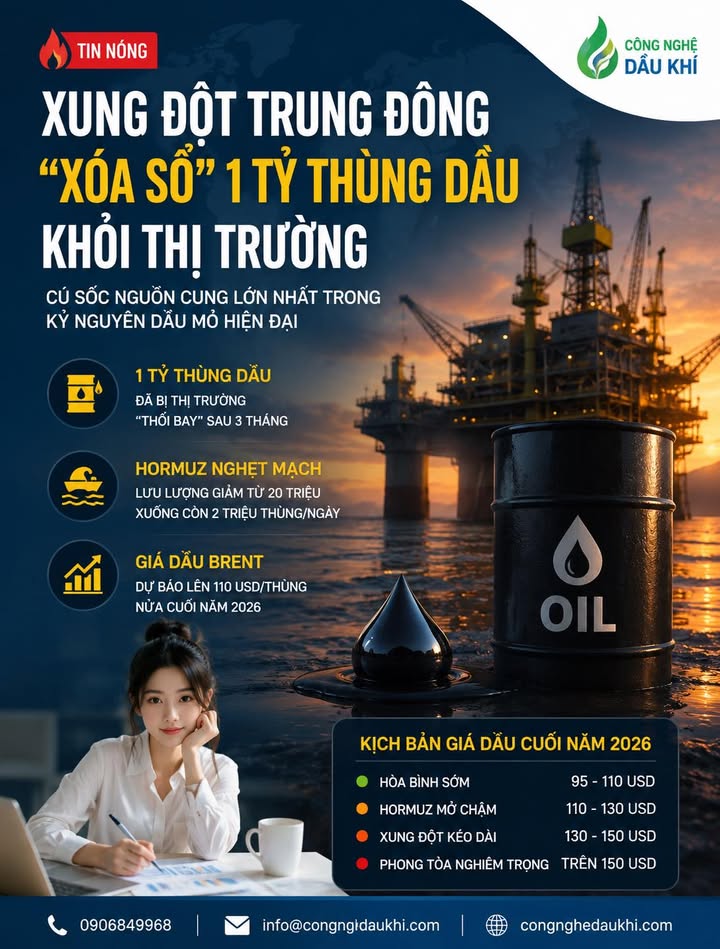
The cumulative loss of oil supply is 1 billion barrels
Forecast by the end of 2026: Nearly 2 billion barrels
Production was interrupted in the Gulf region by 11.8 million barrels/day
Increase further if the war lasts 350 million barrels/month
Hormuz transport level before the crisis was 20 million barrels/dayy
Currently about 2 million barrels/day
What is worrying is that the amount of oil lost cannot be completely recovered even after the war ends.
Experts warn that many oil fields that are closed for a long time will lose natural pressure, causing part of their output to disappear forever.
Hormuz remains the world's biggest choke point
The Strait of Hormuz remains the most important energy shipping lane on the planet.
About 20% of global oil used to pass through this area every day before the conflict broke out.
When Hormuz's operations are restricted, not only crude oil but LNG, condensate and petrochemical products are affected.
Phase Oil Flow Through Hormuz
Before the conflict, 20 million barrels/day
Currently 2 million barrels/day
Forecast 2027 16 million barrels/day
Even in the most optimistic scenario, analysts also believe that it will take until 2027 for Hormuz to approach a normal state.
How high can Brent oil prices rise?
Enverus Intelligence Research has raised its Brent oil price forecast for the second half of 2026 from 95 USD to 110 USD/barrel.
Brent Forecasting Organization
Old forecast was 95 USD/barrel
New forecast 110 USD/barrel
Average in 2027 is 105 USD/barrel
If converted at the exchange rate of about 26,000 VND/USD
110 USD/four barrelequivalent to about 2.86 million VND/barrel of oil.
However, many experts believe that the level of 110 USD still does not fully reflect the risks if the war lasts or Hormuz continues to be blockaded.
Why hasn't oil prices exploded more strongly?
This is a question that surprises many investors.
Three main reasons are keeping oil prices from increasing too sharply
✅ The market still bets that the US and Iran will reach a diplomatic agreement
✅ Investors expect Hormuz to reopen in the third quarter of 2026
✅ OPEC still has some spare capacity
However, if any of these assumptions fail, the market could see a new, very strong rally.
Directly affected industries
Sea transportation
✈️ Aviation
Petrochemical
Logistics
⚡ Electrifying
⛽ Retail gasoline
Economies dependent on energy imports such as Japan, South Korea, India and many European countries will face the greatest pressure.
The most notable scenario at the end of 2026
Impact Scenario
Early Peace Brent 95 - 110 USD
Hormuz opens slowly Brent 110 - 130 USD
Conflict lasts Brent 130 - 150 USD
Severe blockade Could exceed 150 USD
The market is no longer debating whether there is a supply shortage or not. The biggest question right now is the worldHow much more oil will be lost before strategic shipping routes are fully restored?
In your opinion, if the amount of oil lost really approaches 2 billion barrels by the end of the year as forecast, will Brent price stop at 110 USD or will it explode beyond 150 USD/barrel?
#TrungDong #Hormuz #GiaDau #Brent #WTI #OPEC #Iran #MyIran #NangLuong #DauMo #CongNgheDauKhi #OilPrice #EnergyCrisis #KinhTeTheGioi #TaiChinh #DauTho #LNG #XangDau #ThiTruongHangHoa #DauKhiToanCau