#DauMo #WTI #Brent #Iran #My #Hormuz #OPEC #NangLuong #CongNgheDauKhi #ThiTruongDauMo
If more than 13 million barrels of oil per day really return to the market in the short term, will oil prices plummet to below 60 USD/barrel or is the world underestimating the risk of prolonged energy shortages?
Over the past several weeks, many international analytical organizations have begun to suggest the scenario that the global oil market will face a large oversupply in 2027. The main reason comes from the expectation that an agreement between the US and Iran can help cool Middle East tensions, completely reopen the Strait of Hormuz and restore interrupted oil production in the region.
However, many energy experts believe that this assessment may be too optimistic and ignores a series of practical factors.
What Makes Analysts Worry About Oversupply?
During the period of escalating tensions, many oil fields and export facilities in the Middle East were operating below capacity or temporarily halting exploitation.
It is estimated that the total capacity affected could exceed 13 million barrels/day.
Volume Factor
Output bimpact in the Middle East More than 13 million barrels/day
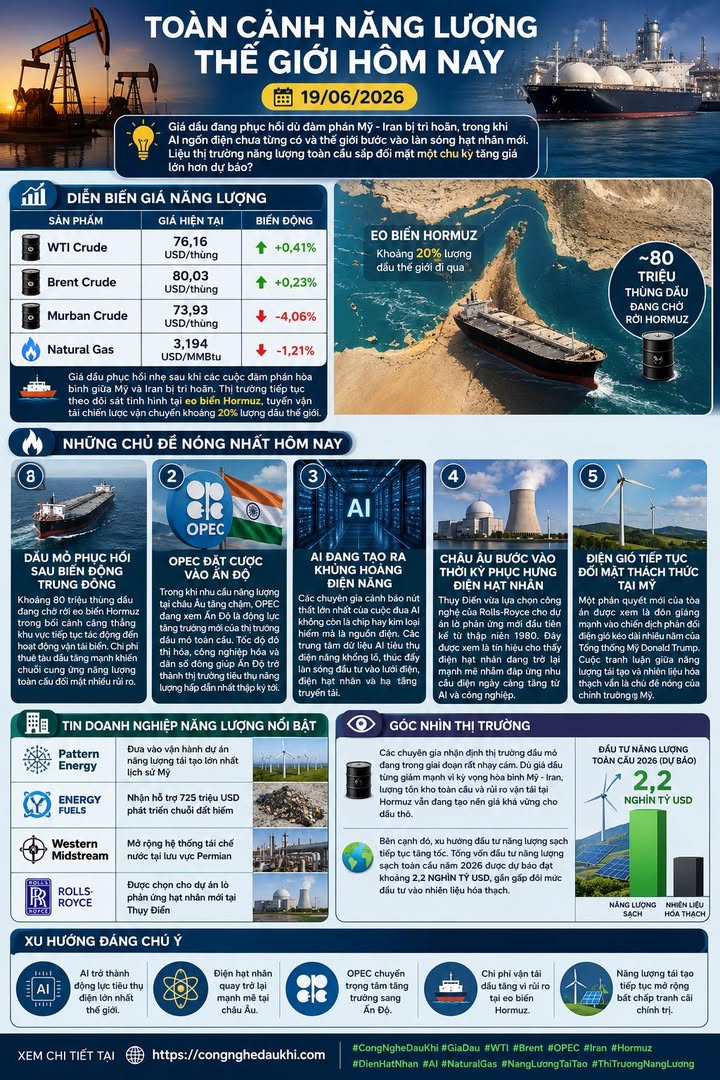
The amount of oil transported through Hormuz is about 20 million barrels/day
Share of global oil trade Nearly 20%
Impacted areas Iran, Iraq, Kuwait, UAE, Saudi Arabia
If all of this supply returns at once, the theory is that oil prices will come under strong downward pressure.
But in reality the energy market has never operated so simply.
The Agreement Is Just a Starting Point
Even if the US and Iran reach a political agreement, the process of restoring oil production cannot take place in just a few days.
Steps to be taken include:
✅ Lift or relax sanctions
✅ Restore the international financial and payment system
✅ Technical inspection of decommissioned oil wells
✅ Bring manpower and equipment back to the scene
✅ Restore the logistics and shipping chain
✅ Increase oil refining and export capacity
This process can take many months, even years.
The World Is Shorter In Inventory Than People Think
One of the most overlooked points is current oil inventory levels.
Besides China, which maintains large reserves, the rest of the world has relatively low inventory levels.
Inventory Status Area
China GaoUS Average
Low Europe
Japan Low
Korea Low
Many developing countries Very low
When supply is restored, a large amount of oil may not go into immediate consumption but be used to rebuild strategic reserves.
This helps absorb the additional supply significantly.
Reopening Hormuz Doesn't Mean Oil Prices Collapse
The Strait of Hormuz is the world's most important energy transport route.
About 20% of global oil trade passes through this region.
As geopolitical risks decline, shipping and shipping insurance costs may cool.
However, that does not mean oil demand has decreased.
Conversely, restored trade activity could also promote increased energy consumption.
Factors That Could Keep Oil Prices High
Demand growth from AI
AI data centers are consuming huge amounts of electricity.
This leads to a sharp increase in demand for natural gas, fuel oil and energy infrastructure investment.
Strategic inventory needs to be replenished
Many countries have used strategic reserves during periods of strong energy price fluctuations.
New supply can be absorbed by re-storage activities.
OPEC Can Adjust Output
If the market shows signsSigns of oversupply, OPEC is fully capable of cutting production to protect oil prices.
Geopolitical Risk Has Not Disappeared
An agreement does not mean all conflicts are resolved.
Any incident in Iran, Iraq, Syria, Yemen or Hormuz could cause the market to reverse quickly.
Oil Price Scenario in the Next 12 Months
Expected Brent Price Scenario
The deal was successful and supply recovered quickly to 65 - 75 USD/barrel
Recovery is slow and inventory is replenished at 75 - 90 USD/barrel
New disruption appears in the Middle East 90 - 120 USD/barrel
Geopolitical crisis recurs strongly Over 120 USD/barrel
Market Perspective
It's worth noting that many current forecasts are assuming everything goes perfectly.
Meanwhile, the history of the oil and gas industry shows that Middle East negotiations are often long, complicated and easily reversed.
Therefore, instead of looking at the figure of 13 million barrels/day and concluding that the market is about to have a large oversupply, investors need to closely monitor the progress of US-Iran negotiations, the speed of recovery of actual production, global inventory levels and the response from OPEC.
The US-Iran agreement, if successful, could be good news for the energy market. But it is not necessarily the end of the cycle of high oil prices. In pediatricsIn many cases, this is just the opening chapter of a tumultuous period of global energy rebalancing.
#DauMo #WTI #Brent #Iran #Hormuz #OPEC #GiaDau #NangLuong #CongNgheDauKhi #ThiTruongNangLuong #KinhTeTheGioi #DauTu #TrungDong #OilMarket #EnergyNews #CongNgheDauKhi