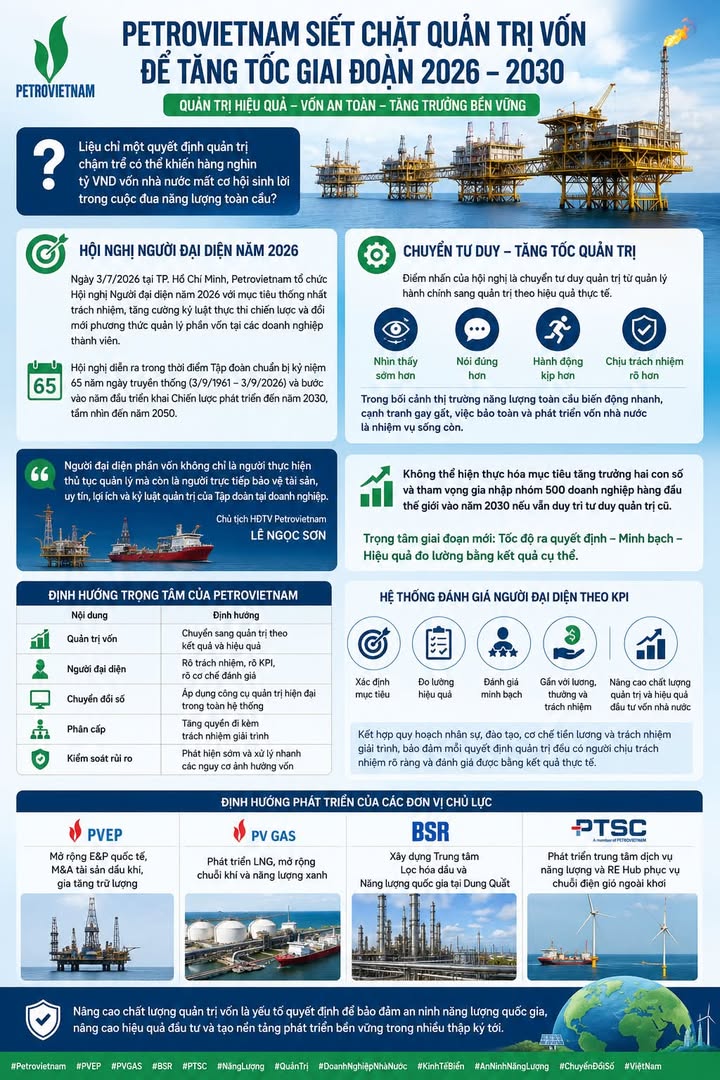
Petrovietnam Tightens Capital Governance to Accelerate Growth Through 2026-2030
In the rapidly evolving global energy landscape, could delayed management decisions cause billions of Vietnamese đồng in state capital to miss out on profitable opportunities? This question looms large as Petrovietnam, Vietnam's national oil and gas conglomerate, implements sweeping governance reforms to secure its position in the competitive energy transition.
Strategic Reorientation at a Critical Juncture
On July 3, 2026, Petrovietnam convened its Representatives Conference in Ho Chi Minh City, marking a pivotal moment in the state-owned enterprise's trajectory. The conference aimed to unify responsibilities, enhance strategic execution discipline, and innovate capital management approaches across its subsidiary companies. The gathering occurs as the corporation prepares to celebrate its 65th anniversary of establishment and enters the first year implementing its Development Strategy through 2030, with a vision extending to 2050.
The conference's central theme represents a fundamental shift in corporate philosophy: transitioning from administrative management to governance based on actual performance. In a global energy market characterized by rapid volatility, intensifying competition, and long-term commercial constraints in gas, electricity, and LNG value chains, preserving and developing state capital has become a matter of survival for the corporation.
Leadership's Vision for Governance Transformation
Mr. Lê Ngọc Sơn, Chairman of Petrovietnam's Member Council, emphasized that capital representatives are not merely procedural administrators but direct guardians of the corporation's assets, reputation, interests, and governance standards within subsidiary enterprises. He mandated that the team of capital representatives must adhere to four critical criteria: see more clearly, speak more accurately, act more promptly, and assume clearer responsibility.
Corporate leadership affirmed that Petrovietnam cannot achieve its double-digit growth targets or its ambition to join the ranks of the world's top 500 companies by 2030 without transforming its governance mindset. This signals that the corporation's new phase will prioritize accelerating decision-making processes, enhancing transparency, and measuring effectiveness through concrete outcomes rather than administrative procedures.
Framework for Enhanced Capital Governance
The conference established a comprehensive framework for improving capital governance across the Petrovietnam ecosystem. This framework focuses on several interconnected pillars designed to create more agile, accountable, and effective management structures.
| Strategic Pillar | Implementation Direction |
|---|---|
| Capital Governance | Transition to management based on results and effectiveness |
| Capital Representatives | Clear responsibilities, clear KPIs, clear evaluation mechanisms |
| Digital Transformation | Implement modern governance tools across the entire system |
| Decentralization | Increased authority accompanied by accountability reporting |
| Risk Control | Early detection and rapid response to capital-threatening risks |
Performance-Based Evaluation System
A particularly significant development is the establishment of a KPI-based evaluation system for capital representatives, integrated with human resource planning, training programs, salary mechanisms, and accountability frameworks. This represents a substantial change designed to ensure that every governance decision has clearly identified responsible parties and can be assessed against actual performance metrics.
The new evaluation framework will replace traditional qualitative assessments with quantitative measures that directly link governance decisions to financial and operational outcomes. This approach aims to eliminate the ambiguity that has sometimes characterized state-owned enterprise governance, where responsibility for outcomes could become diluted across multiple stakeholders.
Strategic Directions for Key Subsidiaries
The conference featured strategic presentations from Petrovietnam's core business units, each outlining ambitious plans aligned with the corporation's overall direction. These subsidiaries form the backbone of Vietnam's energy infrastructure and are critical to the nation's energy security and economic development.
| Subsidiary | Strategic Priorities |
|---|---|
| PVEP (Petrovietnam Exploration and Production) | International E&P expansion, M&A of cash-flow generating oil and gas assets, increasing reserves |
| PV GAS (Petrovietnam Gas) | Strong development of gas and LNG value chains, international business expansion, green energy growth |
| BSR (Bình Sơn Refining and Petrochemical) | Establishment of National Refining and Petrochemical Center at Dung Quat |
| PTSC (Petrovietnam Technical Services) | Development of energy service center and RE Hub for offshore wind power chain |
Specialized Focus Areas and Market Positioning
Each subsidiary is pursuing specialized strategies that leverage their core competencies while addressing emerging opportunities in the global energy transition:
- PVEP is focusing on international exploration and production activities, with particular emphasis on acquiring assets that generate stable cash flows. This strategy aims to secure Vietnam's long-term energy resources while building international operational capabilities.
- PV GAS is developing comprehensive gas and LNG value chains, expanding both domestically and internationally. The subsidiary is also positioning itself as a key player in Vietnam's emerging green energy sector, recognizing the growing importance of renewable energy in the national energy mix.
- BSR is establishing a National Refining and Petrochemical Center at Dung Quat, which will serve as a hub for Vietnam's downstream petroleum industry. This development aims to enhance domestic processing capabilities and reduce dependence on imported refined products.
- PTSC is transitioning from traditional oil and gas services to become an integrated energy service provider with a focus on offshore wind power. The company's RE Hub initiative aims to develop specialized capabilities for Vietnam's rapidly growing offshore wind sector.
Broader Context: Energy Transition and National Security
Petrovietnam's governance reforms occur against a backdrop of rapidly increasing energy demand, accelerating energy transition processes, and intensifying competitive pressures. In this context, enhancing capital quality management has emerged as a decisive factor for ensuring national energy security, improving investment efficiency, and creating a foundation for sustainable development over coming decades.
The corporation's leadership recognizes that traditional governance models may be insufficient to navigate the complex challenges of the 21st-century energy landscape. By implementing more agile, results-oriented governance structures, Petrovietnam aims to position itself as both a national champion in energy security and a competitive player in global energy markets.
Implications for Vietnam's Energy Future
The transformation of Petrovietnam's governance approach carries significant implications for Vietnam's energy future and economic development. As the country continues its rapid industrialization and urbanization, securing reliable, affordable, and sustainable energy sources becomes increasingly critical.
The corporation's emphasis on international expansion, particularly through PVEP's exploration activities and PV GAS's LNG development, reflects Vietnam's strategy to diversify its energy sources and reduce dependence on imported fuels. Meanwhile, the focus on green energy across multiple subsidiaries signals recognition of the global energy transition and Vietnam's commitment to reducing carbon emissions.
Conclusion: A New Paradigm for State-Owned Enterprise Governance
Petrovietnam's comprehensive governance reforms represent a significant evolution in how state-owned enterprises can operate in competitive global markets. By shifting from administrative management to results-based governance, implementing clear accountability mechanisms, and empowering subsidiaries with strategic autonomy, the corporation aims to achieve ambitious growth targets while fulfilling its mandate as guardian of national energy security.
The success of these reforms will depend not only on the implementation of new systems and processes but also on the cultural transformation of the organization. As Petrovietnam embarks on this journey, it serves as a potential model for other state-owned enterprises seeking to balance national objectives with competitive performance in an increasingly complex global environment.
As the energy landscape continues to evolve, Petrovietnam's governance transformation may prove to be a critical factor in determining whether Vietnam can achieve its energy security goals while participating meaningfully in the global energy transition. The corporation's experience will likely provide valuable insights for other developing nations navigating similar challenges in their energy sectors.