Can India surpass the US and Europe to become the world's largest sustainable aviation fuel production center when the aviation industry is seriously lacking in SAF supply?
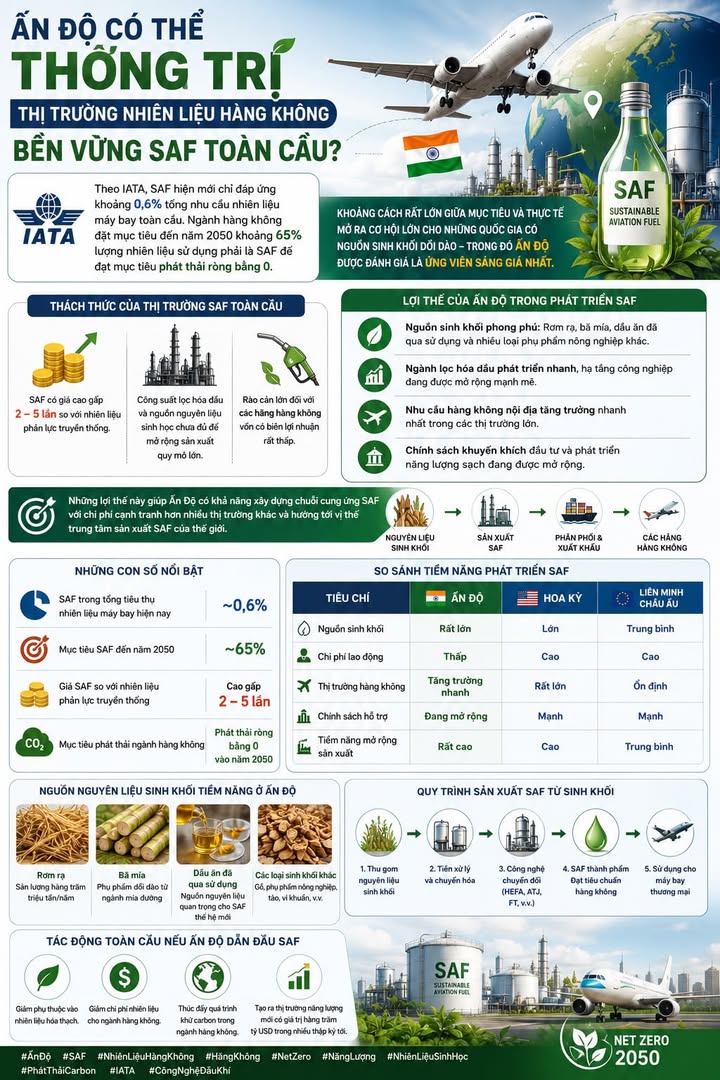
According to the International Air Transport Association IATA, SAF sustainable aviation fuel currently only meets about 0.6% of total global jet fuel demand. Meanwhile, the aviation industry targets that by 2050, about 65% of the fuel used must be SAF to achieve the net zero emissions target.
The huge gap between goals and reality is creating opportunities for countries with abundant biomass resources, of which India is considered one of the brightest candidates.
Currently, SAF still costs 2 to 5 times more than traditional jet fuel. This is a big barrier for airlines, which have very low profit margins. Besides, the world's petrochemical refining capacity and biological raw material resources are still not enough to expand production on a large scale.
India has many benefitsThis is a significant advantage when there are huge sources of agricultural by-products such as straw, sugarcane bagasse, used cooking oil and many other types of biomass. These raw materials can be converted into SAF using many modern technologies without directly competing with food production.
In addition to rich raw material resources, India also has a rapidly growing petrochemical industry, strong domestic aviation demand and policies to encourage investment in clean energy. This gives the South Asian country the ability to build a SAF supply chain at a more competitive cost than many other markets.
Comparison table of SAF development potential
Criteria India United States European Union
Biomass source Very Large Large Medium
Labor costs Low High High
Aviation market Fast growth Very large Stable
Support policy Expanding Manh Manh
Potential for production expansion Very High High Medium
Outstanding data table
Value Indicator
SAF in total aircraft fuel consumption today is about 0.6%
SAF target by 2050 About 65%
SAF price compared to traditional jet fuel is 2 to 5 times higher
Aviation emissions target Net zero emissions by 2050
If India successfully expands SAF production capacity, the countryThis company will not only reduce its dependence on fossil fuels but can also become an important clean fuel supplier for the Asian region and the world. That will contribute to reducing fuel costs, promoting decarbonization of the aviation industry and creating a new energy market worth hundreds of billions of dollars over the next decades.
#India #SAF #AviationFuel #Aviation #NetZero #Energy #Biofuel #CarbonEmissions #IATA #OilGasTechnology