If we continue to wait for the perfect electricity market to expand DPPA, will Vietnam lose the opportunity to attract investment and retain large export corporations?
The DPPA direct electricity trading mechanism is becoming one of the most important links in the process of reforming Vietnam's electricity industry. According to analysis by Dr. Nguyen Huy Hoach of the Scientific Council of Vietnam Energy Magazine announced on July 24, 2026, the current key issue is no longer choosing between DPPA and the competitive electricity market, but rather building a roadmap for these two processes to develop in parallel, support each other and not cause insecurity for the national electricity system.
DPPA allows renewable energy generators to sign contracts to sell electricity directly to large electricity users, instead of just selling all output through a single buyer model. This mechanism helps businesses proactively choose clean power sources, while generators have the ability to find customers, sign long-term contracts and mobilize capital.ho project.
The meaning of DPPA is therefore not limited to a commercial contract. When customers have the right to choose suppliers and generators have the right to choose buyers, the market begins to show clearer signs of competition in electricity prices, service quality, clean energy ratio and supply stability.
The Government's issuance of Decree No. 57/2025/ND-CP and Decree No. 243/2026/ND-CP is considered an important step in the process of realizing DPPA in Vietnam. The new framework expands access to renewable electricity for large electricity users, especially exporting businesses that are under pressure to reduce emissions and demonstrate energy origins in the supply chain.
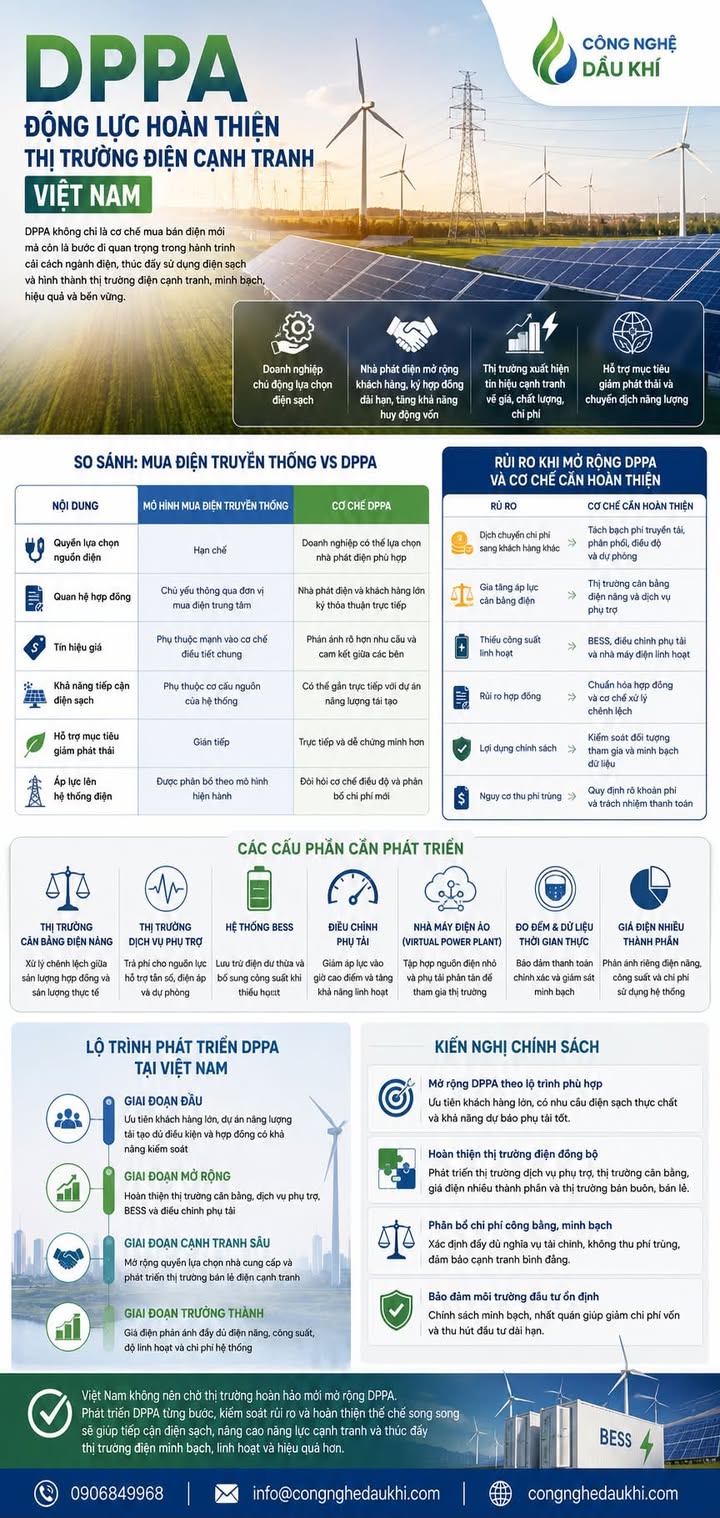
Contents of Traditional electricity purchasing model DPPA mechanism
Right to choose power source Restrictions Businesses can choose the appropriate power generator
Contractual relations Mainly through the central electricity purchasing unit. Generators and large customers sign direct agreements
Price signals Strongly depend on the common regulatory mechanism. Reflect more clearly the needs and commitments between parties
Access to clean electricity Depends on the system's source structure. Can be directly tied to renewable energy projects
Target supportreduce emissions Indirect Direct and easier to demonstrate
Pressure on the power system Allocated according to the current model Requires a new dispatching and cost allocation mechanism
The biggest debate today is whether Vietnam should wait for the competitive electricity market to fully operate before expanding DPPA. A cautious view is that large customers switching to buying electricity directly can change revenue streams, methods of mobilizing power sources and cost allocation mechanisms throughout the system.
These concerns are well-founded because the cost of an electrical system is not just about the amount of electricity consumed. The system also has to pay for transmission, distribution, dispatching, capacity backup, maintaining frequency, balancing supply and demand and handling unusual fluctuations. Even if businesses sign contracts directly with wind or solar power plants, the national power system must still be ready to provide electricity when renewable sources decline due to weather.
DPPA customers are often industrial plants with large electricity consumption, high load factors and significant contributions to the overall revenue of the electricity industry. If these businesses leave the traditional electricity purchasing mechanism but do not fully pay the costs of using the grid, dispatching and backupIn addition, part of the burden may be shifted to households or businesses that do not participate in the DPPA.
Wind and solar power sources also have fluctuating characteristics. Output can vary by hour, weather and season, while industrial production requires constant power. The system therefore still needs flexible power plants, energy storage batteries, load regulation programs and ancillary services to make up the difference.
Risks when expanding DPPA Cause Mechanism needs to be improved
Shifting costs to other customers DPPA participants have not fully paid system costs Separating transmission, distribution, dispatch and backup costs
Increasing pressure on power balance Wind power and solar power fluctuate Power balance market and ancillary services
Lack of flexible capacity Base power source and storage have not yet developed synchronous BESS, load adjustment and flexible power plants
Contract risks Market price and actual output fluctuate. Contract standardization and difference handling mechanism
Taking advantage of policies Expanding too quickly when monitoring is limited Controlling participants and data transparency
Risk of duplicate fees Price components have not been clearly separated. Clearly defined fees and responsibilitiespayment responsibility
However, the conclusion that we must wait for the electricity market to be absolutely perfect before developing DPPA is not consistent with reform practice. An electricity market cannot be completed with regulations on paper alone. The competition mechanism must be tested through actual transactions, business feedback, moderation activities and the ability to handle arising situations.
International experience shows that DPPA is often implemented concurrently with the process of opening and reforming the electricity market. The need to buy clean electricity from industrial customers has created pressure on management agencies to make electricity prices transparent, improve the metering system, build a balanced market and develop operational support services.
DPPA therefore both depends on the competitive electricity market and can become a driving force for market development. As the number of live transactions increases, the need to properly value transmission, spare capacity, flexibility and dispatching services becomes clearer. This is a condition for electricity prices to more fully reflect the cost of the system.
Vietnam should continue to expand DPPA in a controlled manner, giving priority to electricity customers firsthave good load forecasting ability and have a real need for clean electricity. This group often includes businesses that produce export goods, data centers, electronics, textile, steel, chemical factories and corporations that have made commitments to reduce emissions.
Mass expansion to small customers during the period of incomplete monitoring, payment and cost allocation systems can increase management costs, arise disputes and create the risk of taking advantage of the mechanism. An appropriate roadmap needs to link the scale of DPPA expansion with the actual operating capacity of the power system.
Another urgent need is to develop the ancillary services market. When the proportion of wind and solar power increases, the system needs more resources that can react quickly to maintain stable frequency, voltage and balance supply and demand. These resources must be compensated accordingly rather than continuing to be viewed as a free support obligation.
The BESS energy storage battery system can store electricity when renewable sources are surplus and generate electricity when demand increases. Load adjustment programs can encourage businesses to reduce or shift electricity demand away from peak hours. Virtual power plants can aggregate thousands of distributed power sources and storage systemsand flexible loads to enter the market as a unified unit.
Components to be developed Role for DPPA and power system
Power balancing market Handles the difference between contract output and actual output
Ancillary Services Market Pay for frequency, voltage, and redundancy support resources
BESS system Stores excess electricity and supplements capacity when there is a shortage
Adjust load Reduce pressure during peak hours and increase flexibility
Virtual power plant Brings together small power sources and distributed loads to participate in the market
Real-time measurement and data Ensure accurate payments and transparent monitoring
Multi-component electricity price Reflects electricity, capacity and system usage costs separately
NSMO National Electricity System and Market Operating Company plays a particularly important role in the new model. Operators must have access to complete data, accurate forecasting systems and modern dispatching tools to handle the variability of renewable energy sources as well as direct power purchase contracts.
The system cost allocation mechanism needs to be built according to the principles of fairness, transparency and no duplicate fees. DPPA customers still use transmission and distribution gridsdistribution, metering system, dispatching services and backup power of the national power system. Therefore, they must pay correctly and fully for the actual services used.
On the contrary, the fees must also be publicized and clearly separated to avoid businesses paying the cost in the DPPA contract while continuing to bear a similar fee in the electricity price or system service price. This transparency directly determines business confidence and the ability to attract long-term investment capital.
For renewable energy projects, policy stability is as important as electricity prices. Wind power plants, solar power plants and storage systems often have long payback periods. If price regulations, grid usage fees, differential payments or participation conditions change continuously, investors will demand higher returns to compensate for the risk.
Increased capital costs will eventually be reflected in the electricity selling price for businesses. A highly predictive legal framework therefore not only protects investors but also helps reduce clean electricity prices in the long term.
Vietnam's DPPA development roadmap needs to be associated with the process of completing a competitive wholesale and retail electricity market. Each step expands the number of participantsThe pass comes with upgraded transmission infrastructure, metering systems, data platforms, payment mechanisms and monitoring capacity.
Implementation Focus Phase
First phase Prioritize large customers, qualified renewable energy projects and controllable contracts
Expansion phase Complete market balancing, ancillary services, BESS and load regulation
Deep competition phase Expand supplier choice and develop a competitive electricity retail market
Maturity stage Electricity prices fully reflect electricity, capacity, flexibility and system costs
Electricity Law No. 61/2024/QH15, Decree No. 57/2025/ND-CP and Decree No. 243/2026/ND-CP have created an important foundation for the DPPA development process. However, the effectiveness of the mechanism will depend on the quality of implementation, data transparency, dispatch capacity and the ability to fairly resolve interests between generators, DPPA customers, grid operators and remaining customer groups.
Vietnam should not choose to delay reform until all conditions become perfect. A more appropriate approach is to expand DPPA step by step, controlling risks at each stage and using the problems that arise in practice.n to continue improving the institution.
If properly organized, DPPA will help businesses access clean electricity, improve their ability to meet export standards, promote investment in renewable energy and create a clearer signal of competition in the electricity market. More importantly, this mechanism can become a real test of the capacity to reform Vietnam's electricity industry, from a model dependent on a single buyer to a more transparent, flexible and efficient market.