Can a Vietnamese oil refining enterprise turn a geopolitical crisis into a record growth opportunity, or is this just a temporary result thanks to rising oil prices?
Vietnam Refining and Petrochemical Corporation, BSR, recorded the highest production and business results since coming into operation in the first 6 months of 2026, despite the world oil market continuously fluctuating due to conflicts in the Middle East, risks of transport disruption through the Strait of Hormuz, increased logistics costs and the USD/VND exchange rate remaining at a high level.
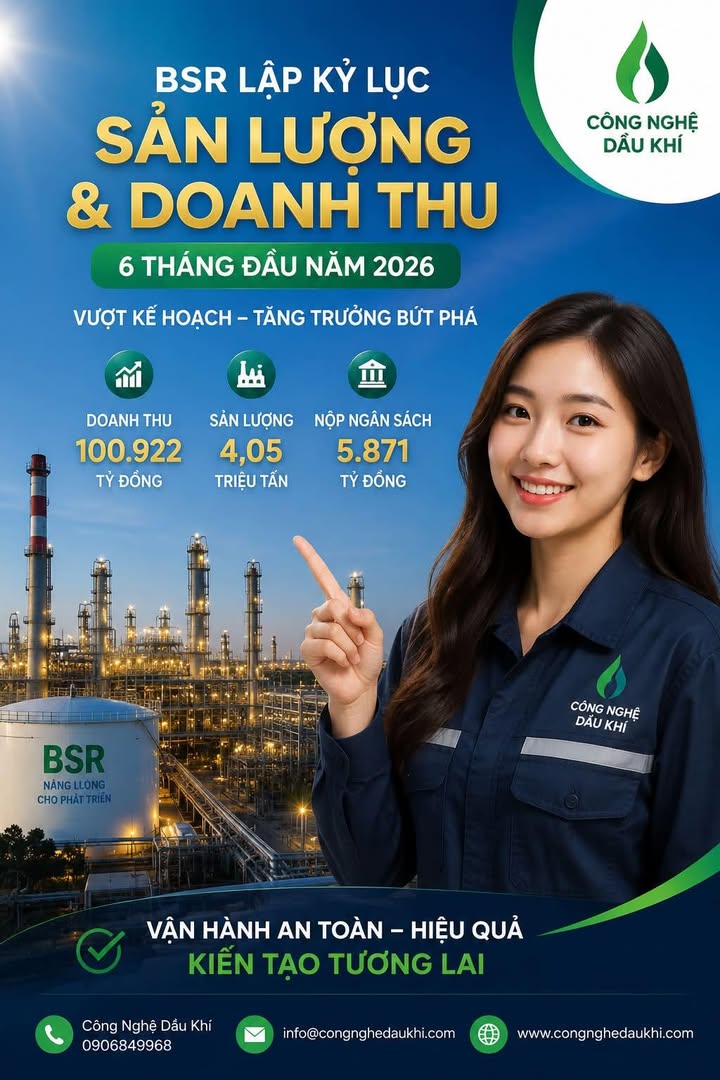
BSR's consolidated revenue is estimated to reach 100,922 billion VND, an increase of about 45% over the same period in 2025. State budget payment reaches 5,871 billion VND. Production output exceeded 4.05 million tons, while consumption output reached more than 4.03 million tons. Dung Quat Oil Refinery maintains stable operation with an average converted capacity of about 124% of design capacity, the highest level in its operating history.
Targets for the first 6 months of 2026 Results
Consolidated revenue 100,922 billion VND
Growth over the same period About 45%
Submit house budgetwater 5,871 billion VND
Production output More than 4.05 million tons
Consumption output: More than 4.03 million tons
Average conversion capacity About 124%
Number of safe working hours: More than 57.5 million hours
Crude oil capacity after completing tank No. 9 585,000 m³
The above results were formed in the context of the average Brent oil price in the first 6 months of the year reaching about 93.54 USD per barrel, up more than 30% over the same period. Oil prices and the price difference between crude oil and gasoline, diesel, and aviation fuel products in Asia remain at favorable levels, thereby significantly improving the processing profit margin of Dung Quat Oil Refinery.
According to data announced at the preliminary conference, oil price developments and processing profit margin contributed about 26,765 billion VND, equivalent to 85.6% of the increase in revenue compared to the same period in 2025. Operating solutions, optimizing the structure of raw materials, products, inventory and costs contributed an additional about 1,261 billion VND.
The notable point is that BSR does not just passively benefit from oil prices. When geopolitical tensions escalated, the business quickly established a working group directly directed by General Director Nguyen Viet Thang, continuously monitored the market and built 15 operating scenarios for short- and medium-term situations.term and long term.
Scenarios focus on ensuring crude oil sources, adjusting import plans, controlling inventory, managing cash flow, preventing price risks and choosing a product structure suitable to market demand. BSR increased the output of Jet A-1, diesel and other products with high economic value, and expanded processing activities outside Dung Quat Oil Refinery to increase the total system equivalent capacity to 124%.
This strategy shows that volatility management capacity has become the decisive factor. In the oil refining industry, large revenue does not mean certain profits because input material prices, output product prices, inventory costs, exchange rates and transportation can change drastically in just a short time. Operating at high capacity is only effective when the business simultaneously controls the crude oil structure, import schedule, sales output and safety inventory level.
BSR also achieved more than 57.5 million safe man-hours, showing that record output was not at the expense of loosening operating standards. This is a particularly important factor for a petrochemical refinery complex with equipment systems that operate continuously under conditions of high temperature, pressure and risk.
Besides business activitiesTraditionally, BSR is promoting a shift to green fuels and higher value-added products. Dung Quat Ethanol Plant was restored to operation to supply E100 for the national biofuel program. From May 2026, the enterprise will officially produce and widely supply E10 RON95 biofuel.
The development of E10 gasoline is of great significance in the context of Vietnam's need to reduce dependence on fossil fuels, lower emissions and create more output for domestic biological raw materials. However, the effectiveness of the program also depends on the ability to ensure a stable source of ethanol, uniform quality, competitive price and a wide enough distribution system.
BSR was also asked by Petrovietnam to further research on sustainable aviation fuel SAF, expand the petrochemical field and strengthen links with Nghi Son Refining and Petrochemical Company Limited. If implemented effectively, this orientation can help businesses gradually reduce their dependence on traditional petroleum and participate in higher-value segments.
The Dung Quat Oil Refinery Upgrade and Expansion Project has entered the EPC implementation phase. This is a project of strategic significance for the ability to increase capacity and diversify oil sourcesraw materials, improve product quality and meet increasingly high environmental standards.
However, the project also faces great pressure from prices of materials, industrial equipment, transportation costs and exchange rate fluctuations. BSR needs to strictly control progress, total investment, contractor quality and the ability to synchronize the existing system with the extension. Any delays or capital overruns can directly impact financial performance for many years.
In operations management, BSR is promoting the application of artificial intelligence, Digital Twin and 3D printing technology. Digital Twin allows building digital models of equipment and production lines, supporting monitoring of operating status, predicting damage and optimizing maintenance plans. 3D printing technology can shorten the manufacturing time of some replacement parts, reduce dependence on imported supplies and limit machine downtime.
The completion of crude oil tank No. 9 has increased the total capacity to 585,000 m³, helping BSR increase its ability to reserve raw materials, be more proactive in facing the risk of transportation interruptions and flexibly choose the time to import oil. The tank truck export system has been upgraded, increasing export capacity by about 45%, contributing to reducing pressure at the delivery stage and improving efficiency.supply chain results.
BSR also made its mark when it changed its name to Vietnam Refining and Petrochemical Corporation, was awarded the First Class Labor Medal by the President, continued to be in the Top 10 Vietnam Green ESG Enterprises and included BSR shares in the VN30 basket after moving to list on the Ho Chi Minh City Stock Exchange in 2025.
Although the results of the first half of the year are very positive, the outlook for the last 6 months of the year still contains many variables. Oil prices could fall if geopolitical tensions cool or global supply increases. Refining profit margins are at risk of narrowing as factories in the region increase capacity. Petroleum consumption demand can also be influenced by economic growth, monetary policy and the shift to electric vehicles.
Factors supporting growth Risks need to be controlled
High operating capacity Strong fluctuations in oil prices
Favorable oil refining profit margin Risk of product oversupply
Jet A-1 and diesel demand increases Logistics and insurance costs
Expanding E10 gasoline and green fuel USD/VND exchange rate is at a high level
Upgrading the storage and sales system EPC project progress risks
Application of AI and Digital Twin Increased costs of equipment and supplies
BSR's performance in the first half of 2026 reflects the kCombining favorable market conditions, high operating capacity, quick response ability and strong links in the Petrovietnam value chain. More importantly, the business has maintained the petroleum supply flow during a period of risky international markets, thereby contributing to ensuring national energy security.
The biggest challenge today is no longer setting another short-term revenue record, but converting accumulated resources into long-term competitiveness, completing upgrade projects on schedule, expanding petrochemicals, developing green fuels and maintaining efficiency when the oil price cycle reverses.