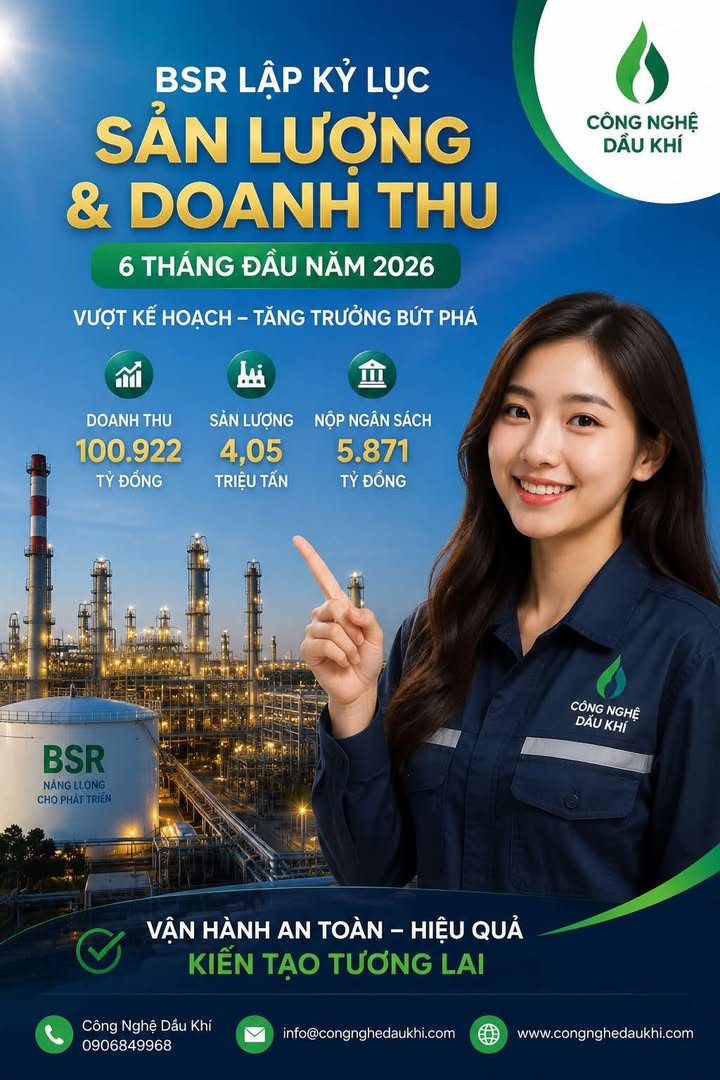
BSR Achieves Record Revenue and Production Amid Global Energy Market Volatility
In an era marked by geopolitical tensions and energy market uncertainty, Vietnam's state-owned oil refining giant, BSR (Binh Son Refinery and Petrochemical Company), has demonstrated remarkable resilience by achieving unprecedented financial and production metrics in the first half of 2026. The company's performance not only sets new records in its operational history but also raises important questions about the sustainability of such growth in an increasingly volatile global energy landscape.
Historic Performance Metrics
BSR has reported consolidated revenue of approximately 100,922 billion Vietnamese dong (about $4.1 billion), marking a remarkable 45% increase compared to the same period in 2025. The company's contributions to the national budget reached 5,871 billion dong, underscoring its significant economic impact. Production volume exceeded 4.05 million tons, while sales volume surpassed 4.03 million tons, reflecting strong market demand and efficient operations.
Perhaps most impressively, the Dung Quat Refinery maintained stable operations with an average converted capacity of approximately 124% of design capacity—the highest level in the facility's operational history. This exceptional performance was achieved while maintaining rigorous safety standards, with the company recording over 57.5 million safe working hours.
| BSR Performance Summary: First Half 2026 | |
|---|---|
| Indicator | Result |
| Consolidated Revenue | 100,922 billion VND |
| Year-over-Year Growth | Approximately 45% |
| Tax Payments to State Budget | 5,871 billion VND |
| Production Volume | Over 4.05 million tons |
| Sales Volume | Over 4.03 million tons |
| Average Converted Capacity | Approximately 124% |
| Safe Working Hours | Over 57.5 million hours |
| Total Crude Oil Storage Capacity | 585,000 m³ |
Favorable Market Conditions
BSR's record performance occurred against a backdrop of favorable market conditions. The average Brent crude price reached approximately $93.54 per barrel during the first half of 2026, representing more than a 30% increase compared to the same period in 2025. Additionally, the price spread between crude oil and refined products in Asia remained advantageous, significantly improving the facility's refining margins.
Market analysis presented during BSR's mid-year conference revealed that favorable oil prices and refining margins contributed approximately 26,765 billion VND to revenue growth—equivalent to 85.6% of the total increase compared to the previous year. Operational optimization strategies, including raw material and product structure optimization, inventory management, and cost control, contributed an additional 1,261 billion VND.
Strategic Risk Management
What distinguishes BSR's achievement is that the company did not passively benefit from favorable market conditions. As geopolitical tensions escalated, BSR established a special task force directly supervised by General Director Nguyen Viet Thang. This team continuously monitored market developments and developed 15 operational scenarios covering short-term, medium-term, and long-term contingencies.
These scenarios focused on ensuring crude oil supply, adjusting import plans, controlling inventory, managing cash flow, preventing price risks, and selecting product structures aligned with market demand. BSR strategically increased production of high-value products such as Jet A-1 and diesel while expanding external processing activities to boost the system's overall capacity to 124%.
Strategic Initiatives and Future Directions
Beyond traditional refining operations, BSR is actively pursuing a strategic transformation toward greener fuels and higher-value products. The company has resumed operations at the Dung Quat Ethanol plant to supply E100 for Vietnam's national biofuel program. Since May 2026, BSR has officially produced and widely supplied E10 RON95 gasoline—a significant development given Vietnam's need to reduce fossil fuel dependence, lower emissions, and create additional outlets for domestic biofeedstocks.
BSR has also been directed by Petrovietnam to conduct in-depth research on sustainable aviation fuel (SAF), expand petrochemical operations, and strengthen cooperation with Nghi Son Refinery and Petrochemical Company. These initiatives, if successfully implemented, could help the company gradually reduce its dependence on traditional petroleum products and participate in higher-value market segments.
Digital Transformation and Technological Advancement
BSR is accelerating its digital transformation by implementing artificial intelligence, Digital Twin technology, and 3D printing. The Digital Twin approach allows for the creation of digital models of equipment and production lines, enabling real-time operational monitoring, failure prediction, and maintenance optimization. 3D printing technology can reduce manufacturing time for certain replacement components, decreasing reliance on imported supplies and minimizing downtime.
The completion of crude oil tank number 9 has increased total storage capacity to 585,000 m³, enhancing BSR's ability to stockpile raw materials, respond proactively to potential transportation disruptions, and flexibly choose optimal import timing. The company has also upgraded its bulk loading system, increasing sales capacity by approximately 45% and reducing pressure at the delivery and reception stages, thereby improving supply chain efficiency.
Recognition and Corporate Evolution
BSR's achievements have been recognized through several notable milestones. The company officially changed its name to Vietnam Oil and Petrochemical Corporation, received the First Class Labor Medal from the President of Vietnam, maintained its position among Vietnam's Top 10 Green ESG Enterprises, and was included in the VN30 index after transferring its listing to the Ho Chi Minh City Stock Exchange in 2025.
Strategic Expansion Project
The Dung Quat Refinery Upgrade and Expansion Project has entered the EPC (Engineering, Procurement, and Construction) implementation phase. This project strategically enhances capacity, diversifies crude oil input sources, improves product quality, and meets increasingly stringent environmental standards.
However, the project faces significant challenges from rising prices of industrial materials and equipment, transportation costs, and exchange rate fluctuations. BSR must strictly control project timelines, total investment costs, contractor quality, and ensure proper integration between existing systems and expansion components. Any delays or cost overruns could directly impact financial performance for many years.
Outlook and Challenges
Despite the positive first-half results, the outlook for the remainder of 2026 contains numerous variables. Oil prices could decline if geopolitical tensions ease or global supply increases. Refining margins may narrow as regional refineries boost capacity. Fuel demand could be affected by economic growth trends, monetary policies, and the shift toward electric vehicles.
| Growth Drivers and Risk Factors for BSR | |
|---|---|
| Growth Drivers | Risk Factors |
| High operating capacity | Volatility in oil prices |
| Favorable refining margins | Risk of product oversupply |
| Increased demand for Jet A-1 and diesel | Rising logistics and insurance costs |
| Expansion of E10 and green fuels | Strong USD/VND exchange rate |
| Upgraded storage and distribution systems | Risks to EPC project timeline |
| Application of AI and Digital Twin | Rising equipment and material costs |
Conclusion: Beyond Short-Term Records
BSR's first-half 2026 performance reflects a combination of favorable market conditions, high operating capacity, rapid response capabilities, and the strength of Petrovietnam's value chain integration. More importantly, the company has maintained fuel supply during a period of significant international market risks, contributing to national energy security.
The greatest challenge now is not achieving additional short-term revenue records, but transforming accumulated resources into long-term competitive capabilities, completing the upgrade project on schedule, expanding petrochemical operations, developing green fuels, and maintaining effectiveness when the oil price cycle reverses.
BSR's experience demonstrates that in the refining industry, large revenue does not guarantee certain profitability, as raw material costs, product prices, inventory costs, exchange rates, and transportation expenses can change dramatically in short periods. High operating capacity is only effective when a company simultaneously controls crude oil structure, import schedules, sales volumes, and safe inventory levels.
As Vietnam continues its economic development while addressing environmental commitments, BSR's strategic transformation toward higher-value products and greener energy solutions positions the company as a critical player in the nation's energy transition and economic future.