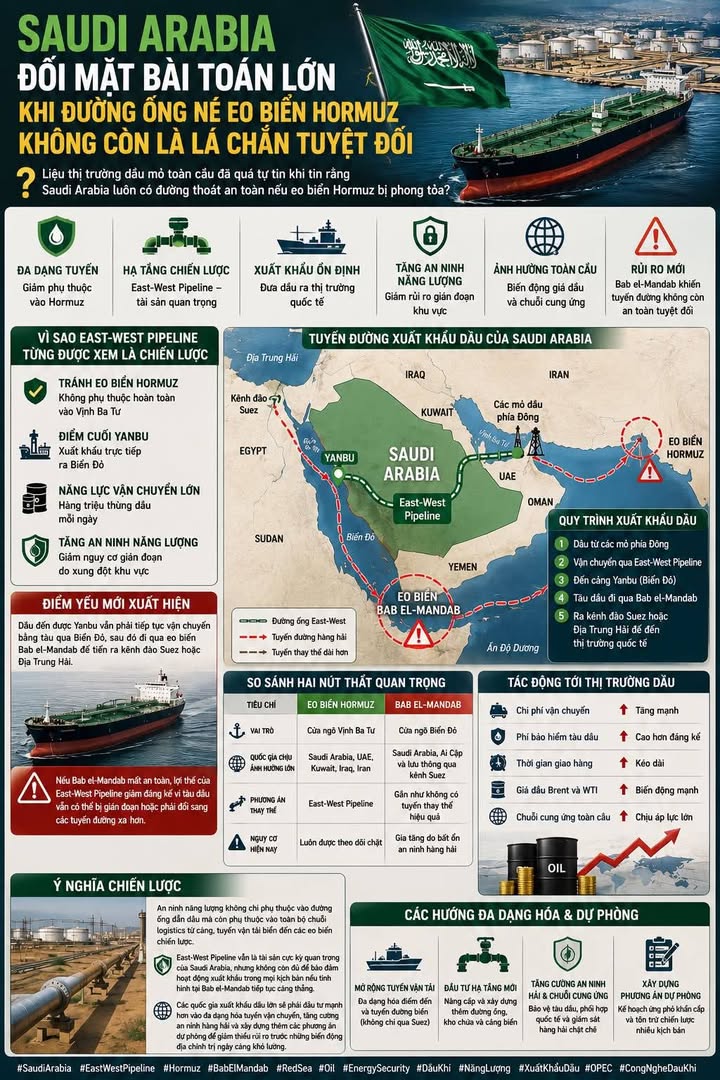
Is the global oil market too confident to believe that Saudi Arabia always has a safe way out if the Strait of Hormuz is blocked?
For many years, Saudi Arabia's energy security strategy has been considered one of the most effective contingency plans in the world. If the Strait of Hormuz becomes conflicted or disrupted, crude oil from eastern fields can be transported via the East-West Pipeline to the port of Yanbu on the Red Sea coast, then continue to export to international markets without going through Hormuz.
However, recent developments in the Red Sea and especially the Bab el-Mandab area have completely changed this perspective. The route once considered a "strategic escape route" now also faces many maritime security risks, making Saudi Arabia's ability to export oil no longer absolutely safe as before.
Why was the East-West Pipeline once considered strategic?
Benefit Factor
Avoid the Strait of Hormuz Do not depend entirely on the Persian Gulf
Yanbu Export Endpointu directly to the Red Sea
Large transportation capacity Millions of barrels of oil per day
Increased energy security Reduced risk of disruption due to regional conflicts
Thanks to this system, Saudi Arabia is always considered the country best able to respond if Hormuz encounters a crisis.
New weaknesses appear
The problem is that the oil that reaches Yanbu must continue to be transported by ship through the Red Sea, then go through the Bab el-Mandab Strait to reach the Suez Canal or the Mediterranean.
If Bab el-Mandab becomes unsafe, the East-West Pipeline's advantage is significantly reduced because tankers can still be interrupted or have to change to further routes.
Compare two important knots
Criteria Strait of Hormuz Bab el-Mandab
Role of Persian Gulf Gateway Red Sea Gateway
Countries heavily influenced Saudi Arabia, UAE, Kuwait, Iraq, Iran Saudi Arabia, Egypt and traffic through the Suez Canal
East-West Pipeline Alternative There is virtually no effective alternative route
Current risks Always closely monitored Increased due to maritime security instability
Impact on the oil market
If both Hormuz and Bab el-Mandab face risks, the energy market will witness many notable consequences.
Impact Influence level
Shipping costs increased sharplyTanker insurance premiums are significantly higher
Delivery time Extended
Brent and WTI oil prices May fluctuate widely
Global supply chain Under great pressure
Not only Saudi Arabia, Gulf oil exporting countries and many international shipping businesses will also be affected if strategic maritime routes continuously become unstable.
Strategic significance
Current developments show that energy security depends not only on oil pipelines but also on the entire logistics chain from ports, shipping routes to strategic straits. The East-West Pipeline remains an extremely important asset for Saudi Arabia, but it is no longer enough to ensure export operations in all scenarios if the situation at Bab el-Mandab continues to be tense.
This change is also a reminder that major oil exporting countries will have to invest more heavily in diversifying shipping routes, enhancing maritime security and building more contingency plans to minimize risks in the face of increasingly unpredictable geopolitical fluctuations.
#SaudiArabia #EastWestPipeline #Hormuz #BabElMandab #RedSea #Oil #EnergySecurity #OilGas #Energy #OilExport #OPEC #CongNgheDauKhi