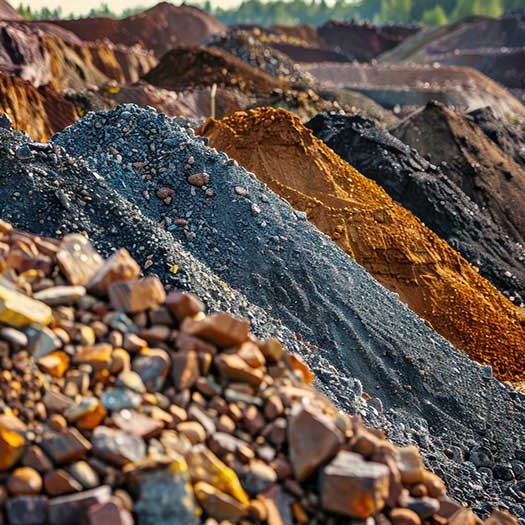
China's Rare Earth Strategy Fu Manufacturing Revolution in the United States
In an escalating geopolitical battle over critical minerals, China is implementing a comprehensive strategy to bring rare earth production fully within its borders. Recent export restrictions by Beijing specifically target the United States' plans to commence commercial production of rare earth magnets by 2027. In response, REalloys (NASDAQ: ALOY) is restructuring every major phase of the North American rare earth industry, creating a vertically integrated supply chain designed to operate independently of Chinese materials.
The Geopolitical Significance of Rare Earth Elements
Rare earth elements (REEs) have become increasingly critical to modern technology, defense systems, and clean energy applications. These 17 chemically similar elements are essential for producing permanent magnets, batteries, electronic components, and military equipment. China currently dominates the rare earth supply chain, controlling approximately 80% of global processing and refining capabilities.
The strategic importance of these minerals has prompted both nations to reassess their positions. China aims to leverage its dominance as a geopolitical tool, while the United States is working to establish a domestic supply chain to reduce dependency on foreign sources, particularly from China.
REalloys' Comprehensive Restructuring Strategy
Over the past two years, REalloys has assembled an integrated supply chain spanning from mining to magnet production. This includes heavy rare earth materials, separation processes, alloy production, and permanent magnet manufacturing, all designed to operate independently from Chinese-sourced materials. The company's first commercial facilities are expected to commence operations in the coming year, coinciding with the implementation of the Pentagon's ban on Chinese-origin rare earth magnets.
Facing increasing pressure from Chinese export restrictions and the impending Pentagon procurement ban, REalloys has emerged as a cornerstone in the reconstruction of America's rare earth industry. The Defense Logistics Agency (DLA) has supported the company's alloy production technology, institutional investors have committed approximately $100 million to accelerate construction, and the U.S. Army has selected REalloys to build the first commercial heavy rare earth processing facility at a U.S. military base.
China's Four-Step Rare Earth Control Campaign
China's campaign is advancing methodically, with each new measure tightening Beijing's control over the global rare earth industry. The strategic steps being implemented by Beijing include:
- Step 1: Licensing - China requires exporters to obtain approval before shipping critical rare earth materials abroad, creating bureaucratic hurdles for international suppliers.
- Step 2: Targeting Specific Companies - China has placed U.S. rare earth companies, including MP Materials and USA Rare Earth, on export control lists, directly targeting American efforts to establish domestic rare earth production.
- Step 3: Enforcement - China has established a public reporting system for suspected export violations related to strategic minerals, increasing transparency while creating additional compliance burdens.
- Step 4: Creating Fear - Arrests of foreign nationals and domestic enforcement actions have made suppliers increasingly cautious about engaging in international rare earth trade.
The result is a supply chain that has become increasingly challenging for Western companies to navigate. Even when materials are technically available, licensing requirements, paperwork, delays, and enforcement risks make Chinese-sourced supply less reliable with each new regulation.
REalloys' Solution: Complete Supply Chain Reconstruction
REalloys' solution is to rebuild the entire supply chain to avoid China, turning Beijing's restrictions into their own strategic opportunity. The company achieved a significant milestone in June, raising approximately $100 million from institutional investors to accelerate its mining-to-magnets platform, including the largest rare earth alloy production facility outside China.
| Supply Chain Stage | Key Activities | Strategic Objectives |
|---|---|---|
| Upstream | Securing non-Chinese raw material sources | Providing feedstock for alloy production |
| Midstream | Converting raw materials into alloys | Countering China's monopoly in this critical segment |
| Downstream | Manufacturing permanent magnets | Serving defense and industrial manufacturing sectors |
Strategic Partnerships and Investment Approach
REalloys is not limiting its strategy to production alone; the company is collaborating with permanent magnet manufacturers to develop the first integrated production platform without Chinese origins. This combination will create a complete supply chain from raw materials, separation, alloy production to permanent magnet manufacturing.
The REalloys leadership team comprises experienced individuals from the defense and industrial sectors, demonstrating a strong commitment to ensuring supply chain security for the United States. They view this as a significant opportunity to challenge China's assumption that the West would continue to depend on Beijing for defense needs.
REalloys, alongside companies like MP Materials, is expanding beyond mere mining to encompass the entire production chain. This represents a major shift in the industry, from merely extracting raw materials to securing the entire supply chain domestically.
The Path Forward: Toward U.S. Rare Earth Independence
The U.S. rare earth strategy involves multiple parallel initiatives:
| Initiative | Key Players | Timeline | Strategic Impact |
|---|---|---|---|
| Mining and Processing | MP Materials, Lynas Rare Earths | 2023-2025 | Establishing domestic extraction capabilities |
| Alloy Production | REalloys, Strategic Materials | 2024-2026 | Breaking China's processing monopoly |
| Magnet Manufacturing | REalloys, Magnetek, Arnold Magnetic | 2025-2027 | Creating end-to domestic supply chain |
| Defense Integration | U.S. Army, Navy, DLA | Ongoing | Securing defense supply chain |
Conclusion: The New Front in Industrial Manufacturing
As commercial production approaches, with additional private investment supplementing government funding and changing defense procurement regulations, the rare earth war is shifting from policy documents to factory floors. The United States is approaching a point where it can compete for the entire rare earth value chain rather than merely purchasing components from abroad.
The rare earth resource battle is not merely a story about mining; it forms the foundation for the next generation of American industrial manufacturing, where securing stable supply chains will be the decisive factor for success in defense, aerospace, and advanced technology sectors.
This strategic realignment represents more than just economic competition—it's a fundamental reshaping of global manufacturing capabilities and national security priorities in the critical minerals space.