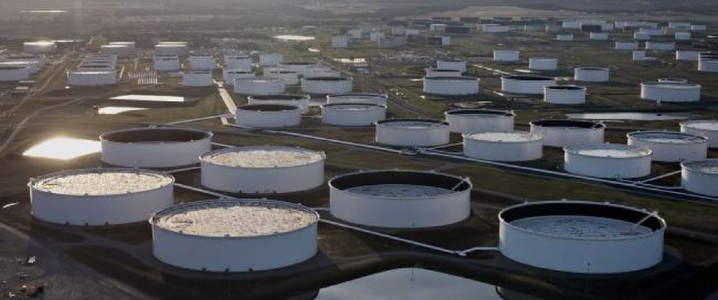
Despite suffering the largest supply disruption in modern history from the Strait of Hormuz crisis for nearly three months, the global oil market seems to have remained eerily calm. However, behind that apparent stability is an alarming reality: countries are gradually "burning" their emergency reserves to maintain the economic engine, and time is running out.
The Truth Behind America's Inventory Numbers
Looking at the overall picture, US commercial crude oil inventories (excluding the Strategic Petroleum Reserve - SPR) appear to remain stable, increasing by about 25 million barrels year-to-date. However, when zooming in on the short-term data, a shocking decline is taking place.
In just the past 5 weeks, US commercial crude oil inventories have evaporated about 25 million barrels - wiping out the entire accumulated amount of the entire year 2026. Notably, this number only stopped at 25 million barrels thanks to unprecedented intervention from the government.
The US Strategic Reserve (SPR) currently has only 374.2 million barrels left after record releases. The week ending May 15 saw a withdrawal of 9.92 million barrels, and the week before that 8.61 million barrels – the two largest weekly SPR releases on record. If not 30 million barrels With additional injections from SPR, US commercial inventories actually evaporated by 55 million barrels in just over a month.
Table 1: Analysis of US Crude Oil Inventories Movement (Over the past 5 weeks)
| Criteria | Quantity (Million barrels) | Practical meaning |
| Decrease in commercial inventory announced | - 25 | Creates the illusion that the market is still balancing itself and adapting to the shortage. |
| Amount of discharge oil from SPR warehouse (Emergency Reserve) | + 30 | The curtain covers the true severity of the supply crisis. |
| ACTUAL commercial inventory reduction (If no SPR) | - 55 | The rate of depletion is extremely fast, signaling the risk of serious supply tightening in the near future. |
Global Shock and Rapid Depletion of Stockpiles
Not only the US, but the global market has had to use reserves as the main "shock absorber". Analysts estimate the global system has absorbed approx 13 million barrels/day missing supplies through inventory reduction and release of emergency reserves.
What is worrying is that demand destruction - the factor that usually helps cool prices - has not really happened yet. Despite rising prices, freight activities and travel demand remain high. Inventories of distillates, especially diesel fuel, are plummeting.
Data from the Energy Information Administration (EIA) shows that global crude oil and fuel inventories are depleting at an alarming rate. Veteran analyst Paul Horsnell warns that the cumulative inventory loss could reach 1.2 billion barrels. At this rate, some trading systems may reach the "minimum operating level" (the level at which oil transportation and delivery becomes difficult) as soon as next August.
Table 2: Rate of Decline in Global Petroleum Inventories (EIA Data & Projections)
| Time | Inventory reduction rate (Million barrels/day) | Warning status |
| March 2026 | - 5.27 | Serious decline began to take place. |
| April 2026 | - 8.62 | The rate of decline accelerated sharply due to the lingering impact of the Hormuz crisis. |
| August 2026 (Expected) | Cumulative reduction can be achieved 1.2 Billion barrels | Risk of touching "minimum operating level", leading to price spikes to force down demand. |
The Illusion of Rapid Recovery
The market is very thirsty for new supply, but no country - including the US - is willing or able to dramatically increase output. The era of output growth at all costs for the US shale oil industry has ended, giving way to strict financial discipline from Wall Street. The number of drilling rigs remains at a flat level.
Many people expect that the reopening of the Strait of Hormuz will solve the problem immediately. This is a fatal mistake. Physical systems move a lot slower than financial markets. Even if the traffic route is cleared tomorrow, it will take months for tankers to reroute, return to the Gulf, load their cargo and make the long journey to Asia or Europe.
Conclusion: Overuse of the stockpile has bought the world some time, but it has its limits. As these shock absorbers wear off, the market will eventually have to contend with actual supply. The supply crisis is not going away; it's just coming later and promises to be more intense as the reserve curtain rises.
#KhungHoangDauMo #EoBienHormuz #GiaDau #KinhTeToanCau #AnNinhNangLuong #DuTruChienLuoc #OilPrice #TinTucKinhTe
Do you want me to analyze in more detail the economic implications for the global supply chain if oil inventories hit "minimum operating" levels next August as the article warns?