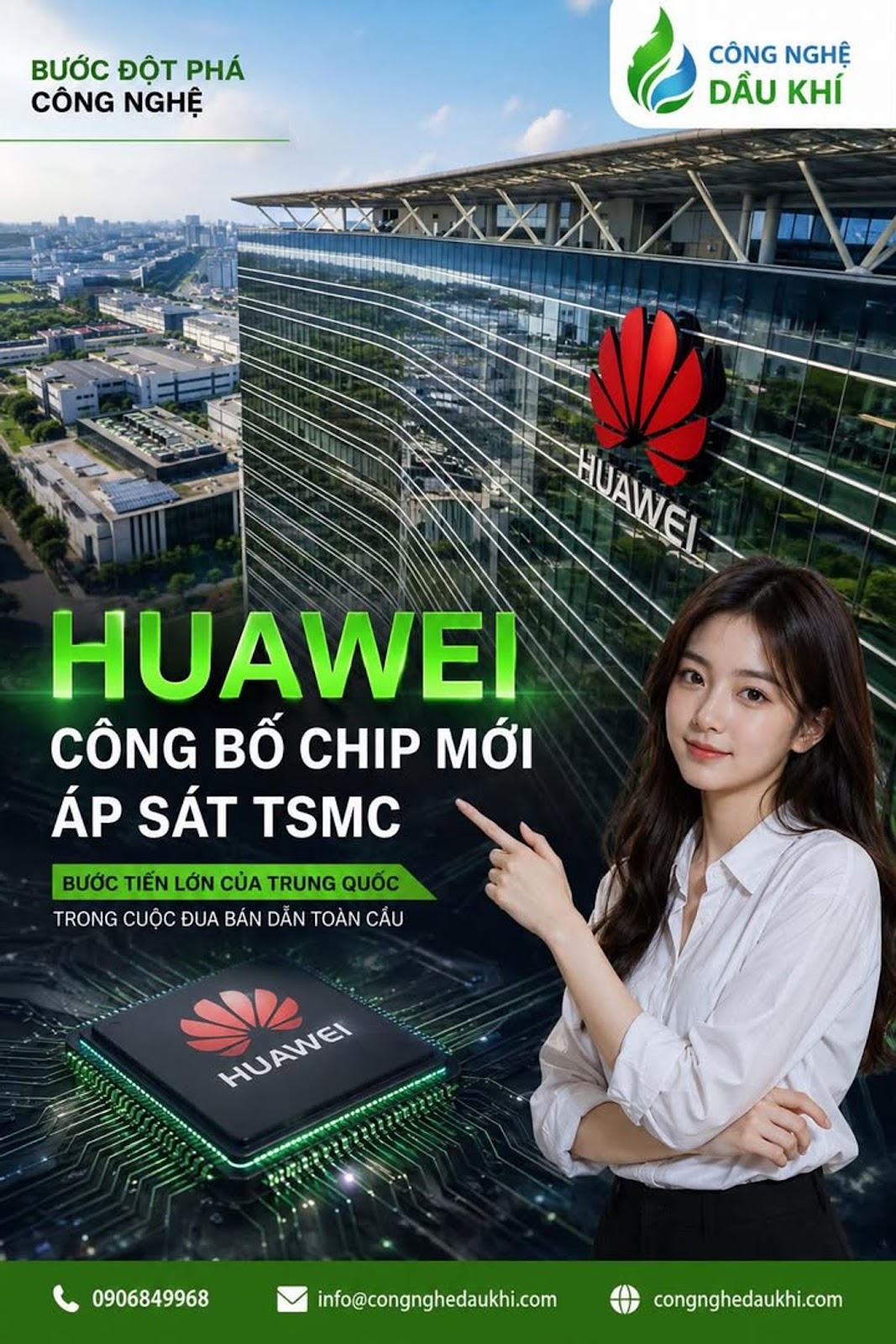
If Huawei can really produce chips on par with 1.4nm without ASML's EUV machine, will the global semiconductor game be completely rewritten?
Huawei has just released what is considered its boldest statement in years when it affirmed that it has found a completely different direction to produce high-end chips without depending on the most advanced lithography technology from the West.
What is shocking is not that Huawei continues to make chips.
What surprises the technology world is that Huawei wants to change the very rules of semiconductor development that have dominated the world for decades.
What is Huawei doing?
While TSMC, Samsung and Intel continue to shrink transistors to increase performance, Huawei believes that race is reaching its physical limit.
Huawei introduces a new concept called Tau Scaling Law and LogicFolding architecture.
Instead of trying to make transistors smaller, Huawei focused
✅ Increase data transfer speed inside the chip
✅ Shorten the distance between processing blocks
✅ Optimize signal flow
✅ Stacking chip structure in 3D style
✅ Increase overall system performance instead of just reducing transistor size
According to Huawei, this could be a way to help China overcome the technology ban from the US.
Compare Huawei strategy with TSMC
Development Direction Firm
TSMC Shrinks transistors to 2nm then 1.4nm
Samsung Continues GAA development and progress under 2nm
Intel Focus RibbonFET and PowerVia
Huawei LogicFolding + Tau Scaling + 3D packaging
Source: Reuters, Bloomberg, IDC China.
What makes TSMC pay attention
Currently, Huawei and SMIC are still considered about 5 years behind TSMC in chip production technology.
TSMC has planned to commercialize 1.4nm chips in 2028.
Meanwhile, Huawei announced that it will achieve a transistor density equivalent to 1.4nm by 2031 through its own path.
This is the first time a major technology corporation claims it can reach the 1.4nm level without using ASML's EUV system.
Current distance
Advanced Manufacturing Technology Company
TSMC 2nm is underway
Samsung 2nm GAA
Intel Intel 18A
SMIC About 7nm generation upgrade
Huawei Chip design based on SMIC
Why is Nvidia also affected?
Huawei doesn't just want to compete in smartphones.
The bigger goal lies with AI.
Huawei's Ascend chip line is becoming an alternative to Nvidia in China when Nvidia's high-end GPUs are restricted from export.
Many Chinese domestic AI systems have started using Ascend to train models instead of relying entirely on Nvidia.
Market reaction
After Huawei's statement
SMIC shares increased sharply
STAR Market chip index in Shanghai reached a new peak
Many Chinese semiconductor enterprises simultaneously increased prices
This shows that the market is betting on China's ability to create an independent semiconductor path.
⚠️ But there are still many question marks
International experts say that Huawei still has to resolve the issuesg extremely difficult math problem
❌ Heat when stacking chips
❌ Percentage of products meeting standards
❌ Production costs
❌ New chip design tool
❌ Scalability for AI data center
Reuters and many semiconductor experts said there is currently no independent data to prove Huawei's performance claims.
The semiconductor war is entering a new phase
For many years, the world believed that to create more powerful chips, you must have smaller transistors.
Huawei is saying the opposite.
If this direction is successful, the game may no longer be completely defined by TSMC, Samsung or Intel.
If it fails, this will be one of the biggest technological gambles in the history of the semiconductor industry.
Notable landmark
Year of Events
2019 The US started to tighten Huawei's grip
2023 Mate 60 causes a stir with its domestic chip
2025 Ascend accelerates AI competition
2026 Announced Tau Scaling Law
2031 1.4nm equivalent density target
Is Huawei really creating a new revolution or is this just a giant communication strategy to challenge TSMC and Nvidia?
#Huawei #TSMC #SMIC #Nvidia #ChipAI #CongNghe #BanDan #AI #TrungQuoc #DauTu #KinhTe #TechNews #TimKiemTop
References from Reuters, Bloomberg, IDC China, Tom's Hardware.