#LNG #My #China #Iran #Hormuz #KhiDotTuNhien #NangLuong #DauKhi #AnNinhNangLuong #CongNgheDauKhi
If China is almost no longer dependent on global energy shocks while the US still has to rely on LNG exports, will the world energy power balance reverse in the next decade?
The Iran war and the disruption in the Strait of Hormuz are creating one of the biggest energy market restructurings since the Russia-Ukraine crisis. While the US is benefiting from a boom in LNG exports, China is quietly building an advantage that could last decades.
It's worth noting that this race is no longer simply about selling more gas. This is a battle over the ability to control the global energy supply chain.
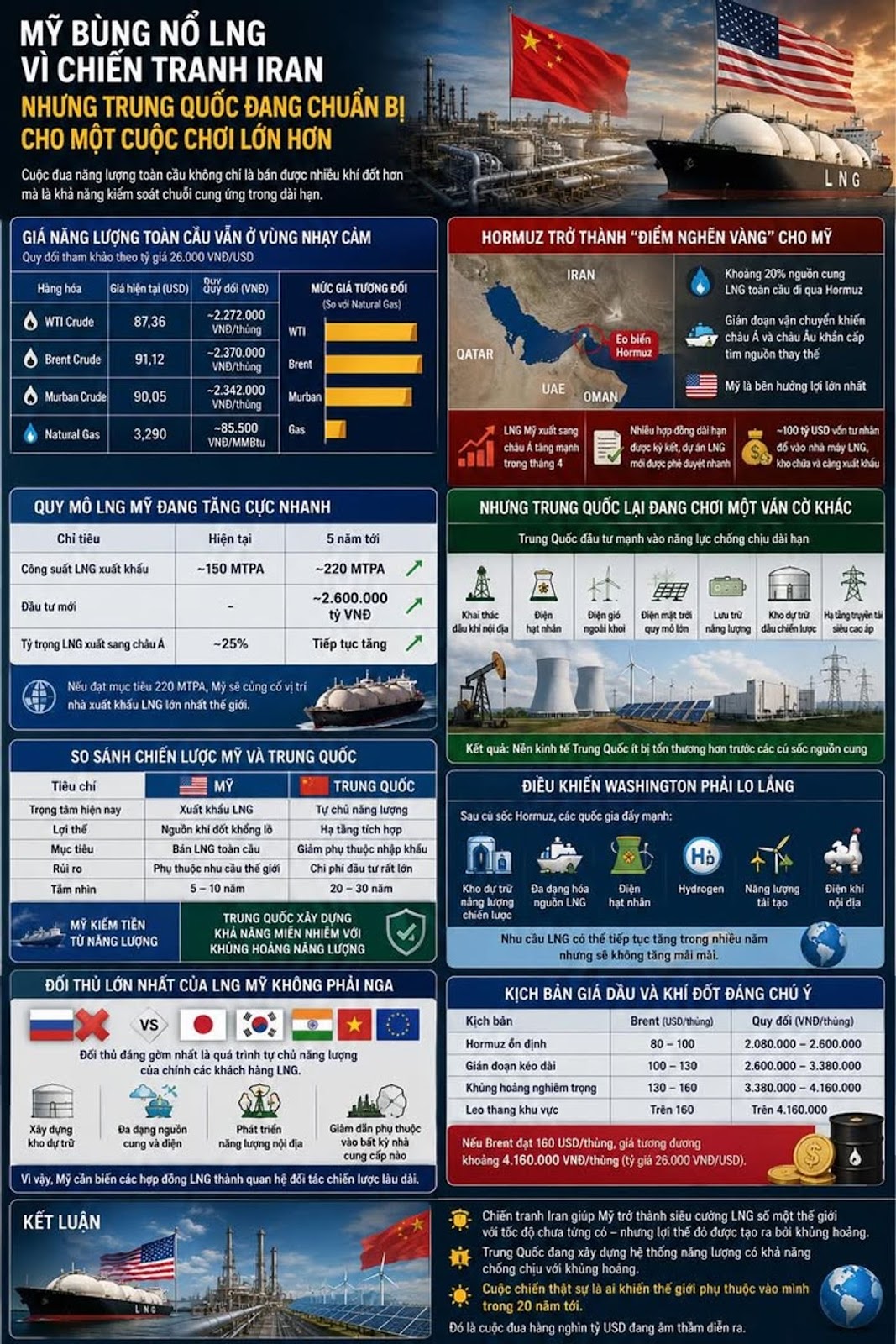
Global energy prices are still in a sensitive area
Commodities Current prices
WTI Crude ~2,272,000 VND/barrel
Brent Crude ~2,370,000 VND/barrel
Murban Crude ~2,342,000 VND/barrel
Natural Gas ~85,500 VND/MMBtu
Conversion for reference is at an exchange rate of about 26,000 VND/USD.
Create an illustration of oil prices
WTI ████████████████████
Brent █████████████████████
Murban ████████████████████▉
Gas █
Hormuz became a "golden choke point" for the US
About 20% of global LNG supply passes through the Hormuz area. When war disrupted shipping activities, Asian and European countries immediately had to find alternative sources.
The biggest beneficiary is America.
According to the newspapersReporting to the international energy market, the amount of US LNG exported to Asia increased sharply in April. A series of long-term contracts were signed. New LNG liquefaction projects are approved faster.
About $100 billion in private capital is pouring into LNG plants, storage facilities and export ports.
The scale of US LNG is increasing extremely rapidly
Current Targets for the next 5 years
LNG export capacity ~150 MTPA ~220 MTPA
New investment - ~2,600,000 billion VND
Proportion of LNG exported to Asia ~25% Continues to increase
If the 220 MTPA target is reached, the US will consolidate its position as the world's largest LNG exporter, far surpassing many traditional competitors.
But China is playing a different game
While Washington takes advantage of short-term opportunities, Beijing focuses on long-term resilience.
Over the past 20 years, China has invested heavily
* Domestic oil and gas exploitation
* Nuclear power
* Offshore wind power
* Large-scale solar power
* Energy storage system
* Strategic oil reserve
* Ultra high voltage transmission infrastructure
As a result, the Chinese economy is less vulnerable to supply shocks.
Compare US and Chinese strategies
American China Criteria
Current focus LNG exports Energy self-reliance
Advantage Huge gas source Integrated infrastructure
Global LNG Sales Goal Reduce import dependence
Risk Depends on world demand Very large investment costs
Vision 5-10 years 20-30 years
This is a strategic difference.
America makes money from energy.
China builds immunity to energy crises.
What makes Washington have to worry
Every country today recognizes a lesson.
No one wants their economy to be paralyzed just because a strait is blocked.
After the Hormuz shock, a series of countries are stepping up
* Strategic energy reserve
* Diversify LNG sources
* Nuclear power
* Hydrogen
* Renewable energy
* Domestic electricity
This means LNG demand may continue to increase for many years but will not increase forever.
US LNG's biggest rival is not Russia
Many people think Russia is America's main rival.
The long-term reality may be different.
The most formidable opponent is the energy autonomy process of LNG customers themselves.
As Japan, South Korea, India, Vietnam or Europe build enough reserves and domestic power sources, they will gradually reduce their dependence on any one supplier.
That's why the US is trying to turn LNG contracts into long-term strategic partnerships instead of just selling gas.
Noteworthy oil and gas price scenario
Brent script
Hormuz is stable at 80 - 100 USD
Long-term interruption 100 - 130 USD
Severe crisis 130 - 160 USD
Escalating the area Above 160 USD
If Brent reaches 160 USD/barrel, the price is equivalent to about 4,160,000 VND/barrel at the current exchange rate.
This is why global energy analysts are monitoring every development in the Middle East every day.
Conclusion
The Iran war is helping the US become the world's number one LNG superpower at an unprecedented speed. But that advantage was created by the crisis.
Meanwhile, China is building a new systemEnergy is resilient to crises.
The real battle is not who sells more LNG today.
The battle is who makes the world depend on him for the next 20 years.
And that is the race for trillions of dollars that is silently taking place behind the daily oil price numbers.
#DauKhi #LNG #My #China #Hormuz #Iran #GiaDau #KhiDot #NangLuongToanCau #AnNinhNangLuong #CongNgheDauKhi #WTI #Brent #Murban #NaturalGas #PVGas #PVN #KinhTeTheGioi #DiaChinhTri #ThiTruongNangLuong