#Hormuz #DauMo #LNG #Iran #TrungDong #GiaDau #NangLuong #BigOil #KinhTeToanCau #TimKiemTop
🤔 If Iran really has long-term control over the Strait of Hormuz and oil shipping companies do not dare to return to the way they were before the war, will the world be entering the biggest energy crisis since the oil shock of the 1970s?
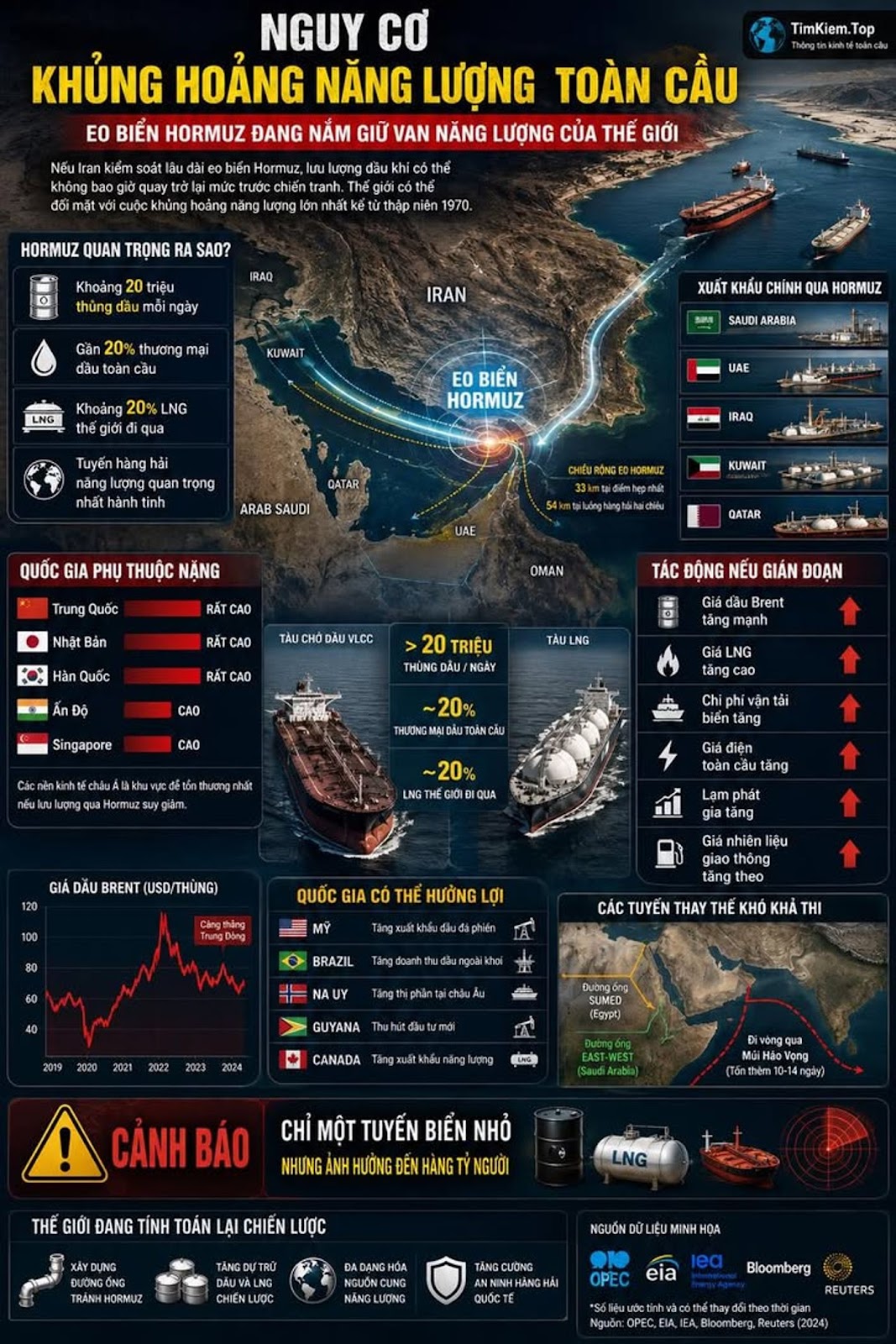
The Strait of Hormuz has long been considered the most important "energy valve" on the planet. Every day, tens of millions of barrels of crude oil and huge amounts of liquefied natural gas pass through this maritime route only a few dozen kilometers wide to supply Asia, Europe and many major economies.
However, the prolonged conflict in the Middle East is completely changing the situation.
Many international energy experts warn that oil and gas flows through Hormuz may never return to pre-war levels even after the fighting ends.
The cause does not lie in the route being completely closed, but in psychological factors, marine insurance, transportation costs and prolonged geopolitical risks.
Why is Hormuz so important?
Table of the role of the Strait of Hormuz in the global energy market
Estimated Target
Crude oil transported every day is about 20 million barrels
The proportion of global oil trade is nearly 20%
Global LNG passes through Hormuz About 20%
Main exporting countries Saudi Arabia, UAE, Kuwait, Iraq, Qatar
Major importing countries are China, Japan, Korea, and India
If transport traffic drops sharply for just a few weeks, the global market could face a supply shortage.
Iran holds a strategic advantage
What worries the market the most is Iran's special geographical location.
Most maritime routes must pass close to waters under Tehran's military control.
According to many energy security analysts, whether the war ends or not, Iran will still maintain significant influence in this region for many years to come.
Amos Hochstein, a former White House senior energy adviser, said that geographical realities mean Iran almost always has the ability to influence shipping traffic in Hormuz.
This makes it impossible for international shipping companies and insurance companies to consider this area as a safe route as before.
Big Oil is starting to send warning signals
Major oil and gas corporations are closely monitoring developments in Hormuz.
What they worry about is not just rising oil prices.
What is more frightening is the risk of a supply gap in the global distribution chain.
Table of potential impacts if Hormuz traffic drops sharply
Influential Factors
Brent oil price increased sharply
LNG Price Increases Rapidly in Asia
Sea transportation costs are increasing
Global Inflation Rising
Electricity prices under increasing pressure
Transportation fuel prices increase accordingly
Many commodity traders say the real impact usually appears after a few weeks to a few months as initial inventories help the market maintain temporary stability.
Who will be most affected?
Asian economies are the most vulnerable region.
Middle East energy dependence table
Country Degree of dependence
China Very high
Japan Very high
Korea Very high
Indian Cao
Singapore Cao
Meanwhile, the US is less directly affected thanks to large domestic shale oil production.
However, rising global fuel prices will still impact the US economy through inflation and logistics costs.
Competitors are benefiting
When Middle East supply is in trouble, many other oil-producing countries could benefit.
Table of potential beneficiaries
Quốc gia Lợi thế
Mỹ Tăng xuất khẩu dầu đá phiến
Brazil Tăng doanh thu dầu ngoài khơi
Na Uy Tăng thị phần tại châu Âu
Guyana Thu hút đầu tư mới
Canada Tăng xuất khẩu năng lượng
Điều này tạo ra sự dịch chuyển lớn trong bản đồ năng lượng thế giới.
Thế giới đang đứng trước bước ngoặt
Trong nhiều thập kỷ, eo biển Hormuz được xem là tuyến vận tải không thể thay thế.
Nhưng cuộc xung đột hiện nay đang buộc các quốc gia và tập đoàn năng lượng phải tính toán lại chiến lược.
Những dự án đường ống tránh Hormuz, các kho LNG dự trữ khổng lồ và chiến lược đa dạng hóa nguồn cung đang được đẩy nhanh hơn bao giờ hết.
Câu hỏi lớn nhất lúc này không phải liệu Hormuz có đóng cửa hay không.
Câu hỏi là liệu thế giới có còn đủ thời gian để thích nghi trước khi cú sốc nguồn cung tiếp theo xảy ra hay không.
🌿 Một eo biển chỉ dài vài trăm km nhưng đang nắm giữ vận mệnh năng lượng của hàng tỷ người trên hành tinh.
#Hormuz #Iran #GiaDau #LNG #TrungDong #NangLuong #DauKhi #KinhTeTheGioi #BigOil #KhungHoangNangLuong #TimKiemTop