#Offshore #Onshore #DauKhi #NangLuong #FPSO #LNG #Petrochemical #Engineering #Construction #CongNgheDauKhi
If an engineer used to manage an oil refinery worth more than 250,000 billion VND but refused to go to a deep sea drilling rig because it was "too dangerous", does that show that Offshore is really a completely different level of difficulty?
In the global oil, gas and energy industry, the debate between offshore and onshore construction has existed for decades. Both are fields that require high technical skills, huge capital resources and extremely complex project management capabilities.
However, if you look deeper, these are two completely different "technical battlefields".
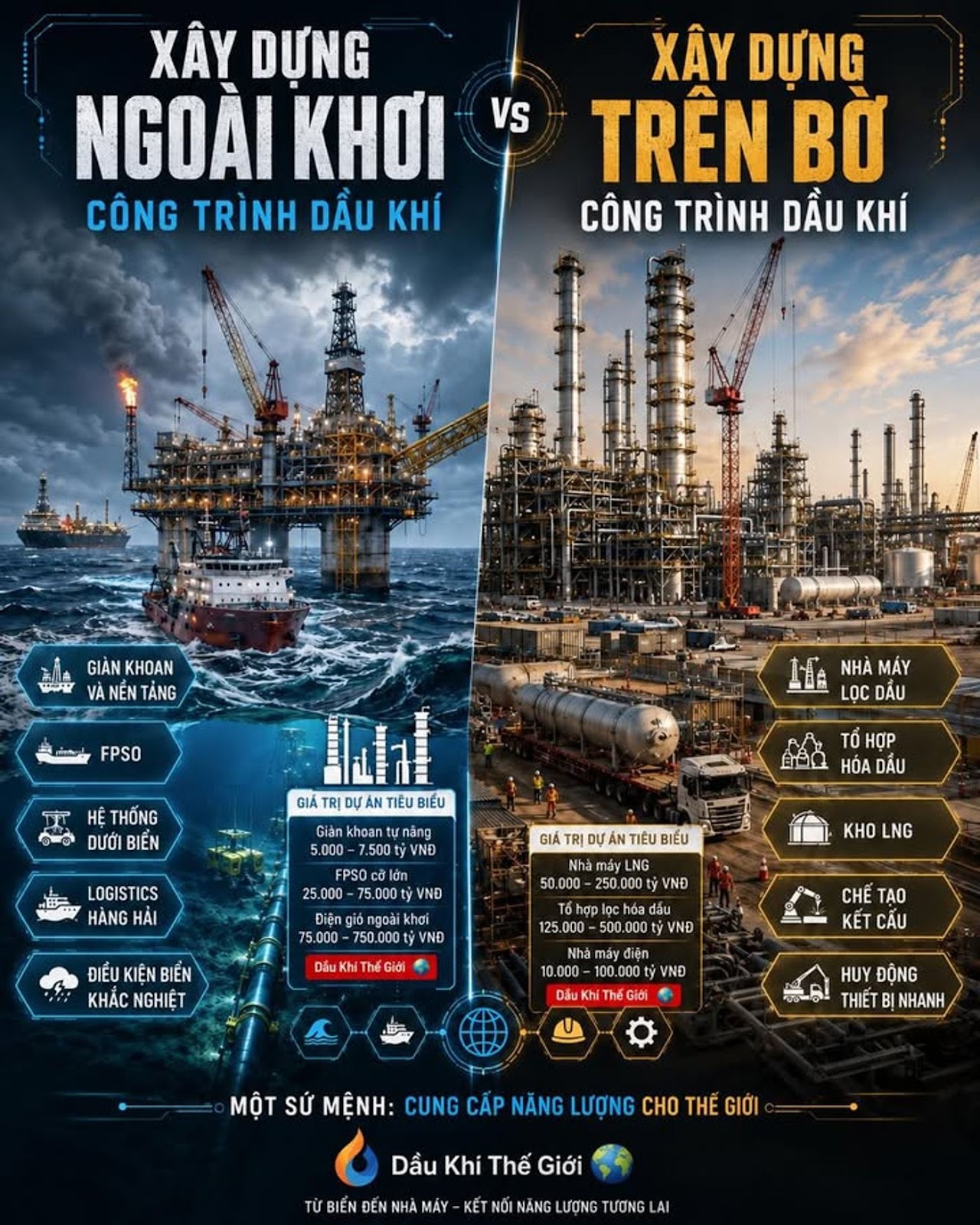
Offshore Construction
Offshore construction takes place in the middle of the ocean, where humans face the forces of nature directly.
Typical projects
✔ Self-raising drilling rig
✔ Semi-submersible drilling rig
✔ FPSO
✔ Undersea pipeline
✔ Deep water mining system
✔ Offshore wind farm
The biggest challenges
Waves are 10 to 20 meters high
Extremely strong storm-level winds
Sea salt corrodes continuously 24/7
Transporting super-long, super-heavy equipment at sea
Working hundreds of kilometers from the mainland
Rescue and operating costs are extremely high
Onshore Construction
Onshore construction focuses on giant industrial complexes.
Typical projects
✔ Oil refinery
✔ Petrochemical complex
✔ LNG warehouse
✔ Power plant
✔ Transnational pipeline
✔Structure manufacturing workshop
Although Onshore does not have to face ocean waves, it faces other pressures.
Tens of thousands of employees working together
Progress is extremely tight
Millions of technical items
Manage thousands of subcontractors
Coordinate huge supplies
Financial pressure is huge
Compare overview
Offshore Onshore Criteria
Working environment: Deep sea, Land
Weather impact Very high Moderate
Operating costs Very High High
Accessibility Difficult Easier
Safety risk Very High High
Human resource management Average Very large
Logistics management is the most difficult. Very complicated
Scalability Limited Flexibility
Typical investment value
Project type Investment scale
Modern jack-up drilling rig 5,000 to 7,500 billion VND
Large FPSO 25,000 to 75,000 billion VND
LNG plant 50,000 to 250,000 billion VND
Refining and petrochemical complex 125,000 to 500,000 billion VND
Offshore wind power 75,000 to 750,000 billion VND
⚙ Common points of both fields
Whether operating at sea or on land, projects are needed
✅ Absolute safety culture
✅ Team of highly qualified engineers
✅ Strict QA/QC system
✅ Asset inspection and management
✅ Super heavy crane installation specialist
✅ Professional risk management
✅ Spirit of coordination under extreme pressure
New world trend
Today the boundary between Offshore and Onshore is gradually blurring.
A modern LNG project might include
➡ Offshore gas exploitation
➡ Marine pipeline
➡ Onshore LNG warehouse
➡ Gas power plant
➡ Energy distribution system
That means success no longer belongs to vRegarding any individual field, it belongs to the ability to integrate the entire value chain.
Conclusion
If Offshore is a battle between technology and nature, then Onshore is a battle between technology, scale, progress and tens of thousands of people.
A storm can stop an entire rig in the middle of the ocean.
But a mistake in coordination can cause a petrochemical project worth hundreds of trillions of VND to be months behind schedule.
So the most interesting question is not whether Offshore or Onshore is more important.
Which area puts you under more pressure if you are responsible for signing off on the entire project?
Do you choose Offshore or Onshore and why?
#XayDungNgoaiKhoi #XayDungCongNghiep #FPSO #GianKhan #LocHoaDau #LNG #Petrovietnam #PVDrilling #EngineeringLife #OilAndGas #MarineEngineering #EnergyTransition #CongNgheDauKhi #NangLuong #DuAnTyDo #KySuDauKhi #QuanLyDuAn #CongNghiepNangLuong #VietNamEnergy #DauKhiVietNam