#TaiNguyenPhi TruyenThong #ShaleGas #ShaleOil #TightGas #CoalbedMethane #OilSands #GasHydrates #HydraulicFracturing #NangLuong #DauKhi #CongNgheDauKhi
Without shale oil and shale gas, would the US still retain its position as an energy superpower or would it still have to rely heavily on oil imported from the Middle East?
For decades, the world oil and gas industry has mainly exploited traditional fields, where oil and natural gas can move through highly permeable rock layers to flow into exploitation wells. However, when easy-to-exploit mines gradually decline, the energy industry is forced to find a huge treasure trove deep underground called non-traditional resources.
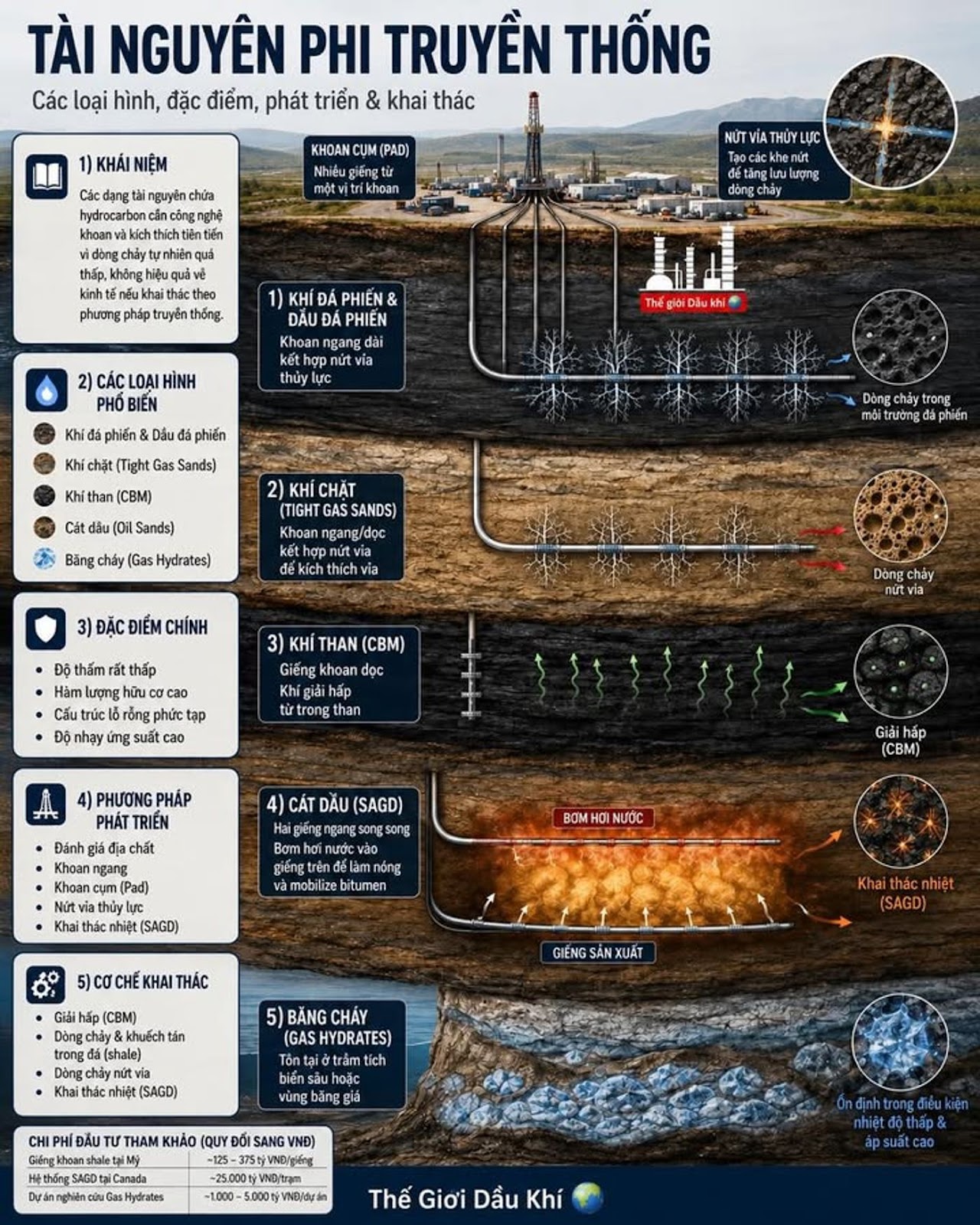
This is a group of resources containing extremely large amounts of hydrocarbons but located in complex geological layers, with very low permeability and almost impossible to exploit effectively using traditional drilling technology.
Common forms of non-traditional resources
Resource type Characteristics
Shale Gas Shale Gas Gas located in shale rock
Shale Oil Shale Oil Oil trapped in shale rock
Tight Gas Gas in extremely tight rock strata
Coalbed Methane Methane adsorbed in coal
Oil Sands Sand contains super heavy bitumen
Gas Hydrates Ice burns on the seabed and in icy areas
Why are non-traditional resources important?
According to many international geological studies, global unconventional energy reserves may be significantly larger than the remaining conventional oil and gas.
Gas Hydrate Fire Ices individual reserves are estimated to contain more carbon than the total known reserves of coal, oil and natural gas combined.
This causes energy powers such as the US, Canada, China, Russia and Japan to invest hundreds of trillions of VND in new mining technology.
The revolution changed America
Target Before 2010 After 2025
Crude oil output Depends on imports Top in the world
Gas output Local shortage Large LNG export
Domestic gas prices High Decreasing sharply
Energy Security Risk Significant Improvement
It is shale oil in the Permian Basin, Bakken and Eagle Ford that has helped the US surpass traditional producers such as Russia and Saudi Arabia to become the world's largest oil producer.
Technologies that create revolutions
Previously, a drilled well only went vertically.
Today, petroleum engineers use a variety of advanced technologies
✅ Horizontal drilling many kilometers long
✅ Pad Drilling cluster drilling
✅ Hydraulic Fracturing
✅ 3D geological model
✅ AI artificial intelligence predicts flow
✅ SAGD heat exploitation for oil sands
Thanks to that, rock formations that were once considered worthless can now produce millions of barrels of oil every day.
Mechanism for exploiting each type
Key Technology Resources
Shale Gas Horizontal drilling + seam fracturing
Tight Gas Irritating Seams
Coalbed Methane Desorption Pressure Relief
Oil Sands SAGD Steam Pump
Gas Hydrates Heating and depressurizing
Huge investment costs
Project Estimated total investment
American shale wells From 125 billion VND to 375 billion VND
Canadian SAGD system Over 25,000 billion VNDGas Hydrates research project Trillions of VND
This is the reason why only large corporations such as ExxonMobil, Chevron, ConocoPhillips, Suncor Energy or PetroChina have enough resources for large-scale deployment.
⚠️ The downside of non-traditional resources
Besides huge economic benefits, this field is also controversial
• Consumes a huge amount of water
• High environmental costs
• Risk of methane emissions
• Seismic impact due to hydraulic fracturing
• Costs for environmental restoration after mining
That's why many countries are finding ways to balance energy security and carbon emission reduction goals.
What will the future of the oil and gas industry look like?
Although the world is promoting renewable energy, most experts still believe that unconventional oil and gas will continue to play an important role for decades to come.
Shale gas is helping to stabilize the global LNG market.
Canadian oil sands remain a strategic source of supply for North America.
Meanwhile, Gas Hydrates is considered the "last energy treasure" that Japan, China and Korea are racing to research.
It is worth noting that future energy competition may no longer be about who owns the most oil, but rather who owns the technology to exploit the most difficult to access underground resources.
#TaiNguyenPhi TruyenThong #ShaleGas #ShaleOil #TightGas #CoalbedMethane #OilSands #GasHydrates #HydraulicFracturing #KhoanNgang #CongNgheDauKhi #NangLuongToanCau #AnNinhNangLuong #DauKhi #CongNghe #CongNgheDauKhi