#OilGas #OilStorage Tank #LPG #Refinery #OilAndGas #StorageTank #OilGas Technology #Energy #PetroleumEngineering #ProcessSafety
Can just one mistake in choosing the type of tank cause hundreds of billions of dong in damage, fire and explosion in the entire factory and disrupt the energy supply chain of an entire region?
In the oil and gas industry, exploiting oil or gas is just the beginning. The bigger challenge lies in safely storing millions of liters of crude oil, gasoline, diesel, LPG, condensate and chemicals under many different temperature and pressure conditions.
Each type of petroleum product has its own characteristics. If the wrong type of tank is used, businesses may face the risk of product evaporation, loss of goods, fire and explosion or violation of international safety standards.
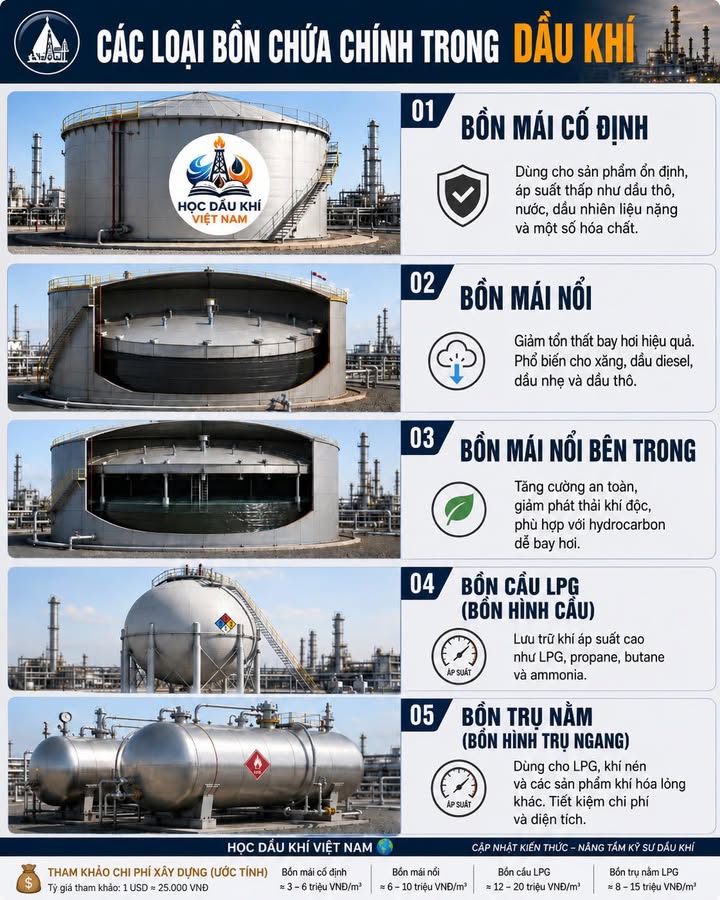
SUMMARY TABLE OF MAIN TYPES OF STORAGE TANKS
Tank type Suitable product Working pressure Outstanding advantages
Fixed Roof Tank Crude oil, industrial water, Low FO oil Low cost, easy to build
Floating Roof Tank Gasoline, diesel, light oils Low Reduce fuel evaporation
Internal Floating Roof Tank Low Volatile Hydrocarbons Increases environmental safety
Spherical Tank LPG, Propane, Butane, High Ammonia Resistant to very high pressure
Bullet Tank LPG, liquefied petroleum gas Medium to high Save space and cost
FIXED ROOF TANK
This type of tank appears most often at crude oil warehouses, refineries and import-export ports.
Characteristics
✅ Fixed roof attached to the tank body
✅ Simple structurean
✅ Low investment costs
✅ Easy to maintain
Often used for
Crude oil
Industrial water
Heavy fuel oil
Some chemicals are stable
The biggest disadvantage is evaporation loss when containing light products such as gasoline.
FLOATING ROOF TANK
This is a popular choice of large oil and gas corporations such as ExxonMobil, Shell, Chevron or Saudi Aramco when storing gasoline and volatile products.
Characteristics
✅ The roof floats directly on the liquid surface
✅ Reduces hydrocarbon vapor voids
✅ Reduce VOC emissions
Evaporation loss reduction can reach up to 90% compared to fixed roof tanks under some operating conditions.
INTERNAL FLOATING ROOF TANK
Is an upgraded version of Floating Roof Tank.
The tank has a fixed roof on the outside but an additional floating roof on the inside.
Advantages
✅ Reduce toxic gas emissions
✅ Limit the risk of fire and explosion
✅ Meet increasingly strict environmental standards
Many modern petroleum depots in Europe and North America are switching to this model.
SPHERICAL TANK
People in the industry often call it "LPG toilet".
This is one of the best pressure-resistant structures in the oil and gas industry.
Usually contains
LPG
Propane
Butane
Ammonia
Advantages
✅ Uniform stress distribution
✅ Resistant to extremely high pressure
✅ Safe when storing liquefied gas
Disadvantages
❌ Construction costs are huge
❌ Requires welding techniques and strict testing
COMPARE PRESSURE RESISTANCE
Tank type Pressure level
Fixed Roof Tank Low
Floating Roof Tank Low
Internal Floating Roof Tank Low
Bullet Tank Medium to high
Spherical Tank Very high
BULLET TANK
TypeHorizontal cylindrical tanks are often found at LPG stations, petrochemical plants or industrial gas warehouses.
Advantages
✅ Lower price than LPG toilets
✅ Construction is faster
✅ Easy to expand the system
Often used for
Commercial LPG
Industrial compressed air
Propane
Butane
WHY CHOOSING THE RIGHT STORAGE TANK IS IMPORTANT
If a warehouse storing 50,000 m³ of gasoline is improperly designed, it can lose fuel worth tens of billions of VND each year due to evaporation.
Meanwhile, for LPG or ammonia, choosing the wrong tank can lead to high pressure leaks and create serious incidents affecting people, the environment and production operations.
CONCLUSION
Behind every oil refinery, fuel depot or energy import-export port is an extremely complex technical system. From Fixed Roof Tank, Floating Roof Tank to Spherical Tank or Bullet Tank, each design is created to serve a specific goal of safety, economic efficiency and environmental protection.
In your opinion, in Vietnam today, which type of tank is being used most at petroleum depots and LPG gas plants? Have we invested heavily enough in modern storage technology?
#Vietnam Oil and Gas #Petroleum Storage #LPG #Oil Storage Tank #Refinery #StorageTank #PetroleumEngineering #OilAndGasIndustry #ProcessSafety #CongHeatDau Khi #Energy #Industrial Safety #Petroleum Engineering #Hydrocarbon #Petrochemical Refining #TerminalStorage #EngineeringLearning