OPEC+ Continuously Increases Production Quotas Amidst Unprecedented Market Paradox
The global oil market is currently facing an unprecedented scenario where the OPEC+ alliance has consecutively raised production quotas for four consecutive months, yet the actual volume of oil reaching the market has decreased by millions of barrels daily due to conflicts and transportation blockades.
Fourth Consecutive Production Increase by OPEC+
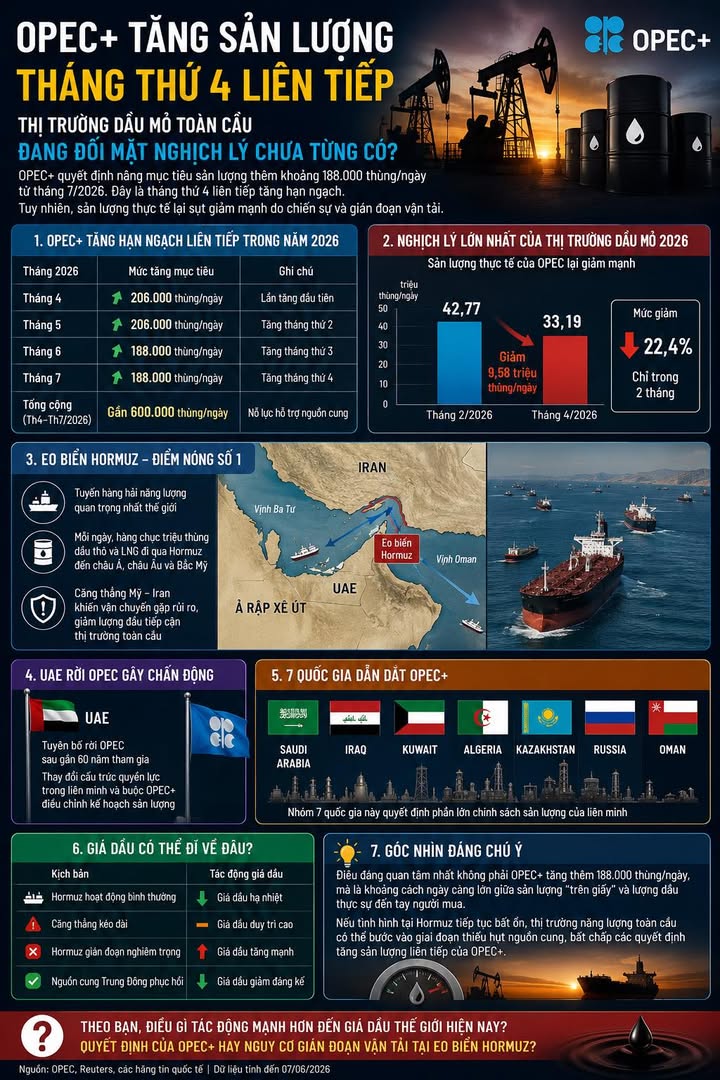
OPEC+ has made the decision to raise its production target by approximately 188,000 barrels per day starting from July 2026. This marks the fourth consecutive month that the alliance has increased extraction quotas in an effort to stabilize the global energy market and curb energy price volatility.
Behind this seemingly positive decision lies a completely contrary reality. Despite the continuous increases in quotas, the actual production of many member countries has faced severe difficulties due to military conflicts in the Middle East and transportation disruptions through the Strait of Hormuz.
OPEC+ Quota Increases (2026)
| Month | Quota Increase (barrels/day) |
|---|---|
| April | 206,000 |
| May | 206,000 |
| June | 188,000 |
| July | 188,000 |
| Total | Nearly 600,000 |
The data above shows that OPEC+ is striving to pump more oil into the market to alleviate supply pressures and contain energy price fluctuations.
The Great Paradox of the 2026 Oil Market
What's surprising is that actual production has not increased in line with these paper decisions.
Actual OPEC Production Changes
| Indicator | February 2026 | April 2026 |
|---|---|---|
| OPEC Production | 42.77 million barrels/day | 33.19 million barrels/day |
| Change | Decrease of 9.58 million barrels/day |
The decrease represents approximately 22.4%. These figures indicate that geopolitical difficulties are having a much greater impact than production management decisions.
The Strait of Hormuz Remains the Primary Hotspot
The Strait of Hormuz is considered the world's most important energy maritime route. Each day, tens of millions of barrels of crude oil and LNG must pass through this area before reaching Asia, Europe, and North America.
Tensions between the United States and Iran have increased operational risks in shipping, significantly reducing the amount of oil that actually reaches the global market.
UAE's Shocking Departure from OPEC
Another factor drawing market attention is the United Arab Emirates' announcement to leave OPEC after nearly 60 years of participation. This event has altered the power structure within the alliance and forced OPEC+ to adjust its production increase plans for the future.
Countries Currently Leading OPEC+
Seven countries currently play a central role in determining OPEC+ production policy:
- Saudi Arabia
- Iraq
- Kuwait
- Algeria
- Kazakhstan
- Russia
- Oman
This group has largely determined the alliance's production policies in recent years.
Where Oil Prices Might Head
Oil Price Scenarios Based on Hormuz Situation
| Scenario | Impact on Oil Prices |
|---|---|
| Hormuz operating normally | Oil prices cool down |
| Prolonged tensions | Oil prices remain high |
| Severe Hormuz disruption | Oil prices surge significantly |
| Middle East supply recovery | Oil prices decrease significantly |
Many experts suggest that current oil prices no longer depend entirely on OPEC+ production levels but are more significantly influenced by geopolitical factors, maritime security, and military risks in the Middle East region.
A Noteworthy Perspective
The most concerning aspect is not OPEC+'s additional 188,000 barrels per day, but the world witnessing an ever-growing gap between "on-paper" production and the amount of oil that can actually reach buyers' hands.
If the situation in Hormuz continues to be unstable, the global energy market could enter a period of supply shortage despite OPEC+'s consecutive production increase decisions.
When considering what impacts global oil prices more today—the decisions of OPEC+ or the risk of transportation disruptions at the Strait of Hormuz—the answer may be more complex than traditional market analysis suggests.