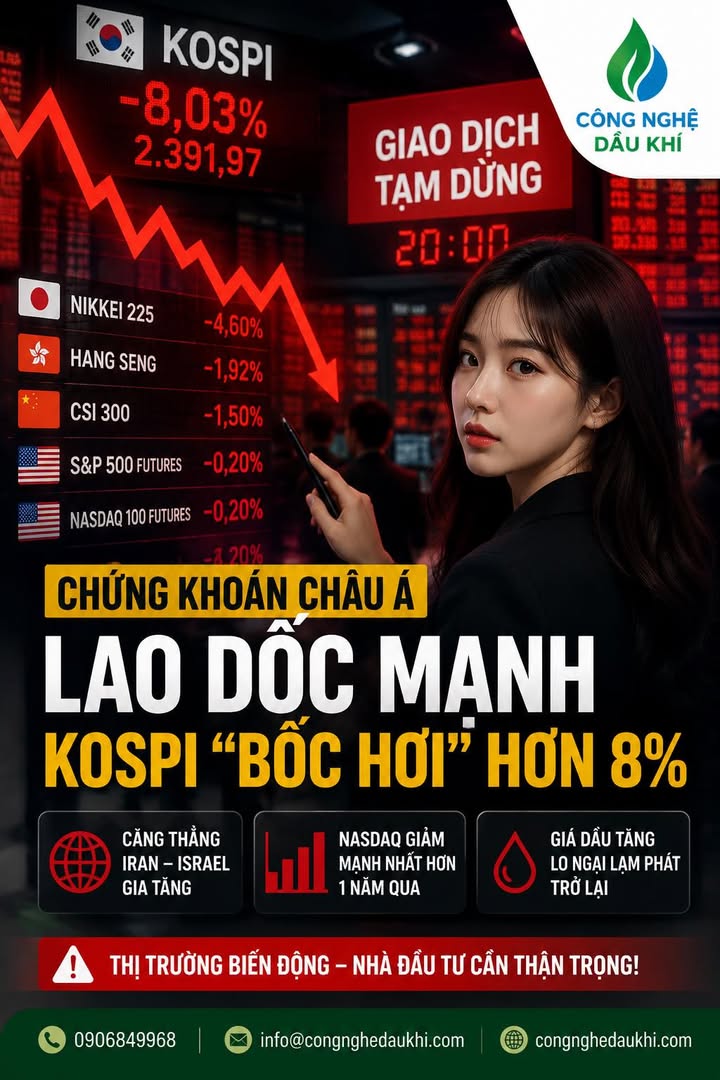
Asian Markets Plunge as South Korea Halts Trading After KOSPI Drops Over 8%
In a dramatic turn of events, Asian stock markets experienced significant declines on June 8, 2026, with South Korea's benchmark index KOSPI plummeting more than 8% at one point, forcing the Korea Exchange to implement a circuit breaker and suspend trading for 20 minutes to prevent uncontrollable selling pressure.
This session marks one of the most volatile trading days for Asian financial markets this year, as major indices across the region simultaneously fell. The question on many investors' minds is whether this represents a normal market correction or the beginning of a new financial crisis reminiscent of the 2008 and 2020 downturns that shook global markets.
Multiple Factors Converge to Trigger Sell-Off
The market decline resulted from a dangerous confluence of factors occurring simultaneously:
- Escalating Military Tensions Between Iran and Israel - Renewed geopolitical concerns in the Middle East
- Spike in Oil Prices - Crude oil prices surged amid regional instability
- Nasdaq's Steep Decline - The tech-heavy index posted its deepest drop in over a year
- High Interest Rate Concerns - Fears that the Federal Reserve will maintain elevated rates
- Profit-Taking in AI and Semiconductor Stocks - Investors sold off overheated technology sectors
Scale of the Decline Across Asian Markets
| Market | Country/Region | Decline |
|---|---|---|
| KOSPI | South Korea | Over 8% |
| Nikkei 225 | Japan | Approximately 4.6% |
| Hang Seng | Hong Kong | Approximately 1.9% |
| CSI 300 | China | Approximately 1.5% |
| MSCI Asia ex Japan | Asia (excluding Japan) | Approximately 2.8% |
Why South Korea Was Hardest Hit
Notably, the KOSPI had previously been one of the world's strongest-performing markets, driven by an AI boom. Two semiconductor giants—Samsung Electronics and SK Hynix—had propelled the entire South Korean market to extraordinary heights over several months.
At certain points, Samsung and SK Hynix alone accounted for more than 40% of the KOSPI's total value. When capital began to withdraw from the AI sector, the entire market came under extreme pressure, explaining the disproportionate impact on South Korean equities.
The Nasdaq Situation
The Nasdaq Composite declined by more than 4%, marking its sharpest drop since 2025. Investors began expressing concerns about several issues:
- AI valuations becoming excessively high
- Rising capital costs amid persistently high interest rates
- Technology companies spending hundreds of billions on AI data centers
- Potential capital being diverted toward upcoming massive IPOs
SpaceX Becomes Market Focus
One of the most closely watched events this week is the planned IPO of SpaceX. Many experts note that massive IPOs typically occur during periods of extreme market euphoria. If substantial capital flows into SpaceX, the pressure could intensify on other technology stocks as investors reallocate funds.
Key Events Investors Are Monitoring
| Event | Market Impact |
|---|---|
| US CPI | Inflation assessment |
| US PPI | Cost pressure evaluation |
| Fed Policy | Interest rate expectations |
| Iran-Israel Conflict | Geopolitical risk |
| SpaceX IPO | Market capital flows |
| Brent Oil Prices | Global inflation pressure |
The Bigger Picture: What Comes Next?
What concerns investors most is that this sell-off occurred immediately after a period of extreme global market gains driven by AI. History shows that rapid growth cycles rarely end with a single sharp decline but rather through successive waves of volatility that leave investors disoriented.
If US inflation exceeds expectations and the Middle East conflict continues to escalate, global financial markets could enter a period of even greater volatility in the coming weeks. The current market correction may be just the beginning of a more substantial adjustment.
As markets navigate these turbulent waters, a critical question emerges for investors: Is this a rare buying opportunity or a warning signal of a larger correction ahead?