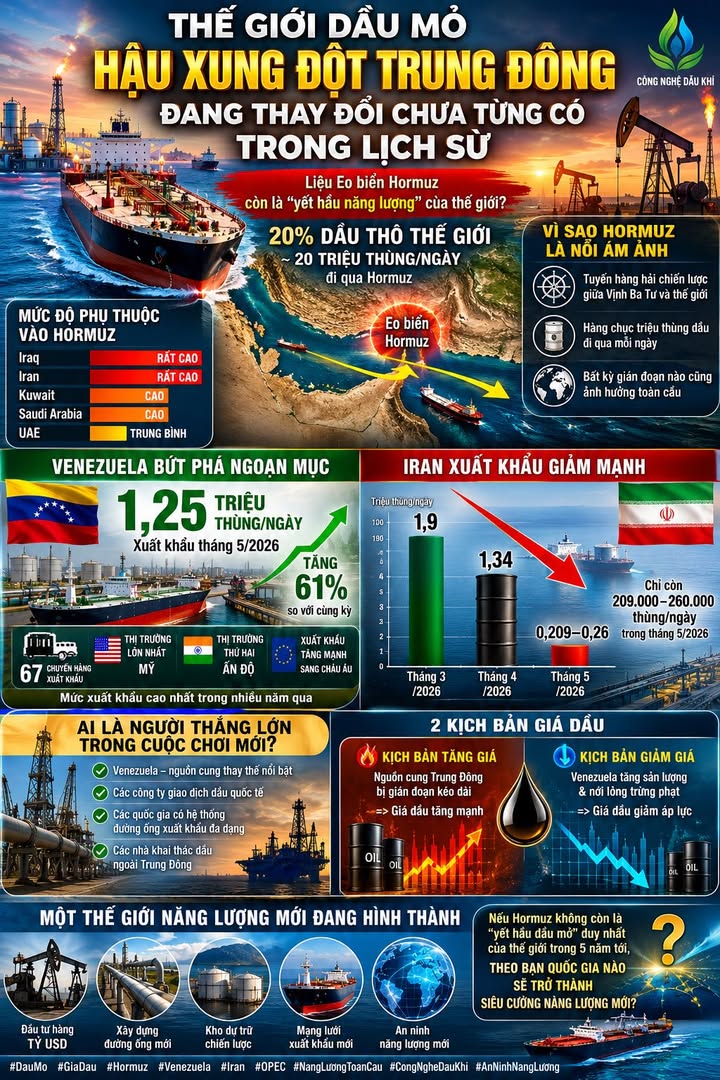
The Post-Middle East Conflict Oil World Is Undergoing Unprecedented Historical Changes
Is the world entering a completely new oil era, where the Strait of Hormuz no longer holds its status as the "energy chokepoint" it has maintained for decades? The geopolitical fluctuations in the Middle East have shaken the entire global energy market. What's notable about this impact is that it's not just about rising or falling oil prices—it's prompting major oil-exporting nations to completely restructure their energy transportation systems.
Gulf oil exporters are urgently seeking ways to move oil from ports to overland pipeline routes to reduce dependence on the Strait of Hormuz. Many experts believe that even if conflicts end, the world of oil will not return to its previous state.
Why the Strait of Hormuz Has Become a Persistent Concern
The Strait of Hormuz is a strategic maritime route connecting the Persian Gulf with global markets. Every day, tens of millions of barrels of oil pass through this area. When disruption risks emerge, the entire global energy supply chain is immediately affected.
According to recent analyses, many oil-exporting countries are heavily investing in pipeline systems to avoid the "putting all eggs in one basket" situation. This strategic shift represents one of the most significant reconfigurations of global energy logistics in modern history.
Countries Most Affected by Hormuz Dependence
The following table illustrates the varying degrees of dependence on the Strait of Hormuz among major oil-producing nations in the region:
| Country | Level of Hormuz Dependence |
|---|---|
| Iraq | Very high |
| Kuwait | High |
| Saudi Arabia | High |
| UAE | Medium |
| Iran | Very high |
Particularly noteworthy is that oil production in southern Iraq has reportedly decreased significantly since tensions escalated, demonstrating the severe dependence on this transportation route. This vulnerability has prompted accelerated investment in alternative infrastructure throughout the region.
Venezuela's Unexpected Emergence as a Beneficiary
While the Middle East faces numerous risks, Venezuela is emerging as a notable alternative supply source. The country's oil exports in May reached approximately 1.25 million barrels per day, marking the third consecutive month of growth. Exports to the United States, India, and Europe have all shown strong increases.
The following table details Venezuela's export growth:
| Metric | Value |
|---|---|
| Exports in May 2026 | 1.25 million barrels/day |
| Increase compared to same period last year | 61% |
| Number of export shipments | 67 shipments |
| Largest market | United States |
| Second largest market | India |
This represents the highest export level in many years and indicates Venezuela is gradually returning to the global energy map. The country's resurgence comes at a critical time when traditional supply sources face uncertainty.
What Iran Is Currently Facing
In contrast to Venezuela, Iran's oil exports have sharply decreased in recent times. Oil tanker tracking data shows that Iran's crude and condensate exports in May were only approximately 209,000 to 260,000 barrels per day, significantly lower than the previous level of over 1 million barrels per day.
The following table compares Iran's recent export figures:
| Time Period | Exports |
|---|---|
| March 2026 | 1.9 million barrels/day |
| April 2026 | 1.34 million barrels/day |
| May 2026 | 209,000 - 260,000 barrels/day |
This represents one of the steepest declines in many years and reflects the significant challenges facing Iran's oil sector amid changing geopolitical dynamics and international pressures.
Who Are the Winners in the New Oil Game
Looking at the bigger picture, the biggest beneficiaries appear to include:
- Venezuela - Capitalizing on increased global demand for alternative supply sources
- International oil trading companies - Benefiting from market volatility and arbitrage opportunities
- Countries with diverse export pipeline systems - Those less dependent on single maritime chokepoints
- Non-Middle Eastern oil producers - Gaining market share as traditional suppliers face disruptions
Meanwhile, countries nearly completely dependent on Hormuz are being forced to reconsider their entire national energy strategies. This recalibration is driving massive infrastructure investments across the region and beyond.
What Could Happen With Oil Prices
Experts are currently divided into two main schools of thought regarding future oil price movements:
Strong Increase Scenario:
If Middle Eastern supply disruptions continue, oil prices could rise significantly due to global supply shortages. Any escalation of tensions that affects actual or perceived supply security would likely trigger price volatility.
Price Decrease Scenario:
If Venezuela continues to increase production, sanction exemptions are expanded, and additional supply returns to the market, oil prices could face downward pressure in the medium term. The rebalancing of global supply chains could eventually lead to price stabilization at lower levels.
A New Energy World Is Forming
Most importantly, the key issue isn't whether oil prices rise or fall today. What matters is that major oil-producing countries are investing billions of dollars to build new transport routes, storage facilities, and export networks.
The concept of energy security is no longer simply about the ability to extract oil. It has become a race involving transportation routes, storage capacity, redundancy, and the flexibility of the entire supply chain. This transformation represents a fundamental shift in how nations approach energy independence and security.
The infrastructure being developed today will determine energy security for decades to come. Countries that successfully diversify their export routes and reduce vulnerability to geopolitical disruptions will emerge as the new energy powers in this evolving landscape.
If Hormuz is no longer the world's only "oil chokepoint" within the next five years, which country do you think will emerge as the new energy superpower, replacing the traditional role of the Middle East?
The global energy landscape continues to evolve rapidly, with traditional power structures being challenged by new players and innovative approaches to energy security. As this transformation unfolds, nations and corporations alike must adapt to a more complex, multipolar energy world.